

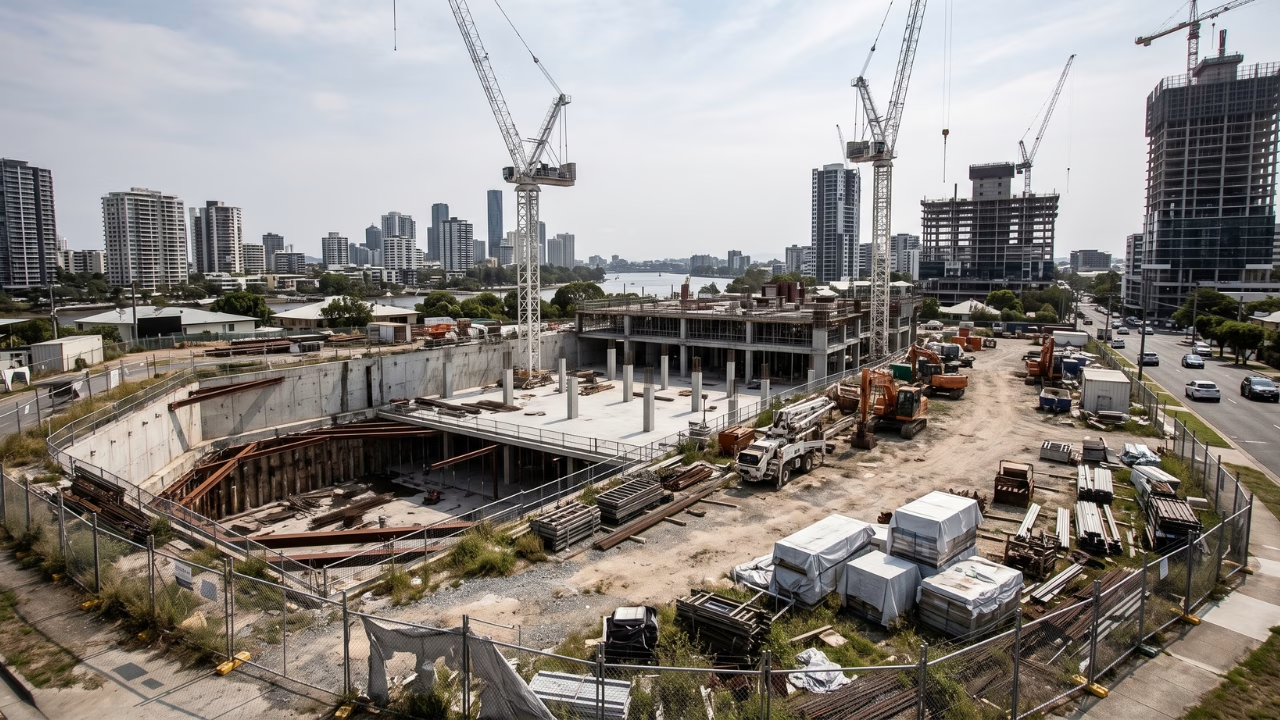
A reported backlog of 112 deferred apartment projects is not one problem. It is several stacked on top of each other, and none of them turns the backlog into guaranteed work.
A report published on 18 October puts 112 apartment projects across Brisbane and the Gold Coast on hold. Together they hold more than 10,000 dwellings and around $5.4 billion in construction.
For commercial builders, trades and suppliers, the number matters less than the reasons behind it. A deferred project is not a lost project. It is not a guaranteed one either.
What does the backlog actually count?
The figures come from research by property group PRD, compiled as of September 2026. Brisbane accounts for 71 projects and 6,711 apartments, worth about $2.5 billion. The Gold Coast holds 41 projects and 3,575 apartments, worth about $2.9 billion.
We have not been able to obtain PRD’s underlying dataset, so these counts are reported rather than independently verified. The city totals do add up to the headline figures.
On those reported figures, the Gold Coast backlog averages roughly $811,000 of construction per dwelling, more than double Brisbane’s roughly $373,000. The gap may reflect a larger share of premium product, though the published figures do not break that down.
The word “deferred” also needs care. The published figures do not separate projects formally paused from those unlikely to return.
What is a deferred apartment project?
A deferred project has been planned, and often approved and marketed, but has not started construction by its expected date. It stays in the pipeline on paper. Deferral is not cancellation, but it is not a commitment to build either. A deferred project can restart, be redesigned, be sold as a site, or lapse.
Why are construction costs the first hurdle?
The plainest explanation is that the numbers do not stack up.
The Property Council of Australia put the average existing Brisbane unit at $831,000 in March, and its research with Urbis found it is now more expensive to build new apartments than to buy existing stock.
The ABS output price index for other residential building in Queensland, cited in that report, rose from around 120 in early 2021 to 164.8 by the September quarter of 2025. The Property Council’s Gold Coast research then found Queensland residential construction costs rose a further 6.4 per cent in the year to June.
When costs climb faster than achievable sale prices, an approved project waits.
A deferred project is not a lost project. It is not a guaranteed one either.
How do presales and finance hold projects back?
Apartment construction loans typically require a set share of the building sold off the plan before funds are released. That makes buyers part of the finance equation.
Several recent changes have thinned that buyer pool. The Reserve Bank lifted the cash rate to 4.60 per cent on 29 September, its fourth increase this year, and noted that new housing loans had declined noticeably.
From 10 August, self managed super funds can no longer use new limited recourse borrowing arrangements to buy residential property, according to the ATO. Borrowing arrangements already in place before that date are not affected, and neither is refinancing them. Geared SMSF buyers are now shut out of new residential launches.
The buyer mix had already shifted. Urbis data shows owner occupiers made up 61 per cent of new Inner Brisbane apartment buyers in preliminary 2025 figures, while interstate investors fell to 5 per cent, down from 41 per cent in 2018.
There is a counterweight. Federal changes limit negative gearing to new builds for residential investments bought after Budget night, starting in the 2027 to 2028 income year. That could make new apartments relatively more attractive to investors, though any effect on presales is not yet visible in the data.
Is builder capacity the real bottleneck?
For many projects the problem is not finding buyers. It is finding a builder willing to price the job.
Construction Skills Queensland’s Horizon 2032 report forecasts the state’s construction pipeline will average around $69 billion a year, peaking at about $75 billion in 2027 to 2028. It projects a labour shortfall averaging 19,100 workers, reaching up to 35,000 in that peak year.
Residential building alone is expected to need around 77,200 workers at its peak, up from about 64,400 in 2025 to 2026.
Urbis warns that Brisbane projects not locking in builders soon are unlikely to finish before 2032. It expects the drain of subcontractors and tradespeople to Olympic projects to grow more acute as the Games approach.
How does infrastructure timing compete with apartments?
The 2032 Games program puts around $11.2 billion of venue and village work into the pipeline, about 68 per cent of it in Brisbane, according to CSQ. A rapid pick up in activity is expected from 2026 to 2027 through to 2030 to 2031.
For a large contractor, government backed work with a fixed deadline carries a different risk profile from a developer project that depends on presales. That does not make apartments unbuildable. It means they compete for the same crews, cranes and concrete in the same window.
CSQ forecasts residential labour demand peaking in 2027 to 2028 and Games labour demand peaking in 2030 to 2031. That leaves little room in between, which is why Urbis warns projects without a builder soon are unlikely to finish before 2032.
Where do existing tenancies fit?
Some inner city apartment sites still carry an older building with a paying tenant. Holding income lets an owner wait for better feasibility without carrying an empty site.
No public dataset shows how many of the 112 projects are in that position. Where a site earns rent, though, the pressure to start is lower, and deferral can be a deliberate commercial choice rather than a sign of distress.
Does a deferred project mean future work?
Not on its own. The backlog sits beside an industry that is already busy. ABS data shows Queensland dwelling commencements reached 11,671 in the June quarter in seasonally adjusted terms, up about 22 per cent on a year earlier, and Queensland residential building work hit a record in the same quarter.
Urbis expects Inner Brisbane completions to fall to an average of just under 2,000 a year from 2027 to 2029, after almost 3,000 in 2026. Across the whole city, the regional plan targets around 8,000 attached dwellings a year to 2031. On the Gold Coast, around 60 per cent of apartments due in 2028 and 2029 are rated at moderate or high risk of delay or withdrawal.
For specialist subcontractors and suppliers, the backlog reads better as a list of conditions than a list of jobs. Projects with a builder appointed and finance in place are live. Projects waiting on presales, cost relief or a contractor are options, not orders.
Are other states tackling the same problem?
Other governments have gone after presales directly. NSW runs a $1 billion presale finance guarantee, Western Australia opened a $250 million presale guarantee on 8 October, and South Australia has proposed a $500 million fund for Adelaide apartments. Victoria has extended a temporary off the plan duty concession for all buyers to 21 April 2027.
In Queensland, the Property Council has called for off the plan stamp duty concessions for owner occupiers buying apartments, alongside tax reform to attract institutional capital.
What does the 10,000 figure mean for builders?
The figure is credible enough to take seriously and soft enough to handle with care. It shows how much planned housing is reported to be waiting. It does not show how much will be built, or when.
That comes down to three things: whether costs ease against sale prices, whether buyers return to off the plan, and whether contractors have room once infrastructure demand peaks. Those signals will decide which of the 112 projects become work.
The Good Builder Take
A backlog is a pipeline with the risk still inside it. The builders and trades best placed are the ones who know which deferred projects have a builder, finance and a realistic start date, and which are still waiting on a market that has not arrived. We will keep tracking what restarts. If you are pricing a project that has stalled on presales or costs, tell us what you are seeing.
Frequently asked questions
Research by PRD, reported on 18 October 2026 and not yet independently verified, counts 112 deferred projects holding 10,286 apartments and about $5.4 billion of construction. Brisbane has 71 projects and 6,711 apartments, and the Gold Coast 41 projects and 3,575 apartments.
Contributing factors include construction costs running ahead of sale prices, presale requirements for finance, a thinner investor buyer pool, competition for builders and trades from major infrastructure and Games work, and, in some cases, owners holding income producing sites until feasibility improves.
No. A deferred project may restart, be redesigned, be sold or lapse. Published figures do not separate formally paused projects from those unlikely to proceed, so the backlog is not a guaranteed pipeline of construction work.
Construction Skills Queensland forecasts the state pipeline will peak at about $75 billion in 2027 to 2028, with a labour shortfall of up to 35,000 workers that year. Games venue and village labour demand is expected to peak later, in 2030 to 2031.
Related articles
- WA’s $250 Million Pre-sale Guarantee Is Open. NSW Has Already Shown How It Plays Out
- Total Construction Work Fell 2.1 Per Cent in the June Quarter, but Residential Building Just Hit a Record High
- Australian Construction Industry Trends Guide
Last updated: 19 October 2026. Backlog figures as reported on 18 October 2026; ABS data for the June quarter 2026.
General Information Only. This article provides general information only and does not constitute legal, financial or professional advice. It does not take into account your individual circumstances. Seek independent professional advice before making any decision.



0 Comments