


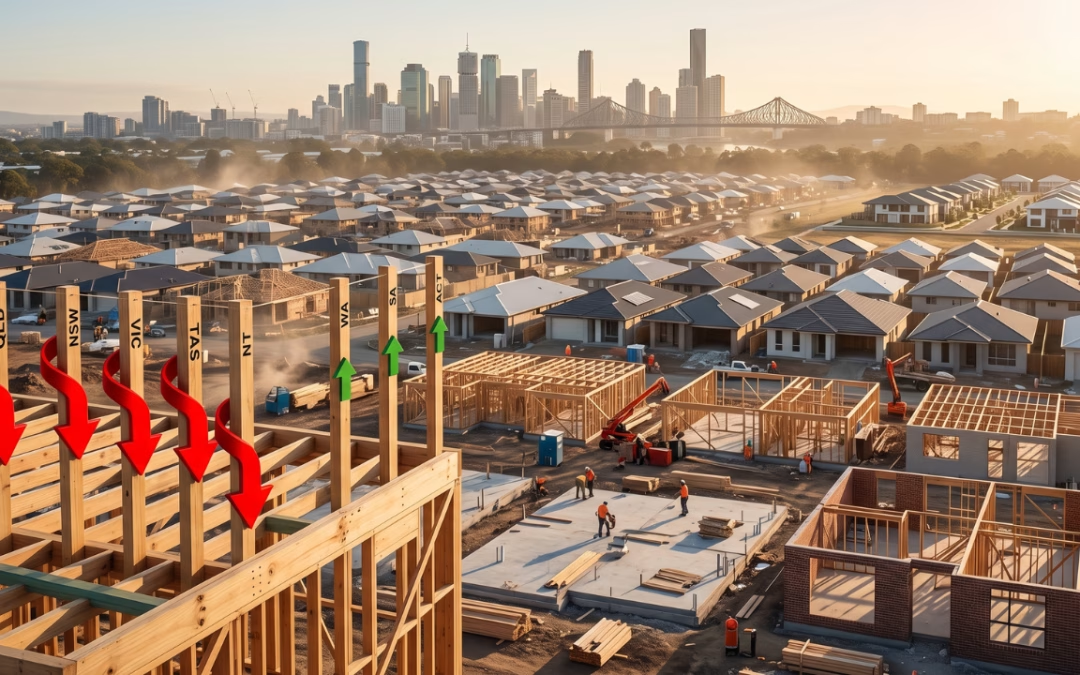
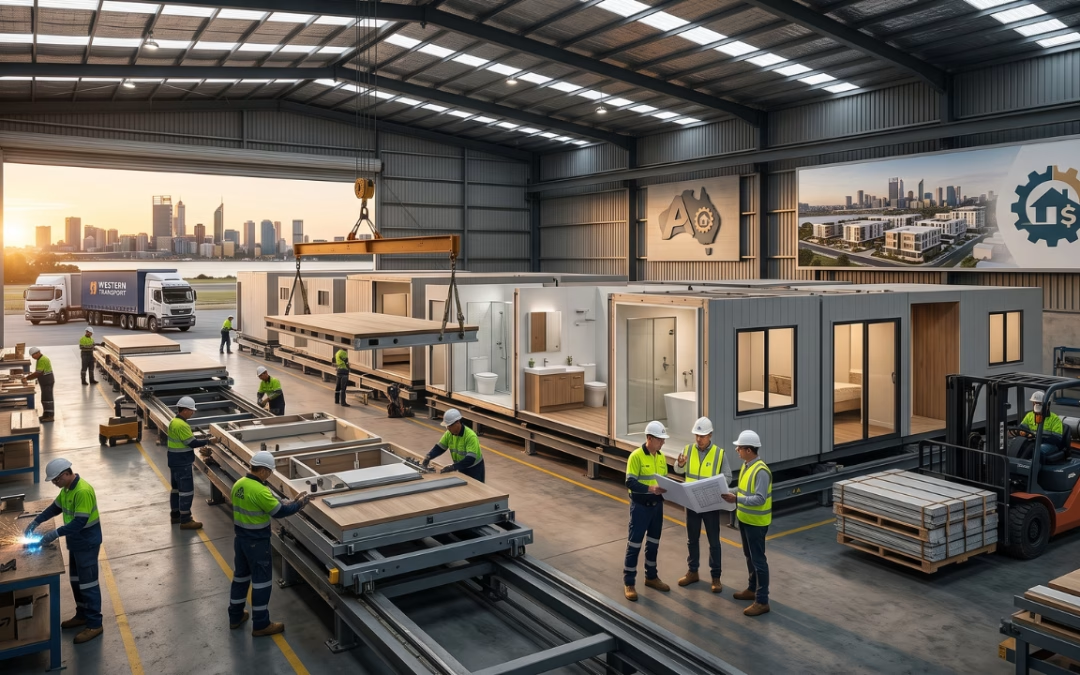
Australia’s housing system is under enormous pressure. Costs are up, timelines have blown out, labour is tight, and affordability continues to slide. With governments and industry now openly acknowledging the need for faster, smarter ways to build, one solution keeps emerging: prefabricated and modular construction.
But while the promise is big, Australia’s prefab sector has been stuck in first gear responsible for less than 5% of new home builds nationwide. The technology exists, the manufacturers exist, and the demand absolutely exists. What has been missing is the piece that underpins every high-trust industry: clarity.
This month, Standards Australia has stepped in.

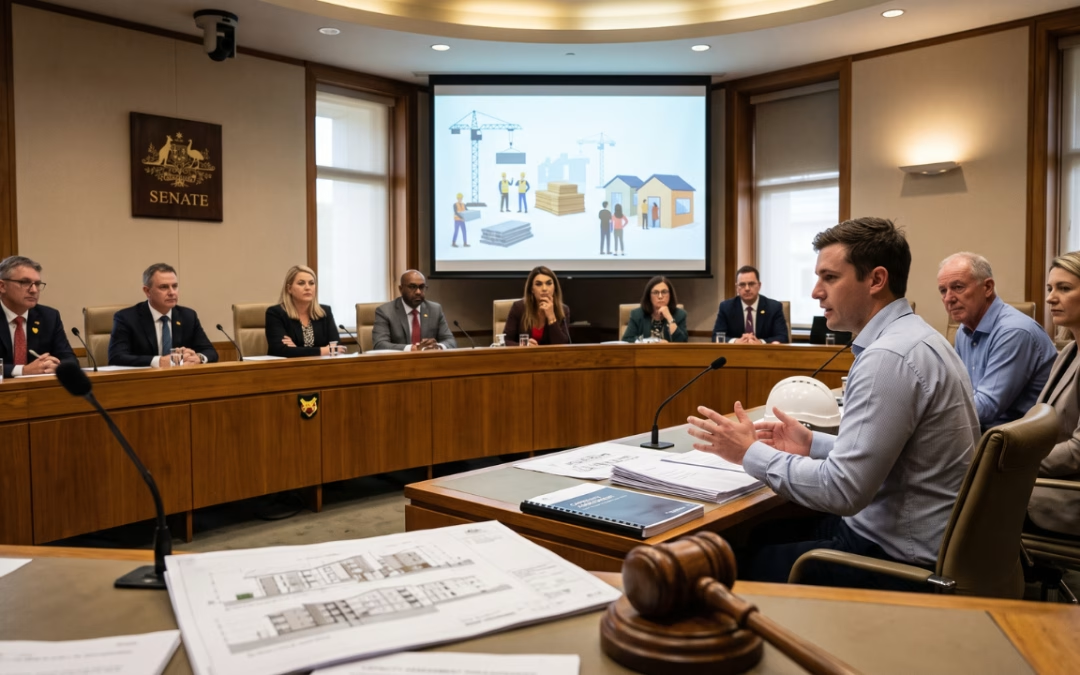
The organisation has released a draft version of SA HB 268, a handbook for prefabricated and modular construction, and is inviting public comment until 13 January 2026. It may not sound headline-grabbing, but industry experts say this consultation could become one of the most important steps toward modernising Australian home building.
If adopted and refined, SA HB 268 has the potential to become the foundation for a future national Standard, something Australia has never had for modular or offsite construction.
And for builders trying to forecast timelines, price projects accurately, or avoid regulatory headaches, that shift could be game-changing.
Why Prefabrication Hasn’t Scaled….Yet
Prefab and modular construction promise everything the traditional system struggles with:
- Build a home in four months instead of twelve.
- Cut onsite risks and improve safety.
- Reduce waste and environmental impact.
- Deliver predictable quality through controlled manufacturing.
- Boost supply in regional and remote communities.
So why hasn’t it taken off?
In one word: consistency.
Different states use different terms. Designers specify different systems. Councils interpret definitions in their own way. Manufacturers describe similar products with different language. Regulators struggle to categorise or approve new models.
The result is predictable: confusion, bottlenecks, slow approvals, and a general reluctance from builders, certifiers and insurers to fully embrace prefab.
The Australian Building Codes Board has been warning about this for years. Now, with capacity constraints piling up, the gap between what prefab could deliver and what it currently delivers is widening.
SA HB 268 is an attempt to close that gap.
A Handbook to Bring the Industry Into Alignment
The draft handbook focuses on one thing: terminology.
At first glance, a glossary might not seem like a transformative tool but for a sector built on precision, uniform language is foundational.
SA HB 268 sets out to define and standardise terms across:
- Design and engineering concepts
- Module and pod types
- Chassis and structural components
- Lifting, craning, and placement methods
- Manufacturing and transport processes
- Installation and sequencing
- Digital workflows, including BIM
- Lifecycle processes, including relocation, repurposing and end-of-life
The breadth of definitions suggests something deeper: the sector is maturing fast, and with maturity comes complexity. Without shared language, even the most advanced technologies and innovations risk being misunderstood or under-utilised.
Standards Australia notes that evolving construction methods have led to “confusion and misinterpretation” across the industry. SA HB 268 is a structural attempt to fix that.
Why Consistent Language Matters for Builders
If you’re a builder, especially one working across multiple local government areas or state borders, inconsistent terminology has real-world consequences:
- Different certifiers interpret the same system differently.
- Confusion about what counts as “modular”, “relocatable”, or “panelised” affects approvals.
- Procurement documentation becomes messy, triggering risk and cost blowouts.
- Disputes arise when terminology used by suppliers doesn’t match contract documentation.
A nationally aligned glossary reduces these pain points.
It also supports fairer competition, helping smaller prefab manufacturers enter the market without being buried under ambiguous requirements.
And as the handbook hints, this work feeds directly into future digital transformation. Clear, agreed-upon terms allow for cleaner data exchange, making technologies like BIM more powerful and enabling automated approvals and more accurate cost forecasting.
A Step Toward a Full Australian Standard
SA HB 268 is not yet an Australian Standard but its positioning makes the direction clear.
The glossary is explicitly described as part of a transitional phase. Standard development work is already underway in parallel, with the long-term intent to produce a dedicated Standard for prefabricated modular building design and construction.
Three system-wide shifts are happening simultaneously:
- Prefab is becoming mainstream, not niche.
- Governments are preparing to regulate it more clearly, especially for housing and disaster-resilient buildings.
- Industry is demanding consistency to support investment.
The handbook is a bridge between where the sector is today and a future where prefab forms a significant portion of Australia’s housing supply.
Industry Reaction: Quiet Anticipation and Practical Optimism
Within The Good Builder community, prefab adoption has been a hot talking point.
Builders want speed.
Suppliers want certainty.
Regulators want alignment.
Consumers want affordability and quality.
A consistent terminology framework supports all four.
It is also a signal to investors and manufacturers that Australia is serious about industrialised building methods, a crucial step if we want more local capacity, not just imported systems.
Looking Ahead: From Glossary to Guidance
Beyond definitions, the draft hints at much larger ambitions.
Future editions are expected to expand into:
- Design guidance
- Assembly and sequencing requirements
- Transport and craning safety frameworks
- Installation and de-installation protocols
- Relocation and repurposing pathways
- End-of-life standards
In other words, the glossary is the foundation but the house is still to come.
Importantly, Standards Australia says this will not be a slow, infrequent update cycle. The organisation anticipates moving away from static publications toward continuous digital review and improvement. This approach mirrors what fast-moving sectors, like cybersecurity or digital engineering, already rely on.
Prefab is evolving rapidly. Standards will need to evolve just as quickly.
Why Public Feedback Matters
Standards Australia is inviting contributions from:
- Builders
- Designers
- Engineers
- Manufacturers
- Installers
- Transport operators
- Regulators
- Industry bodies and associations
- Prefab specialists
- Developers and housing providers
The diversity of stakeholders reflects the diversity of systems involved.
Public consultation remains open until 13 January 2026, allowing ample time for builders to review, discuss, and contribute their frontline knowledge.
The Bottom Line
If Australia wants to scale modern construction methods and most experts agree we must then we need more than factories, new materials, or clever design platforms.
We need a shared language that lets everyone in the supply chain understand each other with confidence.
SA HB 268 is not the headline-grabbing part of the prefab revolution, but it may end up being one of the most important.
The consultation period is an opportunity for builders to influence the direction of an industry shift that will reshape how homes are delivered in the decades ahead.
For a sector under pressure, clarity is not a luxury, it’s a necessity.

Author: TGB Editorial



0 Comments