


A Chatswood project that started life as a 251-apartment scheme is now before the state as 552 apartments across two towers of 58 and 60 storeys. The size of the jump tells builders something useful about the planning system they are working in.
Billbergia and Metrics Credit Partners have lodged plans for a $1.3 billion mixed-use development in Chatswood, taking two towers of 58 and 60 storeys to the New South Wales Housing Delivery Authority for assessment. The project, known as Chatswood Grand Residences at 8 Wilson Street, would deliver 552 apartments and house more than 1,000 people on Sydney’s lower North Shore.
That headline number is worth sitting with for a moment. Not because most builders will ever tender on a 60-storey tower, but because of what the path to this point reveals about how major housing now moves through the system in NSW. The same site was first put forward in 2023 as 251 apartments across two 27-storey towers. By late 2024 it had grown to 332 homes across 36 storeys. The version now on public exhibition is more than double the original apartment count and more than twice the height.
For builders, the interesting question is not how Billbergia got bigger. It is what changed in the planning environment to make a scheme of this scale not just possible, but the expected play.
What is the Housing Delivery Authority?
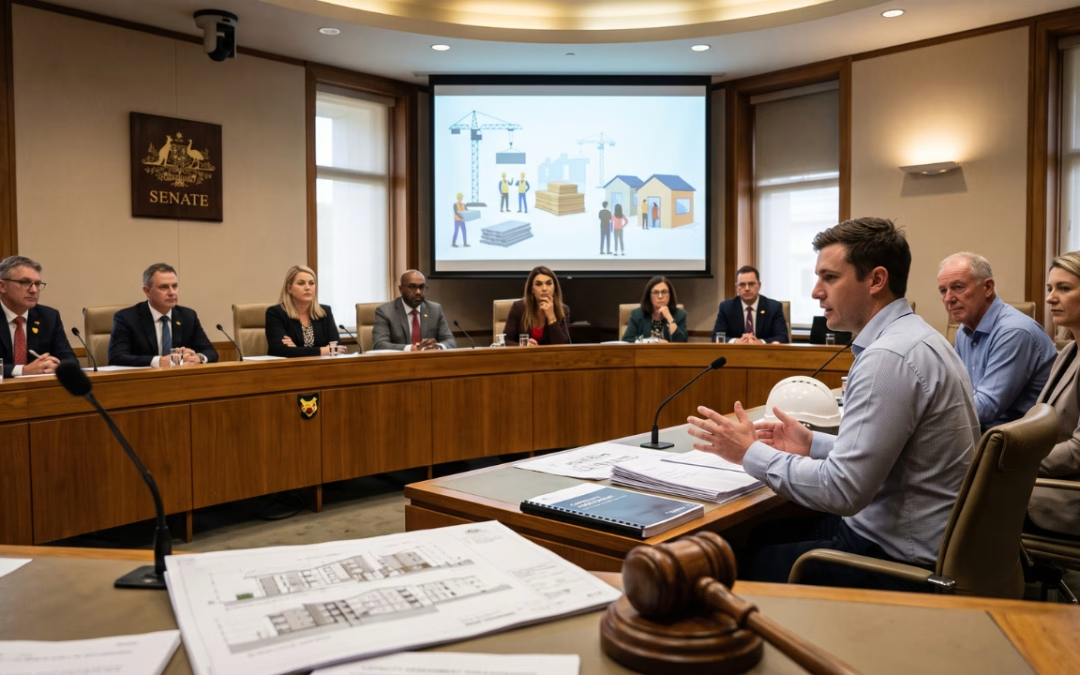
The Housing Delivery Authority, or HDA, is a NSW body set up to speed up the assessment of large residential and mixed-use projects. Rather than a project being assessed by the local council, the HDA can recommend that the Minister for Planning declare it State Significant Development. Once declared, the project is assessed by the state through a streamlined pathway, with the option of concurrent rezoning, public exhibition and input sought from the relevant council.
It is aimed squarely at the big end of the pipeline. Projects need to clear a value threshold of $60 million in metropolitan areas and $30 million in regional NSW to be eligible. Since it began inviting proposals in early 2025, the HDA has worked through hundreds of expressions of interest and recommended more than 300 proposals for State Significant declaration, amounting to capacity for over 100,000 potential homes. The first project approved through the pathway, a development at Gordon, was assessed in around seven months.
The HDA did not appear in isolation. It sits inside a fast-tracked planning pathway that the state has been assembling over the past two years, designed to cut the lead time between a concept and a shovel in the ground. The logic is simple. Approval delays are one of the largest hidden costs in residential development. Every month a major project sits in assessment is a month of holding costs, financing costs and exposure to shifting market conditions.
Why this project is a useful signal
Chatswood Grand Residences is a clean example of the system working as intended, from the state’s point of view. The site is in the heart of an established centre, within walking distance of Chatswood Interchange, two major shopping centres and Beauchamp Park. It is exactly the kind of well-located, high-yield site the HDA was built to push through.
It also lines up with the state’s finalised Transport Oriented Development precincts, the policy of concentrating higher density within walking distance of train and metro stations. The developer has explicitly framed the project as aligning with those reforms. When a site sits in the right location, at the right scale, near the right infrastructure, the planning system is now actively built to reward going bigger.
It supports the North Shore’s critical housing needs while delivering an outstanding public domain outcome. — Saul Moran, Development Director, Billbergia (from the project announcement)
The scheme was designed by PBD Architects following a design excellence competition, and features two slender towers above a two-level podium carrying around 2,563 square metres of retail and commercial space, plus 2,500 square metres of revitalised public domain. A cross-shaped laneway precinct at ground level is intended to knit the development into the surrounding streets. The development is also accompanied by up to $80 million in community and social infrastructure contributions, made up of state and local Infrastructure Contributions and a Voluntary Planning Agreement with Willoughby City Council.
How the project has grown
The clearest way to see what the planning shift has enabled is to lay the three versions of the project side by side.
| Version | Apartments | Height | Pathway |
| 2023 concept | 251 | 2 x 27 storeys | Council (Willoughby) |
| Late 2024 scheme | 332 | 2 x 36 storeys | State Significant (SSD) |
| 2026 lodgement | 552 | 58 and 60 storeys | HDA fast-track (SSDA) |
Source: Billbergia announcements and project filings, 2023 to 2026.
The trajectory is not unique to this site. It reflects a broader recalibration of what a major NSW infill project looks like when the approvals pathway and the density controls are pulling in the same direction.
What it means for builders and subcontractors
A single 60-storey tower lodgement is not, on its own, a builder’s opportunity. Most residential builders will never bid this work, and the head contractor for a project of this scale will be a tier-one operator. But the signal underneath it matters across the supply chain.
First, it confirms where the large-scale pipeline is forming. High-density, transit-connected infill in established centres is now the spine of NSW housing supply. For trades, suppliers and specialist subcontractors, that shapes where sustained work will sit over the next five years. Fitout, facades, vertical transport, services and the long tail of finishing trades all flow from projects like this once they move into construction.
Second, it is part of the state’s National Housing Accord commitments. NSW has committed to delivering 377,000 new homes over five years to July 2029, and the HDA is one of the main levers being used to hit that target. Builders trying to read the medium-term market are better served watching the pathway than any single project. The pathway tells you where the volume is going.
Third, this is one local example of a wider shift toward higher-density housing near transport that is reshaping the kind of work available across the country. Builders who have already developed the systems to operate in dense, constrained, compliance-heavy environments are positioned differently to those whose experience is mostly greenfield detached housing. The skill set the market is rewarding is changing, and projects like this are the clearest evidence of it.
| THE GOOD BUILDER TAKE A 60-storey lodgement is not work most builders will bid. But the size of the jump from 251 to 552 apartments on the same site is a clear read on where the NSW pipeline is heading. High-density, transit-connected infill is now the spine of housing supply in this state, and the HDA fast-track is the mechanism moving it. Watch the pathway, not just the project. It tells you where the volume, and the work, will sit over the next five years. |
The tension that still sits underneath
None of this is without friction. Pathways that allow the state to assess and approve major projects outside the council process raise a familiar question about who controls development in a community. The state argues that councils are still consulted and that public exhibition still applies. Critics argue that local input is weakened when the assessment moves up to the state. It is the same fault line running through planning systems around the country, and other states are testing different answers to it. Queensland recently reset its housing pathway to restore a degree of council control, a deliberate move in the opposite direction to the NSW approach.
For builders, the politics of that debate matter less than the practical outcome. What the pathway delivers is a more predictable route to approval for the right kind of project in the right kind of location. In a state still working through a serious housing supply shortfall, that predictability has real value, whatever happens to the projects caught in the middle of the argument.
Where this one goes next
The State Significant Development Application is on public exhibition until 14 July 2026. A sales campaign is already underway. Subject to approvals, construction is expected to commence in late 2026, with completion targeted for 2031. Billbergia and Metrics are also progressing several other large Sydney projects together, including an 80-storey CBD scheme and the $2.2 billion Concord Central precinct in the inner west.
Whether Chatswood Grand Residences lands at 552 apartments or somewhere short of it after assessment, the more useful takeaway for builders is the pattern it sits inside. The biggest projects in NSW are getting taller, denser and faster through the system, clustered around transport and concentrated in established centres. That is the shape of the pipeline now. The builders who understand it are the ones who can resource and price ahead of where the work is actually going.
Frequently asked questions
What is Chatswood Grand Residences?
It is a $1.3 billion mixed-use development at 8 Wilson Street, Chatswood, by Billbergia and Metrics Credit Partners. The current scheme proposes 552 apartments across two towers of 58 and 60 storeys, with retail, commercial and public space at the base.
What is the NSW Housing Delivery Authority?
The HDA is a state body that fast-tracks assessment of large residential and mixed-use projects by recommending they be declared State Significant Development, moving them out of the standard council pathway into a streamlined state-led process.
How many apartments are in the Billbergia and Metrics Chatswood project?
The version now on public exhibition proposes 552 apartments, ranging from studios to four-bedroom homes, up from 332 in the previous scheme and 251 when the site was first put forward in 2023.
When will construction start on the Chatswood towers?
Subject to approvals, construction is expected to commence in late 2026, with completion targeted for 2031. The development application is on public exhibition until 14 July 2026.
What does the HDA fast-track mean for builders?
Most builders will not bid a project of this scale, but the pathway signals where the large NSW pipeline is forming: high-density, transit-connected infill in established centres. That shapes where sustained work for trades, suppliers and subcontractors will sit over the next five years.
Last updated: June 2026
General information only. This article is intended as general industry information and does not constitute professional, financial or legal guidance. Builders should make their own enquiries and seek appropriate professional input before acting on any matter discussed here.



0 Comments