


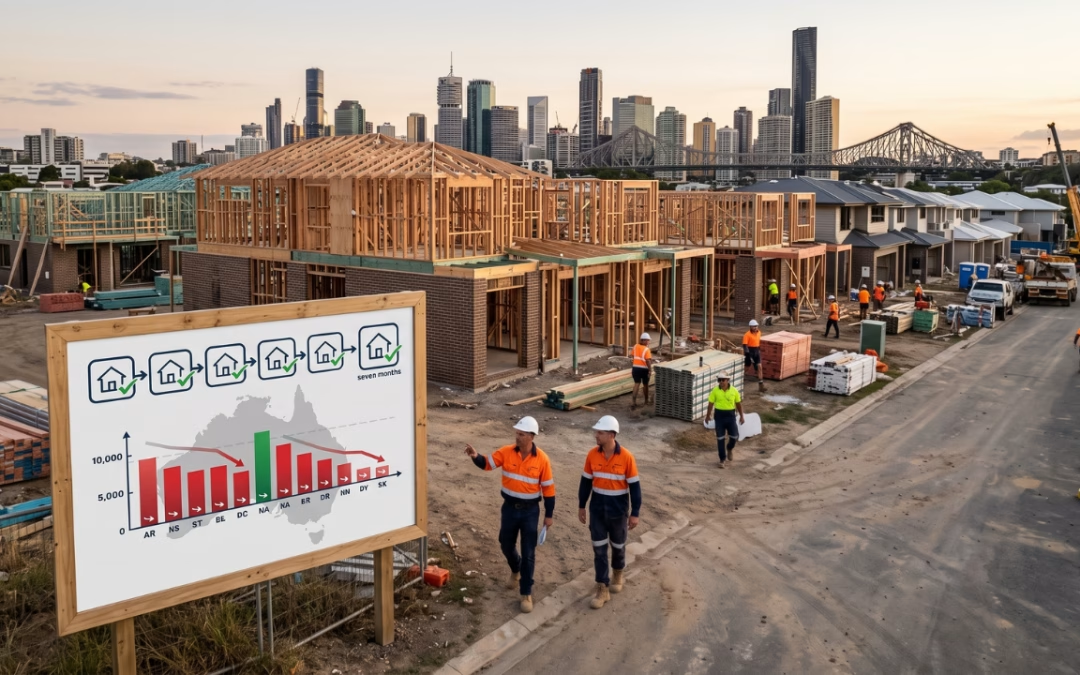
Australian residential construction costs have surged from around $1,750 per square metre before the pandemic to $2,600 to $4,300 today. That number is easy to quote. What builders and clients need to understand is what it means on the actual contract.
Brisbane-based builder Matt Grieve has been watching the numbers move for a while. As Director of Frameology Constructions, he prices residential builds at the higher end of the market. Earlier this month, he sat down and audited his current cost position and mapped what he expects to see over the next six to twelve months.
What he found was a market under pressure from two directions at once.

The first is structural. Brisbane was already the most expensive residential construction market in Australia before the current crisis, according to data from Turner and Townsend and the Australian Bureau of Statistics. The second is acute. The US-Israel conflict with Iran and the subsequent closure of the Strait of Hormuz have layered a new cost shock on top of an already elevated baseline.
“I’ve been hearing some fear-mongering from builders that the entire project cost will increase by 20 per cent,” Grieve says. “That’s simply not the case. But the real numbers are still significant, and anyone with a project in the pipeline needs to understand them properly.”
The 47 Per Cent Number
Master Builders Australia has been clear about where construction costs sit right now. Building costs have increased by approximately 40 per cent nationally over the past five years.
For Brisbane, the position is more pronounced. Pre-pandemic, a mid-to-high-spec residential build in South-East Queensland would have come in somewhere between $1,750 and $2,900 per square metre. Today, that same build sits in the range of $2,600 to $4,300, depending on specification and site conditions.
Put that against a real project. A 250 square metre home at the midpoint of those ranges would cost roughly $212,500 more to build today than it would have five years ago. That figure is not widely spoken about in plain terms. It should be.
Grieve’s analysis focuses specifically on the materials component, which makes up approximately 60 per cent of a mid-high-spec contract value. This is the figure benchmarked against HIA and AIQS data for architectural residential construction in South-East Queensland. Labour, running at 15 to 20 per cent of contract value, and builder margin and overheads at 20 to 25 per cent, are the remaining components.
That 60 per cent materials figure is also the component that is moving most sharply right now.
Two Problems Colliding
Before the Strait of Hormuz was effectively closed in late February 2026, Brisbane’s construction market was already running hot. The ABS Producer Price Index for Brisbane house construction was up 6.4 per cent annually to December 2025, the highest of any capital city. RLB Oceania had forecast a further 5 per cent for 2026 on the back of the Olympic pipeline, infrastructure pressure and trade shortages.
Then the conflict escalated.
Diesel on the east coast of Australia, which was sitting around $1.80 per litre before the war, is approaching $4.00 per litre. Every site vehicle, concrete truck and crane in the country is exposed to that. Freight surcharges of 10 per cent have been confirmed across multiple suppliers. Concrete and cement, both energy-intensive to produce, are looking at near-term increases of 8 to 15 per cent as producers pass through energy costs.
The single most concrete data point in Grieve’s analysis is the Iplex notice. The major plumbing and pipe supplier confirmed price increases effective 17 April 2026: PVC products up 27 per cent, polyethylene up 36 per cent, polypropylene up 31 per cent. A 10 per cent freight surcharge applies to regional customers on top of that.
PVC and polyethylene are petroleum-based materials. When fuel prices move, they move.
“The 12 per cent central estimate is the number to pressure-test your budgets against. It is not a forecast or a worst case. It is directly supported by data already confirmed in the market.”
Altus Group, one of Australia’s leading construction cost consultants, confirmed in a late March analysis that diesel nationally had already exceeded $3.25 per litre and that major Tier 1 and Tier 2 contractors were abandoning fixed-price contracts in favour of cost-plus models with tender validity periods as short as 15 days.
The Scenario Framework
Grieve has developed three planning scenarios for projects in his pipeline, all of which focus on materials only and carry no Frameology margin on the escalation component.
The conservative case assumes 8 per cent material escalation. That scenario requires the Iran crisis to resolve by the end of the second quarter of 2026 and reflects the ABS structural baseline only.
The central case assumes 12 per cent. This is directly supported by confirmed data already in the market as of April 2026: the PVC and plumbing increases, the diesel flow-through and the freight surcharges. It is not a worst-case forecast. It is the planning number.
The elevated scenario assumes 18 per cent. This applies if the Strait of Hormuz disruption is prolonged, if the copper shock intensifies, and if build timelines extend. It is plausible given that, as of late April 2026, shipping traffic through the strait remains at roughly five per cent of pre-war levels despite a conditional ceasefire announced in early April.
The dollar impact at the central planning estimate looks like this:
| Contract Value | Materials (60%) | At 12% Escalation |
| $1,000,000 | $600,000 | +$72,000 |
| $2,000,000 | $1,200,000 | +$144,000 |
| $3,000,000 | $1,800,000 | +$216,000 |
These figures exclude labour escalation, which Grieve notes is already reflected in base pricing, and they exclude builder margin on the escalation component.
“Cost escalation is not a profit opportunity,” Grieve says. “It is a shared market reality and I intend to treat it that way.”
The Fear-Mongering Problem
One issue Grieve flagged directly when sharing his analysis with architects and potential clients is the noise coming from some corners of the industry.
Blanket claims that total project costs will rise by 20 per cent are circulating. They are not accurate. The materials component is what is moving sharply. Labour escalation is real but gradual. Margin is not being applied to escalation provisions.
The practical risk of that kind of messaging is that it either paralyses clients or, in some cases, gives builders cover to inflate contract prices beyond what the data actually supports.
The HIA’s CEO, Jocelyn Martin, has publicly urged builders and contractors to communicate openly about pricing and to factor current pressures into future quotations. That is a reasonable position. Factoring in pressures is not the same as overpricing them.
Three Ways to Handle It
Grieve outlines three contractual mechanisms for managing escalation. Each is structured so that no Frameology margin applies to the escalation component.
The first is a dedicated contingency allowance. A ring-fenced line item in the contract, calculated at 6 to 8 per cent of contract value for a 12 to 14 month build, drawn down only against verifiable evidence. Any unused portion is returned in full at practical completion.
The second is a rise and fall provision. Special conditions inserted into the Master Builders contract, using the ABS Producer Price Index for Brisbane house construction as the index, applied progressively each quarter. The client only pays for escalation that actually occurred.
The third is a traditional fixed price, where escalation risk is modelled upfront and baked into the contract price. Grieve is direct about the trade-off here. To price responsibly in the current environment, the buffer needs to be set at the elevated end of the range. If the market moves less than forecast, the client has paid for an escalation that never materialised and that money does not come back.
“Options one and two exist precisely to solve that problem,” he says. “They protect us from underpricing while ensuring the client is never paying for cost increases that did not actually occur.”
What Builders Should Be Doing Now
The practical response for builders operating in the current environment comes down to a few clear actions.
Get current with your numbers. Pre-pandemic benchmarks are not relevant. Mid-2024 benchmarks may not be relevant. The cost picture has shifted sharply in the last eight weeks and a project priced before April needs to be reviewed.
Check your specification. The materials categories most exposed to current escalation are plumbing rough-in and drainage, electrical and HVAC, concrete, structural steel and imported finishes. If any of these are documented at rates set six to twelve months ago, the numbers need updating before they become a problem mid-build.
Look at the contract mechanism. Fixed-price contracts protect clients when costs fall. They expose builders when costs rise sharply and unpredictably. In the current environment, transparent adjustment mechanisms are not a sign of weakness. They are basic risk management.
Communicate early. Grieve’s approach, reaching out proactively to architects and clients with a clear explanation of the cost environment, is worth considering. It positions the builder as the credible, informed party in the relationship. That matters when clients are nervous and other voices in the market are creating confusion.
The Strait of Hormuz remains effectively closed to commercial shipping as of late April 2026. That situation may ease. It may not. Either way, builders who understand the numbers and can explain them clearly are in a stronger position than those who are guessing.
The Good Builder covers news, analysis and practical resources for Australian residential builders. This article references cost analysis prepared by Matt Grieve, Director of Frameology Constructions, and is intended for general industry information purposes only. Builders should obtain independent advice specific to their contracts and circumstances.

Author: TGB Editorial



0 Comments