


By The Good Builder Editorial Team
Western Australia’s housing sector is facing one of its toughest challenges in decades — rising demand, rental pressures, and a shortfall of affordable dwellings. Against this backdrop, the Cook Labor Government has announced a $7.62 million social housing project in the northern Perth suburb of Warwick, promising much-needed relief for vulnerable residents while creating opportunities for builders and trades.
A Local Solution to a Statewide Challenge
The project will see 15 new dwellings delivered by 2027 — a mix of six one-bedroom and nine two-bedroom apartments. Designed by Proekt Architecture and built by Thomas Building, the development is positioned to provide secure, well-located housing close to Warwick’s transport corridors, shopping precincts, schools, and open space.
Housing and Works Minister John Carey said the initiative is part of a record $5.8 billion program invested in housing and homelessness measures since 2021.
“This project is another important step in our government’s commitment to increasing the supply of social housing in the northern suburbs,” Carey said. “The Warwick site was selected for its strong amenity and accessibility, with public transport, schools, shopping and open space all within easy reach.”
Why Warwick Matters
While the number of homes being built under this announcement may seem modest, the location tells a bigger story. Warwick sits at the intersection of community need and infrastructure access. Its proximity to the Mitchell Freeway, local bus and rail networks, and key employment hubs makes it an ideal site for social housing that connects residents with jobs and services.
For builders, projects like this demonstrate how governments are prioritising “infill” and well-located developments over fringe expansion alone. The focus is on creating homes that not only put a roof over someone’s head but also embed them within thriving, connected communities.
Thomas Building and the Builder Panel
The contract has been awarded through the State Government’s Housing Construction and Refurbishment Builders Panel, which was set up to speed up delivery by tapping into a network of pre-qualified builders. For Thomas Building, it represents both an opportunity and a responsibility: ensuring that taxpayer-funded housing meets high standards of design, liveability, and durability.
By engaging mid-sized, WA-based contractors, the government aims to keep work flowing through the local construction economy, particularly at a time when many builders are struggling with rising costs and thin margins.
The Bigger Picture: 3,500 Social Homes Delivered
Since 2021, more than 3,500 social homes have been added across Western Australia, with many more in the pipeline. Yet demand still far outstrips supply. According to industry and community groups, the waitlist for public housing continues to climb, and thousands of people remain at risk of homelessness.
Kingsley MLA Jessica Stojkovski, whose electorate includes Warwick, said the new homes will deliver security for local families:
“This $7.62 million project in Warwick will deliver safe and secure housing for people in our community who need it most,” she said. “The location makes education and transport accessible, ensuring families can be part of our community and have access to opportunities to thrive.”
Builders’ Role in Social Housing
For the construction sector, projects like Warwick signal a steady stream of government-backed work that can help stabilise pipelines. While private residential approvals remain volatile, social housing contracts provide a reliable flow of projects with locked-in funding.
This matters for small-to-mid builders who are competing in a tight market. Access to government work not only provides cash flow security but also allows companies to showcase their expertise in multi-residential, community-focused design — skills that are increasingly in demand across the wider market.
Beyond Bricks and Mortar
What sets this project apart is not its scale but its intent. With a focus on quality design by Proekt Architecture, the dwellings aim to provide dignity and long-term sustainability, not just basic shelter. This aligns with a broader trend in social housing where governments are looking to raise standards, integrating energy efficiency, accessibility, and community amenity.
It also demonstrates a shift away from short-term refurbishments toward more permanent, high-quality builds that reflect the government’s long-term housing strategy.
Challenges on the Horizon
Still, the path ahead is not without hurdles. Builders delivering social housing continue to face the same pressures as the wider industry — labour shortages, material price volatility, and the risk of project delays.
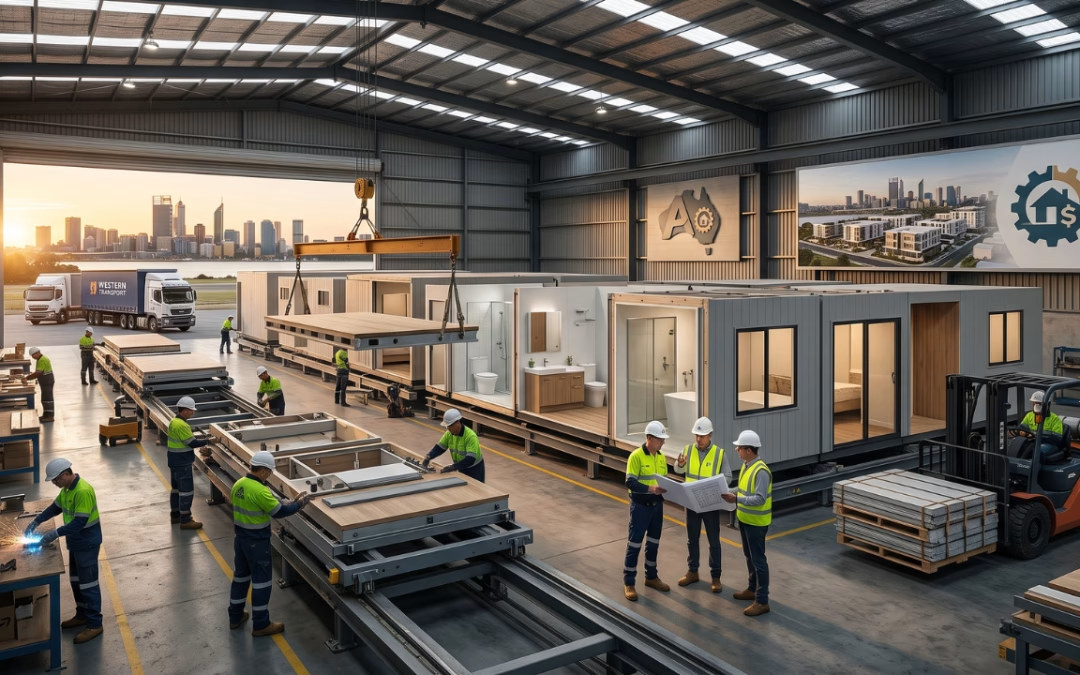
By the time the Warwick apartments reach completion in early 2027, WA will be just two years away from the government’s 2030 housing targets. Meeting those targets will require continued partnerships between government, builders, and suppliers — and possibly new approaches, from modular construction to faster approvals.
The Good Builder Perspective
At The Good Builder, we see Warwick as an example of how construction can play a direct role in solving housing inequality. While 15 apartments won’t solve WA’s housing crisis on their own, the project demonstrates a commitment to building smarter, better-located, and community-focused homes.
It also highlights the role that local builders, designers, and suppliers can play in shaping a more inclusive housing market. The challenge now is to scale these efforts, ensuring that investment translates into long-term housing security for thousands of Western Australians still waiting.

0 Comments