


Australia’s construction industry is staring down a $60 billion-a-year opportunity and the message from the nation’s top leaders is clear: it’s time to stop talking about productivity and start delivering it.
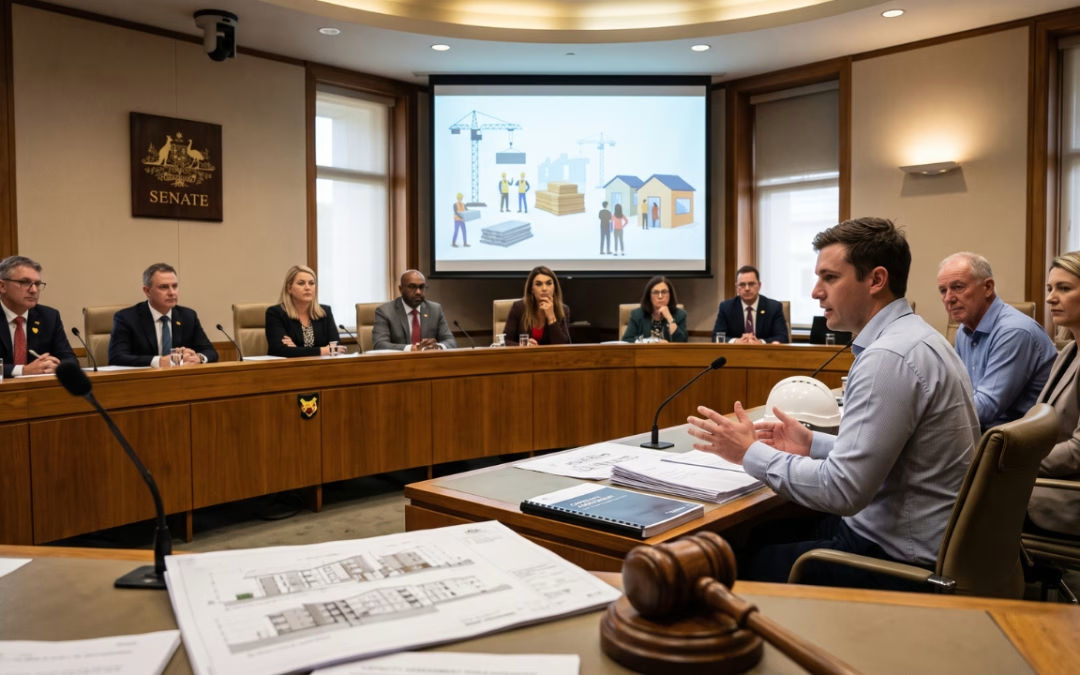
In what some are calling the industry’s equivalent of a COP Summit, more than 120 senior figures from government, unions, academia, and industry converged in Brisbane for a closed-door Leaders’ Exchange. Their goal? To tackle the structural inefficiencies that have long held the sector back.
The Exchange set the stage for last month’s Foundations and Frontiers forum (FF25), where 550 delegates gathered at Nissan Arena to stress-test ideas and commit to real-world change.
“The Leaders’ Exchange creates the blueprint for reform. FF25 is where that blueprint is stress-tested by the broader industry,” said Jon Davies, CEO of the Australian Constructors Association (ACA).
The $60 Billion Prize
Research by Oxford Economics, commissioned by the ACA, has put hard numbers on the table. It shows that even modest reforms could release billions of dollars in value every year:
- Cutting indirect costs by 10% would save $5.7 billion annually.
- Halving tender costs would free up $743 million for project delivery, generating a $2.1 billion boost.
- Greater flexibility in rostered days off (RDOs) could unlock $2.3 billion in additional work, adding $7.3 billion to the economy.
“These are practical levers that could shift the dial significantly,” Davies said. “The key to unlocking the $60 billion prize is focusing on achievable steps. Even modest changes could deliver enormous returns.”
Five Priorities for Reform
Delegates at FF25 distilled the conversations into five key reform areas:
- Harmonisation and standardisation – Aligning regulations, contracts and compliance to reduce duplication and confusion.
- Financial stability – Creating a more resilient financial base for businesses to invest in innovation.
- Earlier collaboration – Engaging all parties earlier in project lifecycles to reduce disputes and rework.
- Sustained innovation – Embedding new technologies and practices permanently, not just during crises.
- Future-ready skills – Building a workforce pipeline aligned with the demands of the next generation of projects.
According to delegates, these priorities are not lofty ideals but practical measures. Many are already being trialled on major projects – the challenge now is scaling them across the industry.
Why Productivity Matters Now
Productivity in construction has lagged behind almost every other sector in Australia for decades. While manufacturing, agriculture and services have lifted efficiency through technology and process reform, building and construction has often been stuck in a cycle of low margins, high risk, and adversarial contracting.
The stakes are higher than ever. Australia is attempting to deliver 1.2 million new homes by 2029 to meet population growth and restore affordability. With insolvencies climbing and costs still volatile, builders know they cannot keep working the same way and expect different results.
“Builders are under pressure from all sides,” said one delegate. “The only way we’re going to deliver the housing targets governments are setting is if we start pulling these productivity levers together.”
A National Strategy Takes Shape
The ACA confirmed that the insights from FF25 will flow into the National Construction Strategy, which is currently being finalised with federal and state governments.
This strategy will sit alongside two other national frameworks already in motion:
- The Blueprint for the Future – outlining long-term priorities for a more sustainable and productive sector.
- The Culture Standard – focused on workplace practices, diversity, and building a healthier industry culture.
The ACA has also committed to developing benchmarks to track productivity across the sector, ensuring reform efforts are measurable and transparent.
Lessons from the Room
Behind the polished speeches and carefully drafted reports, those in the room said the most valuable part of both the Leaders’ Exchange and FF25 was the candid discussion.
“Everyone came ready to share the reality, what’s working, what’s not, and what has to change,” said one participant. “It wasn’t about pointing fingers. It was about finding common ground.”
The inclusion of unions and academia was seen as critical. Productivity reform in construction often falters when it becomes a tug-of-war between management and labour. By bringing diverse voices together early, organisers hoped to avoid that deadlock.
The Good Builder Take
For builders on the ground, the outcomes of FF25 might feel a world away from the day-to-day challenges of keeping jobs on track and cashflow steady. But the themes emerging from Brisbane have direct relevance:
- Simpler contracts and compliance could reduce the paperwork burden that drains time from site managers.
- Stability in the supply chain would mean fewer nasty surprises on margins.
- Earlier collaboration could give subcontractors and suppliers more certainty, helping them plan labour and materials better.
- A skills pipeline means more apprentices and trades where they’re needed most.
In short: these reforms are not just about Tier 1 contractors or government megaprojects. They are about reshaping the entire ecosystem so every builder, from small residential operators to national firms, can deliver more with less waste.
From Words to Action
Of course, the test is whether these ideas stick. The industry has no shortage of reports and recommendations gathering dust. What will matter now is whether ACA and its partners can translate FF25’s priorities into enforceable reforms with bipartisan political support.
Davies is confident. “We can’t afford to let this momentum slip. The industry knows what’s at stake and the prize is too big to ignore.”
For builders, subcontractors, and suppliers across the country, the message is the same: play as one team, or risk falling further behind.


0 Comments