

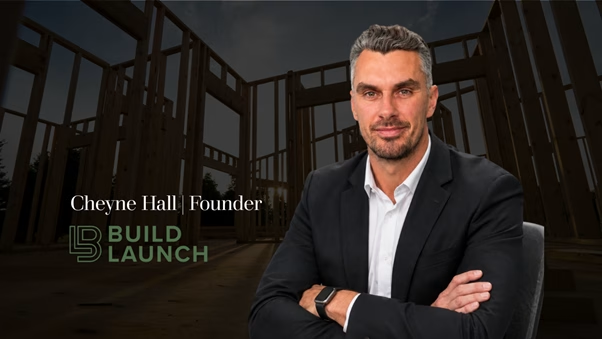
Cheyne Hall grew a lift shaft and renovation business to around 70 staff across three states in four years. On the podcast he set out which roles he believes belong on site, which can sit offshore, and why the timing of a hire matters as much as the hire itself.
Most builders hire when they are already drowning.
That is the pattern Cheyne Hall sees from the other side of the desk. Ten minutes before he sat down with Az on The Good Builder Podcast, he took a discovery call from a volume builder. The director was also the estimator. He had sixteen tenders on the go and one due that night.
The builder told him he needed an estimator. Hall’s view was that the hire should have happened six to twelve months earlier.
Hall has spent 20 years in the industry. He is a joiner and shopfitter by trade, trained on the Central Coast, and later worked on commercial fit outs in Sydney. He went on to run Hall Group and Co, building lift shafts and custom renovations inside existing homes across Victoria, New South Wales and Queensland. He says the business grew from himself and his brother to sixty or seventy staff in four years.
He is now Head of Growth and Strategy at Build Launch, an offshore staffing business for construction companies that he helped found.
Why does hiring at capacity make the workload worse first?
The problem with a late hire, Hall says, is that a new person adds work before they take any away.
Every new starter needs training, and much of that time has to come from the builder. “Doesn’t matter if they’re onshore or offshore, you have to invest time in them,” he said. “So you’ve gone from a 60 hour week to now 70 hour week.”
That load eases as the new hire gets up to speed. But a builder already at capacity has no spare hours to give. In Hall’s experience, the hire that works is the one made when the volume can be seen coming, so the person is trained before the pressure lands.
Az raised a well regarded Sunshine Coast builder that went from around thirty staff to 89 during the COVID period, then back down again. People were added to solve a workload problem and many were never properly trained. Both men described that stretch as a profitless boom.
Hall’s own reflection is that the bottleneck is not always a missing person. Sometimes it is a system, a process or a workflow that needs fixing.
What should stay onshore in a building business?
Hall draws the line at the site.
The roles he argues belong onshore are the construction manager, project managers, site supervisors and lead carpenters. They are the people who decide the quality of the finished home.
The roles he sees as suited to remote work sit back of house: project administration, estimating, contracts administration and finance. His reasoning is that these jobs already run on phone calls, emails and video calls.
What is a back of house role in construction?
Back of house roles are the office functions that keep a residential build moving without being on site: estimating, project administration, contracts administration and finance. They support the site team of construction managers, project managers, supervisors and lead carpenters, who deliver the work itself.
The argument is about where the money goes. Hall claims a remote hire through his business costs around 70 per cent less than a comparable local hire. Build Launch’s website puts its average cost reduction at 68 per cent. These are the provider’s own figures and we have not tested them independently.
What he argues builders do with any saving is the more interesting part. “Use that money to push the front end,” he said. In his view, a stronger site team means a better product and fewer headaches.
Managing that front end is its own job. During the boom, Hall says, his hardest problem was staff asking for more money because the market was paying it, while quieter performers went unrewarded. “That’s not being a builder, that’s being a people manager,” he said.
Why do some offshore hires fail?
Hall is open that his first attempt did not fully work. While scaling Hall Group and Co, he built an offshore team alongside the local one. “They were good, they weren’t great,” he said.
He puts most failures down to two things. The first is putting the wrong person in the role.
“If you hire a marketing person to do project management, it’s not gonna work,” he said. “You don’t go down to Woolworths and find someone that pushes trolleys to do your estimating, do you?”
The second is training. When Hall hired his first in house office administrator, at around $80,000 a year plus super and insurance, she had no construction background. He had to teach her GST, invoicing and what a building program looks like, by hand, over a long period.
Az made the point that none of this is unique to offshore staff. People leave the industry when they are not supported, educated or trained, wherever they sit.
Hall says Build Launch now runs local industry training before placement, then software training, then ongoing mentoring. It also gives clients a list of around 150 tasks an estimator or project assistant can take on, drawn from the workflows of his former company, from sales through to handover.
Is AI a substitute for the right people?
Az was blunt on AI. He said he is worried that builders creating their own tools and automations without understanding them is lowering the bar rather than lifting it.
Hall agreed. “I’m a joiner, I’m not an AI specialist,” he said. His view is that builders benefit from knowing how the tools work in principle, then leaving the build to people who do it for a living.
He also said AI is only as good as the data already sitting in the business. “It’s an accelerator, but it depends on what you’re accelerating,” he said.
“It’s an accelerator, but it depends on what you’re accelerating.”
Where does a builder start when the pressure is on?
Asked what a builder sitting in the office on a Monday morning should do, Hall went back to first principles. “What’s my long term goal? What am I trying to achieve?”
He describes three directions: grow, plateau or exit. Each leads to a different hiring decision. A builder who wants to grow needs to know who will carry the extra tasks. A builder who wants to plateau but is still stressed has something to fix. A builder scaling back may need fewer people, not more.
Hall says he came through a very tough period in 2023, when some of his businesses were closed and others sold. His main lesson from it was that overheads “just cripple big businesses and also they are essential to grow a business.”
That tension sits at the centre of the conversation. Growth needs people. People cost money before they make money. In Hall’s account, the builders who come through it are the ones who see the volume coming and hire ahead of it, into the right roles, with someone accountable for training.
Asked what makes a good builder, he gave an answer that applies as much to hiring as to building: someone who “finds the solution to the problem, goes the right way about finding that solution, and is upfront and honest about it.”
The full conversation with Cheyne Hall is on The Good Builder Podcast, wherever you get your podcasts.
The Good Builder Take
Hiring is usually framed as a question of who. Hall’s argument is that it is just as much a question of when and where.
A hire made at capacity costs the builder hours they do not have. A hire made ahead of the volume buys those hours back. Whether the role sits onshore, offshore or somewhere in between, the common thread is the same: the right person in the right role, trained properly, with someone accountable for both.
Frequently asked questions
According to former builder Cheyne Hall, back of house roles such as project administration, estimating, contracts administration and finance can be done remotely because they already run on phone, email and video calls. He argues the construction manager, project managers, site supervisors and lead carpenters belong onshore, because they determine the quality of the finished home.
Hall’s view is that the best time is six to twelve months before the volume arrives. Every new starter needs training time from the builder, whether they are onshore or offshore, so a builder who hires at full capacity adds hours in the short term before the new hire starts taking work away.
Hall points to two causes. The first is a role mismatch, such as putting a general administrator into an estimating job. The second is a lack of training and mentoring in local systems, software and construction workflows. He notes the same problems cause local hires to fail.
Hall claimed a remote hire through his business costs around 70 per cent less than a comparable local hire, and Build Launch’s website states an average cost reduction of 68 per cent. These are provider figures and have not been independently verified. Actual savings depend on the role, the arrangement and the training time involved.
Related articles
- The Regional Trust Playbook: How Big Builders Win Outside the Cities
- Pricing and Estimating for Australian Builders
Last updated: October 2026
General Information Only: The content published by The Good Builder is provided for general informational and educational purposes. It does not constitute legal, financial, tax, employment or professional advice and should not be relied upon as such. Information may not reflect the most current legal or regulatory developments in your state or territory. The Good Builder accepts no liability for actions taken or not taken based on the content of this article. Independent professional advice should always be sought before making decisions that affect your business.






0 Comments