


Ten new residential lots and seven social housing allotments have been released in Karratha’s Madigan Estate, the latest step in a broader push to grow permanent housing supply in one of Australia’s tightest regional rental markets.
The Western Australian Government has released ten residential lots in Karratha’s Madigan Estate, with sizes ranging from 639 to 898 square metres, available through an offers invited process via Ray White Karratha until 6 May 2026. A further seven lots from the same release have been allocated to social housing.
The announcement follows a sale of 33 Madigan Estate lots to fertiliser manufacturer Perdaman in early 2026, with those properties earmarked for the permanent workforce of the company’s $6.5 billion Karratha Urea Project, known as Project Ceres. The latest lots are intended for the broader community, including families and first home buyers.
DevelopmentWA has now settled 129 lots across the Baynton West and Madigan precincts over the past four years. Additional lots within Madigan Estate are expected to be released later in 2026.
Why This Release Matters
Karratha is not experiencing a typical regional housing cycle. The city is at the centre of a significant industrial expansion, and housing supply has not kept pace.
The City of Karratha’s own cumulative impact modelling identified a shortfall of approximately 900 residential dwellings as of the time of publication, with projections indicating that gap could widen to around 2,000 dwellings over the following five years, driven by increasing demand from operational workforces, service workers, and their families associated with major resource and industrial projects.
Market data reflects that pressure. According to PRD Real Estate’s property market analysis, Karratha’s median weekly house rent reached $1,250 per week by the end of 2025, representing a 4.2 per cent increase over the prior 12 months. Vacancy rates sat at just 0.9 per cent in December 2025, well below the Real Estate Institute of Australia’s benchmark of 3 per cent for a healthy rental market. In mid-2025, the vacancy rate was lower still, recorded at 0.2 per cent.
A vacancy rate of 0.9 per cent in a market with growing industrial demand is not just tight. It is a signal that housing delivery needs to keep pace with project timelines, not trail behind them.
For builders working in the Pilbara, these conditions create both opportunity and challenge. Demand for new housing is real. But sourcing trades and materials in a remote regional market adds cost and complexity that metropolitan projects rarely encounter.
The Perdaman Connection
The backdrop to this latest land release is Project Ceres, Perdaman’s urea manufacturing plant under construction at the Burrup Strategic Industrial Area, approximately 20 kilometres northwest of Karratha. Construction reached 50 per cent completion in 2025, with production scheduled to begin in 2027.
To house its operational workforce, Perdaman has been delivering Project Vesta, an approximate $122 million investment to build over 100 homes in Karratha. The homes are being constructed by local builders Timik Developments and Thomas Building, using staged delivery through to mid-2027. A key policy condition attached to the government land sale is that the homes cannot be leased on the private rental market or used for fly-in-fly-out accommodation. They are reserved for permanent employees.
This restriction reflects a deliberate policy position. Regional economies built around resource projects have historically seen housing demand spike during construction phases and then deflate when major workforce peaks pass. By tying new housing to permanent residency rather than transient accommodation, the intent is to build a more stable community base.
For builders and trades, permanent residents mean sustained demand for services, home improvements, and community infrastructure. A FIFO-dominant workforce does not generate the same local economic activity.
What Builders Need to Know About the Madigan Market
The ten lots now available through Ray White Karratha range from 639 to 898 square metres. That is a workable size range for standard residential builds, though builders active in the Pilbara will be familiar with the cost loadings that apply in remote Western Australia.
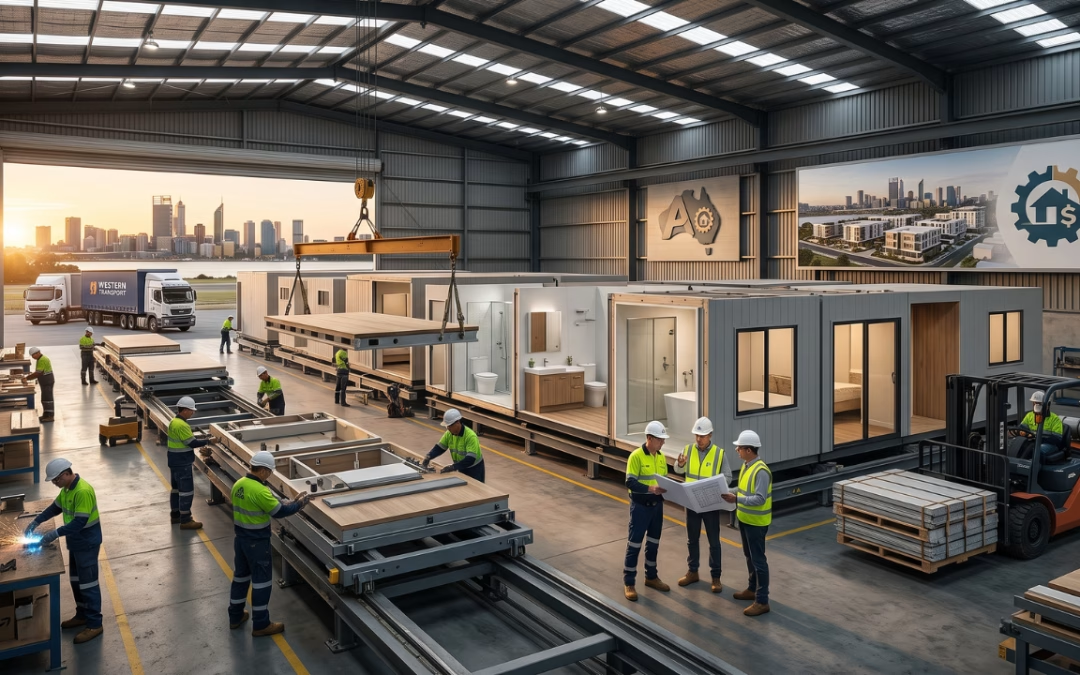
Modular construction has been gaining ground in Karratha as one response to the trade availability problem. The City of Karratha has explored modular apartment solutions for rental supply, and Perdaman’s own housing program uses a combination of traditional and modular methods. For builders looking to tender for future DevelopmentWA releases or larger housing programs in the region, understanding modular delivery methods is increasingly relevant.
The government’s stated intention to release additional lots later in 2026 suggests a pipeline is forming. Over the next four years, Karratha is forecast to see approximately $337.5 million in new projects commencing construction, though residential stock represents only a fraction of that pipeline.
The Broader Picture: Regional Housing Supply as Policy Priority
Karratha is one thread in a larger policy conversation about how Australia houses the workers and communities that underpin its resource economy.
WA Treasurer Rita Saffioti has described the Pilbara’s economic success as central to the success of the broader WA economy. That framing puts housing infrastructure in the same category as port capacity or energy supply. Without it, major projects struggle to attract and retain permanent workforces.
DevelopmentWA’s role as a land release mechanism reflects a deliberate government intervention in a market where private development alone has not delivered sufficient supply. In markets with extreme cost-to-build ratios and limited competing uses for land, government-backed releases can provide the certainty that underpins new construction starts.
For the construction industry, the lesson from Karratha is straightforward. Infrastructure investment and industrial expansion create housing demand. But that demand does not translate into built homes automatically. It requires coordinated land release, planning approvals, and builders willing and able to operate in challenging regional conditions.
The lots are available. The demand is real. The question, as always, is execution.
What This Means for Builders
Builders with capacity to operate in regional Western Australia should be watching the Madigan Estate pipeline closely. The government has signalled further releases later this year, and DevelopmentWA’s track record of 129 settled lots across Baynton West and Madigan suggests the program has operational momentum.
The social housing component, seven of the lots in this current release, also points to growing government commitment to broader housing mix outcomes in the region. Social housing procurement typically involves separate tender processes through the Department of Communities, but it is a signal of the depth of demand being acknowledged across all income levels.
Builders interested in the current release should contact Ray White Karratha or visit developmentwa.com.au for full offer documentation and submission requirements before the 6 May 2026 closing date.
Interested parties can also visit developmentwa.com.au for further information on the current and upcoming releases.
More land news: RM Capital Settles 19.8ha Gympie Land Parcel for $13.5M, with Stage One Already Under Way


0 Comments