


A Walkthrough of the Future
In mid-September, the NSW Government will throw open the doors to one of the state’s first modular housing showcase sites, giving locals a rare chance to walk through a full-scale prefabricated home.
The open day, scheduled for Friday 19 September, is designed to do more than display four walls and a roof. It’s about changing perceptions. Visitors will be able to see and touch a completed home built with a “kit-of-parts” approach, hear from experts, and discover how modular design could help crack the state’s housing affordability and availability crisis.
“We want the community to come and see for themselves what these homes are really like,” said NSW Housing and Homelessness Minister Rose Jackson. “These aren’t second-rate products. They are beautiful, modern homes built to last. Families will be proud to live in them.”
Modular Construction: Not a New Idea, But a New Opportunity
While modular homes are still relatively rare in Australia, the concept is well established overseas. Across Europe, North America, and parts of Asia, prefabrication is no longer viewed as an experiment, it’s an accepted part of mainstream construction.
“NSW is leading the nation in trialling modern methods of construction at scale,” said Professor Mathew Aitchison, CEO of Building 4.0 CRC, which has partnered with government on the showcase. “By systematising construction, we can reduce waste, cut delivery times, and give families access to homes that are modern, adaptable and built to last.”
The research backs him up. Studies show modular methods can shave months off project delivery while dramatically cutting material waste, both critical factors in a market where delays, cost blowouts, and landfill waste dominate headlines.
Why Now? The Housing Crunch
The timing of the showcase is no accident. NSW, like much of the country, is deep in a housing affordability crisis. Population growth is outpacing supply, interest rates remain high, and vacancy rates have hit record lows in Sydney and regional centres.
The Minns Labor Government has staked much of its housing policy on accelerating delivery through its $6.6 billion Building Homes for NSW program. Over 2025–26, 90 modular homes are slated for construction across the state, including 80 duplexes spread over 40 sites.
It’s a modest start in the context of the state’s broader housing deficit, but Jackson argues it’s a proof point that can be scaled.
“In the past year alone, we’ve delivered 1,711 new social and affordable homes, the largest increase in government-built housing in more than a decade,” she said. “Modular construction is one of the tools we’ll use to keep pushing those numbers higher.”
A Break from the Past
Part of the political narrative is contrast. Between 2014 and 2023, NSW saw its stock of public housing fall from 110,805 to 95,765 dwellings. Completions under the former Liberal National Government 2,257 homes lagged the 3,269 sold or removed during the same period.
Labor is keen to signal a reset. By showcasing modular homes, it’s not just about numbers but about quality and pride. “While the Liberals talk down our modular housing industry and oppose new ideas to tackle the crisis, we are out there delivering,” Jackson said.
Busting the Myths
If there’s a hurdle for modular, it’s perception. Many Australians still associate prefabricated homes with low-quality “dongas” or temporary site huts. The showcase aims to flip that script.
Visitors will walk through a dwelling that looks and feels like any other contemporary home: modern kitchens, open-plan layouts, durable finishes, and compliance with the same safety and performance standards as traditional builds.
“These homes aren’t an experiment,” Jackson stressed. “They’re already proven across Europe and the world. We’re just late to the party in Australia.”
Industry Implications: Builders, Suppliers, and MMC
For builders, the shift to modular could mean re-thinking long-held practices. Modern methods of construction (MMC) don’t just cover volumetric modular units; they also include prefabricated wall panels, 3D printing, robotics, and AI-assisted design.
The push opens opportunities for suppliers to innovate, from manufacturers of engineered timber and lightweight steel systems to logistics firms capable of moving volumetric modules efficiently.
It also poses questions about the traditional subcontractor model. With more work done in controlled factory settings, trades may find themselves working in new environments, requiring different skills and workflows.
Yet the payoff could be substantial. Factories aren’t weather-dependent, allowing steadier workflows and potentially safer environments. Predictable production schedules could also make it easier for businesses to scale without the constant boom-bust cycle of on-site projects.
The Showcase as a Turning Point
For Aitchison, the showcase is about confidence. “This is about proving what’s possible,” he said. “We’re showing government, industry and the community that modern methods of construction can deliver quality homes faster, safer, and at lower cost.”
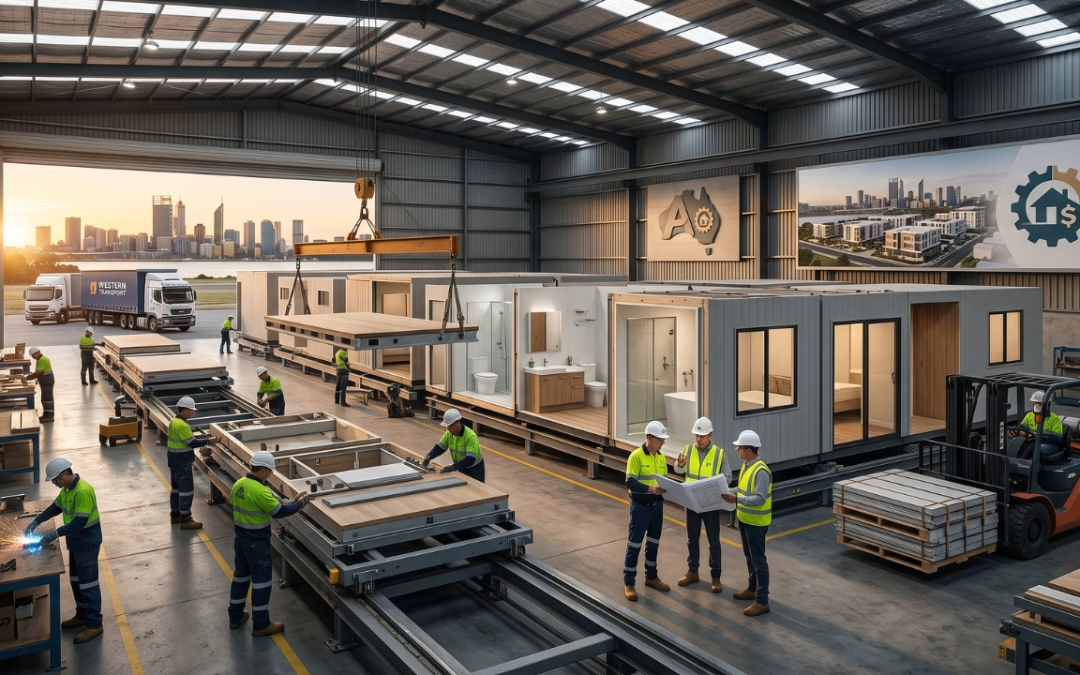
The demonstrator is based on the System 600 kit-of-parts, a modular platform that allows flexibility in design while standardising manufacturing. The approach mirrors techniques that revolutionised industries like automotive and aerospace, where systemisation lifted quality and reduced costs.
If the concept gains traction in NSW, it could ripple nationwide. Other states, from Victoria to Queensland, are closely watching how the program lands with the public and industry alike.
What It Means for Communities
Beyond the industry implications, modular housing could reshape communities themselves. Shorter build times mean less disruption in established suburbs. Reduced waste means cleaner sites and a lighter environmental footprint.
And perhaps most importantly, faster delivery could help more families access safe, affordable housing sooner, whether in urban Sydney or regional centres where housing shortages are biting hardest.
As Jackson put it: “This is our secret weapon to tackle the housing crisis, building faster, reducing waste, and delivering the quality homes our state needs.”
TGB Take
At The Good Builder, we’ve been tracking the rise of modular construction for some time. For an industry under pressure from cost escalations, labour shortages, and consumer demand for sustainability, MMC offers both opportunity and disruption.
The showcase in NSW is more than a political stunt. It’s a glimpse into a future where homes are delivered with the precision of manufactured goods, without sacrificing the liveability Australians expect.
The real opportunity now lies with builders, suppliers, and communities to embrace modular as part of the solution. Far from being held back by old perceptions, Australia’s construction sector is well placed to lead this transformation, showing how innovation and craftsmanship can work hand in hand to deliver faster, smarter, and more sustainable homes for the future.

0 Comments