

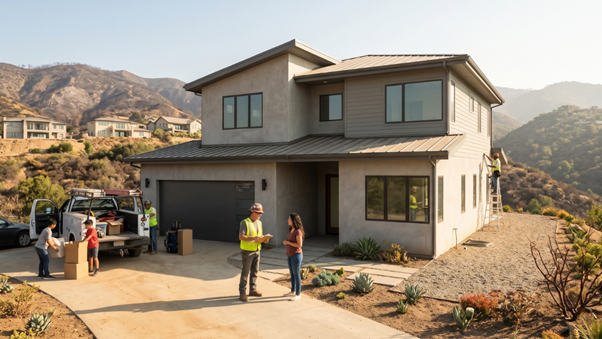
Nearly two years after the Palisades and Eaton fires, finished homes are arriving in greater numbers. What they are made of, and how they got approved, says a lot about how Los Angeles chose to rebuild.
July to October was the busiest stretch yet for finished Los Angeles fire rebuilds. In that time, 165 single family rebuilds were signed off across Pacific Palisades and the unincorporated Eaton burn area, twice the total for January to June.
The houses going up are not copies of what burned. They are built to California’s wildfire construction rules, and state rules for the first five feet around each house are close to taking effect. The permitting system behind them has been rebuilt too.
The rebuild now runs to thousands of permits
The fires destroyed 9,414 structures in the Eaton area and 6,837 in the Palisades, counting homes, businesses and other buildings, according to the LA County fire fact sheet.
Our analysis of the City of Los Angeles building permit data counts 1,811 applications for new single family homes in the Palisades ZIP code 90272 since the fires, as at 7 November. Of those, 1,386 permits have been issued, covering 1,381 properties.
In Altadena and the other unincorporated parts of the Eaton burn area, the county’s EPIC LA fire recovery data shows 2,278 single family rebuild cases with permits issued, under construction or complete, on 2,098 properties, as at 9 November. A further 745 accessory dwelling units are under construction or finished.
Neither dataset covers Pasadena, Sierra Madre or Malibu, which issue their own permits.
A rebuilt house in a fire zone is built to keep embers out
On lots in designated fire hazard zones, California’s wildfire construction rules, long known as Chapter 7A of the building code and section R337 of the residential code, start at the roof. Wood shingles and shakes are banned and the roof covering must be Class A, according to the county’s standard construction notes.
Attic, eave and underfloor openings need vents listed by the State Fire Marshal as flame and ember resistant, or tested to ASTM E2886.
Exterior walls must be noncombustible, ignition resistant or protected, for example with 5/8 inch Type X gypsum behind the cladding, and eaves get similar treatment. Windows need multiple panes with at least one tempered, or a 20 minute fire rating.
Under a state executive order, rebuilds may use the 2022 California code rather than the 2025 edition, although certain fire and life safety requirements still apply, according to the city’s rebuild implementation guidelines. In the 2025 code these wildfire provisions moved into a standalone Wildland Urban Interface Code.
Sprinklers are near universal: 1,675 of the 1,811 Palisades work descriptions specify fire sprinklers, nearly all NFPA 13D.
The houses going up are not copies of what burned.
Zone 0 rules are in their final approval stage
What is Zone 0?
Zone 0 is the ember resistant zone: the first five feet around a building and any attached deck. California already requires defensible space out to 100 feet in fire prone areas, split into Zone 1 (up to 30 feet) and Zone 2 (30 to 100 feet). Zone 0 rules target the embers that collect against walls, limiting mulch, combustible materials, attached wooden fences and woody plants in that strip.
The state Board of Forestry and Fire Protection approved Zone 0 rules on 19 August 2026, then withdrew them from the Office of Administrative Law before its review ended, for clarity edits, according to its November board memo.
The revised rules went back to the board on 5 November. A local fire district reported that the board adopted them that day, and that the board’s public notice anticipates resubmission to that office on or after 13 November. As at 10 November, no final regulation had been filed and no effective date set.
For builders, the key line is in the board’s rule summary: new construction must comply from the effective date, while existing homes get staged timelines of three and up to five years.
Pre approved plans and self certification shorten the paperwork
LA County runs a catalogue of pre approved standard plans for homes and accessory dwellings. Designs are checked once against zoning and building codes, so an owner who picks one faces a shorter, more predictable review for their own lot.
In the county data, 78 Eaton cases reference a standard plan. Their median time from application to permit was 74 days, against about 150 days for other cases. Our comparison uses case descriptions, and simpler houses may explain part of the gap. Across all cases, approvals have lengthened: the Eaton median for permits issued in 2026 was 175 days, against 84 in 2025, and 121 against 73 in the Palisades.
The City of Los Angeles has its own standard plan pilot for the Palisades, and every plan still gets a final LADBS review for the site.
The second shortcut is self certification. In unincorporated areas, experienced architects and engineers carrying at least $500,000 per claim in professional indemnity cover can certify that their plans meet the county code, skipping full plan check.
The county audits at least 20 per cent of these plans and inspects every project. About 80 Eaton rebuild cases carry the self certified label. The city runs its own self certification pilot under an April 2025 emergency order.
Builders are working from catalogues and factories
Brookfield Residential handed six rebuilt homes in Altadena’s La Viña neighbourhood to their owners in September, six months after groundbreaking, according to the company. It says most of its plans are pre approved and that early plan check stages fell from four to six months to 45 to 60 days.
It also says the homes meet the Enhanced level of the Insurance Institute for Business and Home Safety’s Wildfire Prepared Home standard.
Around 80 rebuild applications and permits across both datasets describe factory built, modular or manufactured homes. Modular remains a small share of American housing, and it is a small slice here too.
The county’s June economic update found rising demand for construction and project managers in recovery work, while local hiring overall stayed below pre fire levels. The fire zones are drawing on a national market still short of construction workers.
THE GOOD BUILDER TAKE
The lesson from Los Angeles is that approvals were reorganised around repeatable houses, checked once and then matched to a site.
Pre approved plans put the risk in a reviewed catalogue; self certification puts it on an insured professional facing audit. Both suit simple houses on ordinary sites, and other countries are moving towards automating the plan check itself.
Class A roofs, ember resistant vents and tempered glazing are standard products. Zone 0 moves attention to the five feet where landscaping and handover meet.
Completions have picked up since midyear
In the county’s Eaton data, completed single family rebuilds went from two to ten a month in early 2026 to between 16 and 30 from May to August, then 47 in September and 22 in October.
In the Palisades, 18 new single family homes received their certificate of occupancy or final sign off in October, double the previous monthly high of nine.
So far 68 Palisades homes and 205 Eaton homes are finished, fewer than one in ten of the permits issued. They took a median of about ten months from permit to completion in the county and 13 in the city, and early finishers are likely to be simpler jobs.
Behind them sit about 1,750 Eaton homes under construction and more than 1,300 unfinished Palisades permits. The homes coming through that pipeline are being built to rules written for ember attack, and the routes to a permit now run through a catalogue or a professional’s signature as well as the plan check counter.
Frequently asked questions
As at early November 2026, our analysis of official data counts 68 finished single family homes in the City of Los Angeles part of the Palisades and 205 in the unincorporated Eaton burn area. More than 3,600 single family rebuild permits have been issued across those two areas. Pasadena, Sierra Madre and Malibu report separately.
Homes in designated fire hazard zones must meet California’s wildfire construction rules, historically Chapter 7A of the building code and section R337 of the residential code. These require a Class A roof, flame and ember resistant vents, ignition resistant or protected exterior walls and multiple pane windows with at least one tempered pane. Rebuilds may use the 2022 code under a state executive order, though certain fire and life safety requirements still apply.
Not as at 10 November 2026. The Board of Forestry and Fire Protection approved Zone 0 rules in August, withdrew them for edits before the state review ended and considered revised rules on 5 November. They take effect only once the Office of Administrative Law approves them and they are filed with the Secretary of State, and new construction must comply from that date.
The city and county each check a catalogue of house designs against zoning and building codes before an owner chooses one, so only a site specific review is left. In county data, Eaton cases that reference a standard plan reached permit in a median of 74 days, against about 150 days for other cases, though simpler designs may account for part of the difference.
In unincorporated LA County, registered architects and engineers who meet experience and insurance requirements can certify that their plans comply with the building code, so the permit is issued without a full plan check. The county audits at least 20 per cent of these plans and inspects every project during construction. The City of Los Angeles runs a separate pilot.
Related articles
- Only 1 in 100 New American Houses Is Modular. The Factory Argument Has Not Gone Away.
- Japan Will Check Building Approvals Straight From BIM Data From Spring 2029
- US Construction Added 120,000 Jobs in a Year. It Still Has 326,000 Positions Open.
Last updated 10 November 2026. Figures current to City of Los Angeles LADBS permit data refreshed 7 November 2026 and LA County Public Works EPIC-LA fire recovery case data last edited 9 November 2026.
General Information Only: The information in this article is general in nature and does not constitute legal, financial, tax or professional advice. It does not take into account your particular circumstances. Laws, regulations and market conditions change, and overseas rules discussed here do not apply in Australia. Independent professional advice is recommended before acting on any information in this article.


0 Comments