


Australia’s residential lots are getting smaller, more expensive, and more complex to build on. Here’s the data behind the squeeze, and what it means for builders trying to stay profitable on the blocks they’re being handed.
There is a number that tells the story of Australian housing better than almost any other right now.
Since 2015, the national median block size has fallen from 670 square metres to 645 square metres. That sounds modest. But zoom into individual cities, and the picture becomes sharper, and more confronting.

Sydney has shed roughly 62 square metres from its average new-build site since 2015. Adelaide’s median new lot now sits at 348 square metres, one of the smallest in the country. Brisbane is the notable outlier, where average block sizes have held up or edged higher as outer-ring growth corridors absorbed demand. And the price per square metre of land across the capitals? It has more than doubled in that same period.
The data comes from multiple sources, the ABS, the HIA-Cotality Residential Land Report, and PropTrack, and it all tells the same story. Australian builders are being asked to deliver more complex homes on less land at higher cost.
That is a different business than it was ten years ago.
The Numbers, City by City
The ABS has been tracking site area data for new house approvals for years, and the trend line is consistent. Across the five major capitals combined, average site areas fell 13 percent across the decade to 2021, dropping 64 square metres.
Sydney has experienced the most dramatic compression. ABS data shows Greater Sydney’s average site area fell 32 percent over the 15 years to 2019-20, from 654 square metres to 447 square metres. That is more than 200 square metres gone from the average Sydney new build site in a generation.
Melbourne and Perth have followed a similar downward trajectory. Adelaide, once the city with the largest average blocks, now records median new lot sizes around 348 square metres for greenfield releases, driven by buyers choosing smaller lots as prices surge. Land prices per square metre in Adelaide jumped 27.6 percent in a single year to 2024/25, pushing buyers toward whatever they can afford.
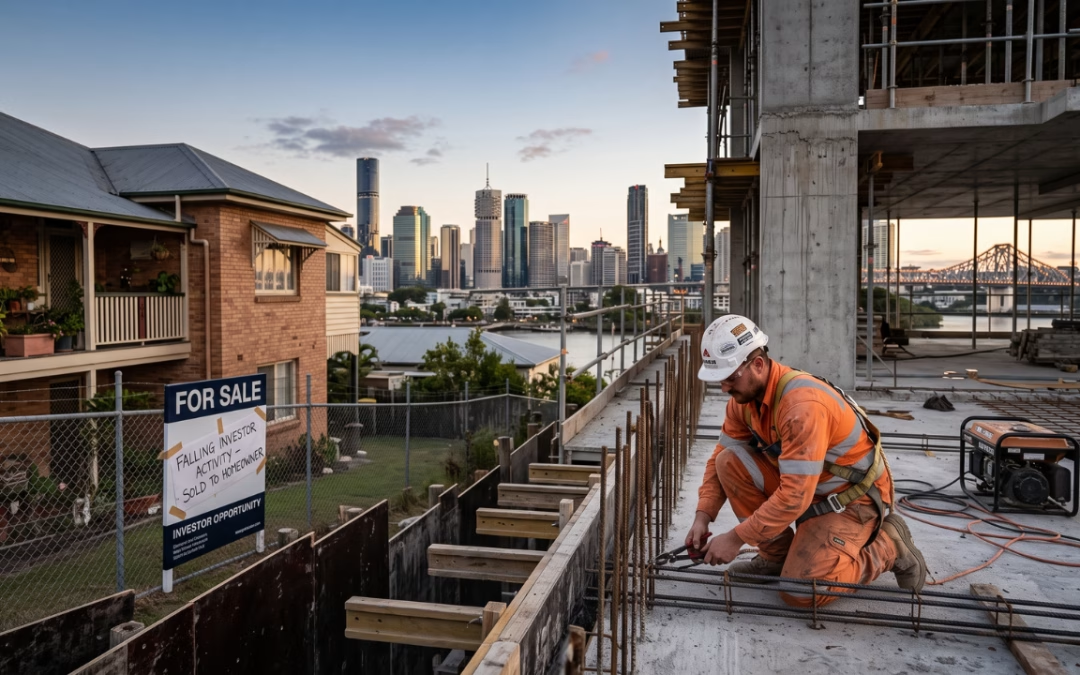
Brisbane is the one capital where block sizes have held up. Greater Brisbane actually saw some of the largest greenfield lots of any capital through much of the past decade, with the SEQ corridor absorbing demand across Ipswich, Logan, and Moreton Bay.
But Brisbane is not immune. South East Queensland land prices cracked $400,000 per lot for the first time in 2024, up 11.5 percent in a year, with land now running at $992 per square metre on average. The blocks may be bigger, but the price tag is catching up fast.
Nationally, the average greenfield lot size is now just 411 square metres, the smallest on record, according to the 2025 State of the Land report. The median capital city lot price has reached a record $391,420 in the September quarter of 2025, up more than 10 percent on the prior year.
The Price Per Square Metre Story
The lot size story gets sharper when you look at what buyers are paying for each square metre they do get.
In Sydney, the price per square metre of greenfield land sits at $1,617, the most expensive in the country by a wide margin. That figure has more than doubled over the decade, consistent with broader data showing Sydney’s land cost per square metre has tripled since 2010.
The national capital city average reached $1,116 per square metre in 2024, an 8 percent jump in a single year. To put that in context, land prices have risen more than double the rate of consumer price inflation over the same period, and five times faster than the cost of building materials.
Land now makes up 75 percent of the value of Australia’s housing stock, up from 54 percent in 1990-91. The total value of residential land has risen to three times GDP. That is a different economy than the one that produced the quarter-acre block.
For buyers, the response has been practical. PropTrack data shows the most common search pattern by 2025 has shifted from a 600 square metre block to a 400 square metre, four-bedroom, two-bathroom home. Expectations have moved because reality moved first.
What This Means on the Ground for Builders
The shift in block sizes is not just a housing affordability story. It is a construction operations story.
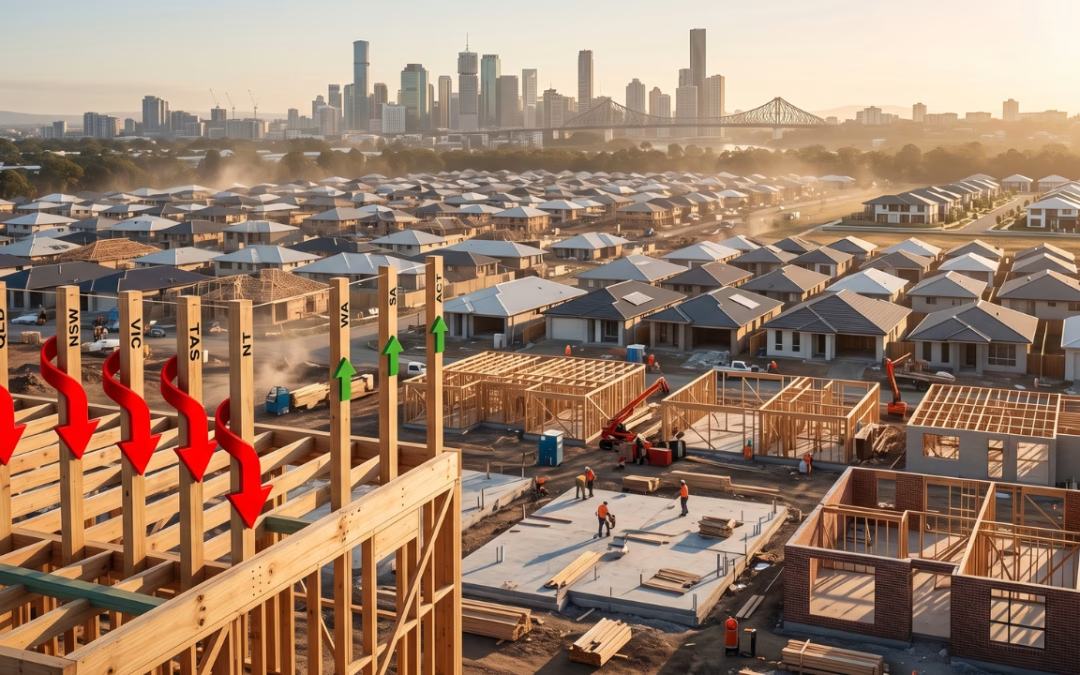
Smaller blocks push homes upward. Two-storey construction has become the default response across most capital city markets, replacing the single-storey sprawl that once defined Australian residential building. That shift changes how sites are managed, how trades are sequenced, and how long projects take.
Narrow lots, now commonly 10 to 12.5 metres wide across many new estates, introduce site access constraints that did not exist on older suburban jobs. Scaffolding, deliveries, and crane placement all need to be reconsidered. Working close to boundary lines on both sides creates party wall issues, privacy considerations, and design constraints that add complexity to every stage.
The ratio of house footprint to site area has shifted significantly. ABS data shows the floor-to-site ratio increased from 0.49 to 0.56 across the decade to 2021. That means more house is now occupying a bigger share of each block. Design teams are maximising every centimetre. Builders are building tighter, higher, and closer to neighbours than they were a decade ago.
Construction costs on narrow lots also tend to run higher per square metre than equivalent projects on larger blocks. Access challenges, custom engineering for tight setbacks, and the added complexity of multi-storey builds all push costs up. Estimates from industry sources suggest narrow lot builds in Sydney’s inner suburbs can run 30 to 50 percent more per square metre than standard-sized lots in the same region.
The Estimating Problem Nobody Talks About
Here is the practical issue for volume builders and project managers: smaller does not always mean cheaper to build.
A 400 square metre block with a two-storey, four-bedroom design can cost more to deliver than a single-storey equivalent on a 550 square metre lot. The materials bill for the house itself may be similar. But site management, scaffolding, build time, and design complexity all go up when you build vertically in a tight envelope.
Builders who are pricing jobs on a per-square-metre basis without adjusting for site conditions are at risk. The block size compression across the market means the job that looks straightforward on paper is often more complicated on site than it was a decade ago.
This has flow-on effects for trade sequencing, contract management, and variation exposure. When a site has less room to move, small problems become bigger ones faster.
The Supply Side Is Not Keeping Pace
Despite the pressure, new lot supply remains constrained. Around 42,700 new lots were released nationally in 2024, a 15 percent improvement on 2023 but still 20 percent below the long-term average and 46 percent below the 2021 peak.
HIA Chief Economist Tim Reardon has been direct about the cause. Government processes around rezoning, land release, and infrastructure delivery are not moving at the pace needed. Land prices keep running ahead because the supply of shovel-ready lots is not there.
The federal government’s target of 1.2 million new homes over five years remains deeply at risk without a significant acceleration in serviced lot delivery. Without more land supply, rising demand just pushes buyers into the established market, which drives up prices further and makes new builds even less competitive.
For builders, this means the pipeline of new greenfield work will remain constrained and expensive to access for the foreseeable future.
Brisbane Is Not a Free Ride Either
It would be tempting to read the Brisbane data as a sign that SEQ offers builders a simpler operating environment. The blocks may be larger on average, but the market has shifted quickly.
Land prices in Brisbane and wider SEQ rose 18 to 21 percent in a single year. Demand has surged as interstate migration continues, and the infrastructure needed to support outer-ring growth in Logan, Ipswich, and Moreton Bay has not always kept pace with lot releases. Builders operating in growth corridors know the trade-offs: bigger blocks, longer drives, and sites that can still be complicated by soil conditions, services, and council requirements.
The Brisbane advantage on lot size is real, but it is narrowing, and price growth is accelerating.
What Builders Can Do With This
The block shrink is not reversible in the short term. The pressures driving it, population growth, land costs, density policies, and planning constraints, are structural. Builders need to adapt to a market where the block they are handed will typically be smaller, more constrained, and more expensive than the equivalent job was a decade ago.
That means reviewing how designs are selected and priced. Single-storey product ranges designed for 500 square metre blocks are not necessarily fit for purpose in markets where 350 to 400 square metres is the new standard. Builders who have not updated their standard product offering to account for the shift in lot sizes are likely leaving margin on the table or taking on risk they have not properly priced.
It also means getting sharper on site-specific estimating. Access constraints, party wall requirements, and two-storey complexity need to be priced individually, not assumed into a standard rate.
And it means understanding the regional picture properly before bidding. Sydney, Adelaide, Melbourne, and SEQ are four different markets with different lot sizes, prices, and build complexities. The builder who treats them as the same market is working with incomplete information.
The block shrink is a data story, but it is also a business conditions story. The market has changed. The builders who understand exactly how it has changed, city by city, are the ones best placed to price and deliver work profitably in 2026 and beyond.
The Takeaway
Australia’s residential blocks have been getting smaller for two decades. The pace has accelerated. The price of what remains has surged. And the complexity of building on tighter, narrower, higher-density lots has increased in step.
Builders who have been around long enough remember the quarter-acre block as the standard brief. That world is gone. The current market is smaller, more expensive, and more technically demanding.
That is not a reason to panic. It is a reason to be precise.
The builders who understand the data behind the block shrink, and have updated their systems, product ranges, and pricing accordingly, are the ones best positioned to stay profitable as the market continues to evolve.
More land news: Brisbane Is Running Out of Industrial Land. Builders Should Pay Attention.

Author: TGB Editorial


0 Comments