


A new Victorian Bill introduced this week would make it a criminal offence for builders to agree to undocumented variations in two situations: when the total contract value reaches $20,000 or more, or when a variation increases the contract cost by $5,000 or more. The timing is not accidental. Both thresholds link directly to the First Resort Home Warranty Scheme starting 1 July 2026.
Victoria has introduced yet another piece of building legislation. This one has gone largely unreported outside industry circles, but it carries practical consequences for every builder working in the state.
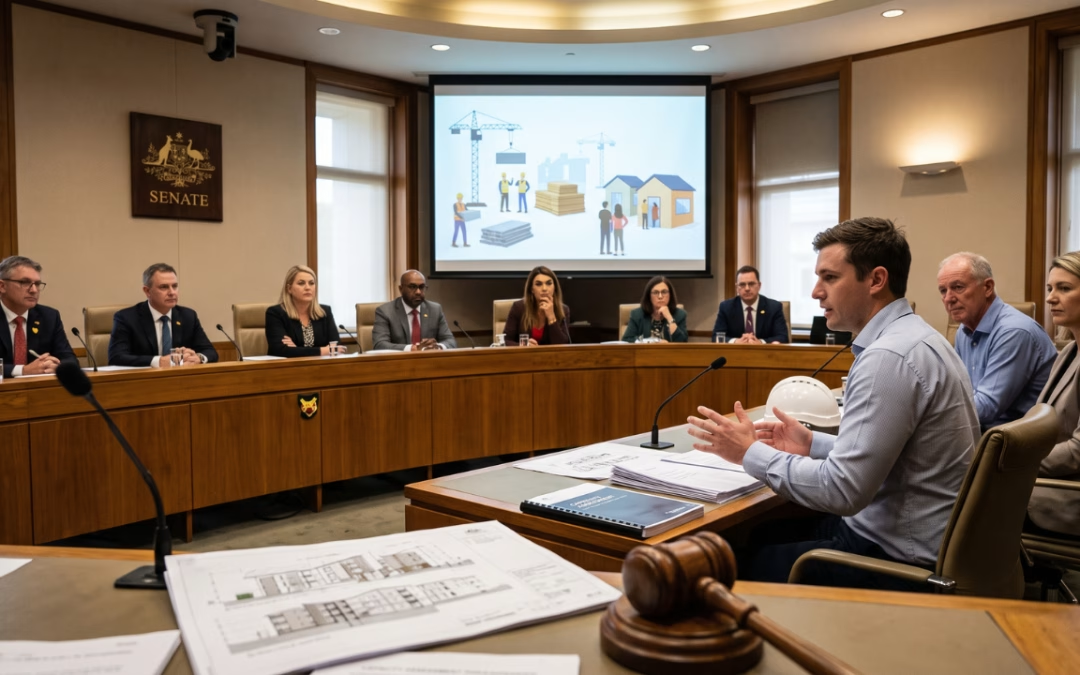
The Consumer Legislation Amendment Bill 2026, introduced into Victorian Parliament on 4 June 2026 by Minister for Consumer Affairs Hon Paul Edbrooke, proposes to make it a criminal offence for a builder to enter into an undocumented variation agreement in either of two circumstances: where the variation brings the total contract value to $20,000 or more, or where the variation increases the contract cost by $5,000 or more (whether individually or cumulatively with prior variations).
The penalty for breaching this provision is 50 penalty units. At the 2026-27 rate of $209.10 per unit, that is a maximum fine of $10,455.
On the surface, this looks like a paperwork rule. Look more carefully, and it is something more specific than that.
What the Bill Actually Does
The legislation creates a new section 38A in the Domestic Building Contracts Act 1995. It targets two everyday situations: a contract where the total value of building work is $20,000 or more, and a variation that increases the contract cost by $5,000 or more, whether as a single variation or cumulatively with previous variations.
In either of those situations, the variation must be in writing, in English, readily legible, and must contain: a detailed description of the work to be carried out under the variation, a detailed description of the work under the original contract, the cost of the variation, and the revised contract price. For cost-plus contracts, the agreement must specify how amounts will be determined rather than fixed dollar figures.
This is not a minor administrative update. It is a new offence with a maximum fine of $10,455 at 2026-27 penalty unit rates.
Under the current law, that gap already carries risk. If a variation is not documented, the usual outcome is that a client who refuses to pay cannot be compelled to pay. VCAT may grant an exception in limited circumstances, but the practical effect is that undocumented variations are difficult to recover.
That existing penalty, losing the right to be paid, is already significant. The proposed legislation adds a criminal offence on top of it.
The new Bill creates a criminal offence for entering into an undocumented variation agreement in two circumstances: where the total contract value hits $20,000 or more, or where a variation increases costs by $5,000 or more. The maximum fine is 50 penalty units, worth $10,455 from 1 July 2026. That is a criminal charge, not a civil dispute.
The Link to the First Resort Warranty Scheme
This is where the mechanics of the reform become clearer.
From 1 July 2026, Victoria is replacing its domestic building insurance with a new First Resort Home Warranty Scheme. Under the old model, sometimes called last resort insurance, homeowners could only make an insurance claim if their builder had died, disappeared, or become insolvent. This was widely regarded as inadequate.
The new scheme changes that. Homeowners can now access the statutory insurance scheme even if the builder is still operating. Coverage applies to domestic building contracts above $20,000 for projects up to three storeys, and builders are required to pay insurance premiums to the Building and Plumbing Commission before contracts commence.
Here is the connection the HIA has identified: when the contract value increases by $5,000 or more due to a variation, the builder is also required to pay an additional premium to the First Resort scheme on behalf of the client. That premium obligation was introduced under the Buyer Protections laws commencing 1 July 2026.
In short, the new criminal offence for undocumented variations effectively exists to generate the paperwork trail that triggers the requirement to pay a higher warranty premium. Without a written variation document, there is no mechanism to calculate or collect the additional premium.
A client who wants to avoid paying a higher warranty premium has an incentive for the variation not to be documented. The builder now faces criminal exposure if the variation goes ahead without paperwork, regardless of what the client prefers.
The Unintended Consequence
The HIA has called on the Victorian Government to withdraw the Bill. Its concern is not with documentation as a principle. It is with the structural problem the Bill creates.
Under the proposed framework, clients who want to avoid triggering a higher warranty premium have a financial incentive for the variation to remain undocumented. At the same time, the builder faces criminal liability if they proceed with an undocumented variation. The client and builder may both prefer to proceed informally, but only the builder faces legal consequences for doing so.
The HIA’s position is that the existing law already punishes undocumented variations adequately, through the loss of any right to payment. Criminalising the same conduct, when the only new policy objective is generating premium evidence, is disproportionate.
From a builder’s perspective, the practical logic of the risk is straightforward. If this Bill passes, the only safe approach is to ensure every variation over $5,000 is documented and signed before a single hour of work is completed. That includes a clear allowance for any additional warranty premium the client will be required to cover. There is no other way to manage the exposure.
Where This Sits in Victoria’s Broader Reform Program
This Bill does not exist in isolation. It is one piece of an unusually dense period of Victorian building legislation.
Since mid-2025, the Victorian Government has passed the Building Legislation Amendment (Buyer Protections) Act 2025, the Domestic Building Contracts Amendment Act 2025, and the Building and Plumbing Administration and Enforcement Act 2026, which received Royal Assent in May this year. The Building Legislation and Treasury Legislation (Tax Relief) Amendment Bill 2026 was introduced simultaneously with the Consumer Legislation Amendment Bill this week.
The collective intent is a building regulatory system with tighter consumer protections, a more powerful regulator in the Building and Plumbing Commission, and a shift toward first resort insurance access for homeowners. Both Master Builders Victoria and the HIA have supported the underlying consumer protection goals while raising concerns about specific provisions and implementation sequencing throughout this reform process.
The First Resort warranty scheme starting 1 July 2026 is the centrepiece of these reforms. It is a genuine improvement for homeowners. But as each new bill is introduced to support its operation, builders are accumulating obligations that carry criminal penalties.
What Builders Should Do Now
The Bill has only just been introduced. It is not yet law. But Victorian builders should treat its intended requirements as immediate operational guidance regardless of what Parliament does, because the underlying exposure, loss of payment for undocumented variations, exists today under current law.
For every variation over $5,000, the only practical approach is written documentation before work begins. That documentation should clearly state the scope of the variation, the revised contract price, and any adjustment to the First Resort warranty premium that applies.
Builders who have relied on verbal agreements, site conversations, or informal arrangements to manage variations need to change that practice now, not when the Bill passes.
Get legal advice if you are unsure how your current variation processes interact with the First Resort scheme and its premium obligations. The interaction between the two is not straightforward, and the consequences of getting it wrong are more serious than they were twelve months ago.
THE GOOD BUILDER TAKE
Victoria has introduced a significant volume of building legislation over the past eighteen months. Most of it has been framed around consumer protection, and the intent of that program is legitimate.
But the proposed criminal offence for undocumented variations over $5,000 raises a structural question the Government has not yet answered: if the policy goal is funding the First Resort warranty scheme correctly, why does achieving that goal require criminalising builders for the same conduct that already costs them their right to payment?
The HIA has a point. The practical outcome is a builder carrying criminal risk for an outcome that both the builder and client may prefer, in a regulatory environment where the client carries no equivalent liability.
Whatever Parliament decides, Victorian builders need to treat variation documentation as non-negotiable. The legal and financial consequences of informal agreements have never been higher.
GENERAL INFORMATION DISCLAIMER
This article is general information only. It does not constitute legal or financial advice. Builders and industry professionals should seek independent legal advice regarding their specific obligations under Victorian building legislation.
More news from Victoria: Victoria’s Townhouse Applications Jump 50 Per Cent. Here Is What the Numbers Actually Mean for Builders.



0 Comments