


Australia’s residential construction pipeline showed a strong late year resurgence in November 2025, with new data revealing a sharp lift in dwelling approvals driven almost entirely by apartments, townhouses and higher density housing.
According to the latest release from the Australian Bureau of Statistics, the total number of dwellings approved rose 15.2 per cent in seasonally adjusted terms to 18,406 approvals. That followed a 6.1 per cent fall in October and marks one of the strongest monthly rebounds seen in 2025.
While the headline number looks positive, the underlying composition of approvals tells a more nuanced story for builders, developers and suppliers heading into 2026.

The Western Growth Story: Scale, Speed and Serviced Land
Development Victoria has accelerated housing delivery across Melbourne’s western suburbs, targeting areas where population growth continues to outpace housing supply.
Over the past year alone, the agency has delivered 163 build-ready residential lots at Riverwalk in Werribee, with a further 159 lots scheduled for delivery in 2026.
Riverwalk is a 197-hectare master-planned community that is already home to more than 2,500 residents and represents one of the last major greenfield precincts available within the estate. For builders, this matters. Late-stage land in established communities typically carries lower delivery risk, clearer infrastructure sequencing and stronger buyer confidence.
The broader context is equally important. Riverwalk sits within the City of Wyndham, one of Australia’s fastest-growing municipalities. The area has added around 12,000 residents in the past two years and is projected to exceed 500,000 people by 2041.
To support that growth, Development Victoria has invested $294 million into Riverwalk, building on a $200 million investment already made at Sunshine North.
For builders and suppliers operating in Melbourne’s west, this level of public investment signals long-term certainty. Roads, services, open space and community infrastructure are being delivered in parallel with housing, not years after the fact.
LUMA Sunshine North: Medium Density Moves Centre Stage
Alongside greenfield delivery, Development Victoria is also increasing its focus on medium-density housing within established suburbs.
At LUMA in Sunshine North, the agency has repurposed surplus government land from a former City West Water site into a new residential neighbourhood.
The full LUMA development will deliver around 300 townhouses, ranging from one to four bedrooms. The first two stages are being delivered by SAW Constructions, with 85 townhouses in Stage 1 already completed and Stage 2 more than three-quarters finished.
Stage 2 includes 86 townhouses designed with long-term liveability in mind, focusing on energy efficiency and reduced running costs. While sustainability language is often used loosely, here it reflects a broader shift in buyer expectations and regulatory pressure around performance, not just aesthetics.
For builders, LUMA demonstrates where government-backed medium-density housing is heading:
- Smaller footprints but higher design scrutiny
- Stronger emphasis on operational energy costs
- Sites close to existing transport and services
It also reflects a reality many builders are already experiencing. Townhouses are increasingly filling the gap between detached housing affordability limits and apartment living that does not suit all buyers.
Inner-City Renewal: Fitzroy Gasworks Enters the Next Phase
While Melbourne’s west focuses on land supply and family housing, the inner north tells a very different story.
The transformation of the former Fitzroy Gasworks site is now moving decisively into delivery mode, with planning approvals secured and development partners appointed.
Developer Local: Residential has been selected to deliver around 360 apartments on Parcel A of the site. Significantly, 33 per cent of these homes will be designated as affordable housing, with 10 per cent of that affordable allocation reserved for First Peoples.
This is not a traditional build-to-sell model. The project is anchored in long-term rental housing, reflecting the growing role of build-to-rent in inner-city housing supply.
For builders and contractors, this shift matters. Build-to-rent projects typically prioritise:
Different procurement and staging models
Durability over short-term finishes
Long-term maintenance efficiency
Consistency across large volumes of apartments
More Density, More Homes, More Complexity
Beyond Parcel A, planning permits have also been approved for Parcels B and C at Fitzroy Gasworks.
These approvals add around 230 additional homes to the precinct, increasing the total planned dwellings from approximately 1,200 to around 1,400 homes, with at least 20 per cent designated as affordable housing across the site.
The revised plans also include 145 additional public car parking spaces and expanded open space, reinforcing the project’s ambition to operate as a genuine mixed-use neighbourhood rather than a closed residential enclave.
Construction timelines reflect the scale and complexity involved:
- Parcel B construction expected to begin April 2026
- Parcel C to follow in mid-2027
- Parcel A scheduled for mid to late 2027
This extended delivery horizon is typical of large urban renewal projects, particularly those involving remediation, heritage integration and multi-developer coordination.
Queensland and New South Wales Lead the Monthly Surge
State level results showed sharp increases in approvals across much of the eastern seaboard.
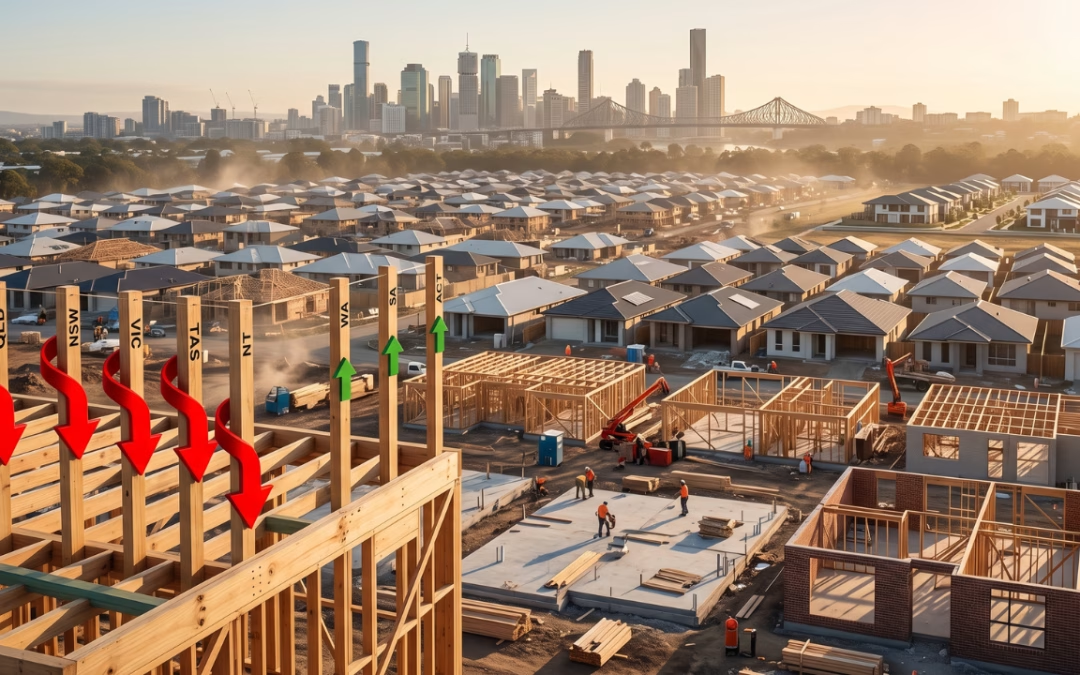
Queensland recorded the strongest monthly rise in total dwelling approvals, up 34.2 per cent. New South Wales followed with a 28.7 per cent increase, while Victoria rose 23.8 per cent. South Australia posted a modest 1.0 per cent rise.
Western Australia and Tasmania were the exceptions, with approvals falling 14.1 per cent and 5.8 per cent respectively.
For detached housing specifically, New South Wales, Queensland and Western Australia all recorded monthly increases, while Victoria and South Australia saw small declines.
These differences reflect local market dynamics rather than a single national narrative. Planning frameworks, land release timing, developer activity and population flows continue to shape outcomes state by state.
Trend Data Reveals a More Cautious Underlying Picture
When viewed through the trend lens, momentum appears more subdued.
Total dwelling approvals rose in Victoria, Western Australia, South Australia, Tasmania and the Northern Territory, while New South Wales and the ACT recorded declines. Queensland was flat.
Private sector house approvals rose on trend in Western Australia, New South Wales and Queensland, fell in Victoria, and were flat in South Australia.
This reinforces the idea that while November delivered a strong bounce, the market is still feeling its way forward rather than accelerating aggressively.
What This Means for Builders Heading Into 2026
For builders, the November approvals data carries several important signals.
First, higher density housing is where the growth is. Builders with capability in apartments, townhouses, terraces and mid rise construction are better aligned with where approvals momentum is strongest.
Second, detached housing is not collapsing, but growth is incremental rather than explosive. This puts pressure on margins and reinforces the importance of operational efficiency, land strategy and product differentiation.
Third, project values remain elevated. Even modest volume growth translates into significant capital flows through the construction sector, which has implications for labour demand, supplier capacity and cash flow management.
Finally, the divergence between seasonally adjusted and trend data highlights the importance of not overreacting to a single month. November was strong, but the broader story is one of gradual stabilisation rather than a full cycle upswing.
As Australia heads into 2026 with population growth still high and housing supply under pressure, approvals data like this suggests the industry is responding, but doing so cautiously.
For builders who can adapt to changing housing formats, manage cost pressures and stay close to planning and approvals pipelines, the coming year presents opportunity as well as risk.
More land news: Record Sales at Playford Alive Set the Stage for 200 New Land Releases Across Northern Adelaide

Author: The Good Builder
The Good Builder is a media platform that provides news and insights for Australia’s home building industry. From exclusive stories and curated insights to bold industry perspectives, we deliver the news and updates that keep builders, suppliers, and the entire home building industry inspired and ahead of the curve.



0 Comments