


Colli Timber & Hardware has secured a $2.734 million government grant and is matching it with its own funds to build one of WA’s most advanced truss and framing facilities. The result: capacity to frame up to 960 homes a year.
A family-owned timber supplier in Western Australia is about to become one of the state’s most significant residential framing operations, and the timing could not be more relevant for builders watching housing supply targets pile up alongside a constrained trades workforce.
Colli Timber & Hardware, based in Cardup south of Perth, has been awarded $2.734 million through the WA Government’s Housing Innovation Fund as one of the 15 local manufacturers backed in a $49 million push to build homes faster. The parent company, Cardoso Pty Ltd, will match that grant dollar for dollar, bringing the total investment in the facility’s upgrade to $5.5 million.

This comes on top of more than $3 million already invested in the Cardup site over the past two years.
The outcome, once the facility is fully commissioned within 24 months, is a production line capable of manufacturing and delivering 20 standard four-by-two home framing systems each week. That is up from five per week currently. The company estimates this represents up to a 400 per cent increase in production capacity over three years and the ability to supply framing and truss systems for up to 960 homes annually.
What the Upgrade Actually Involves
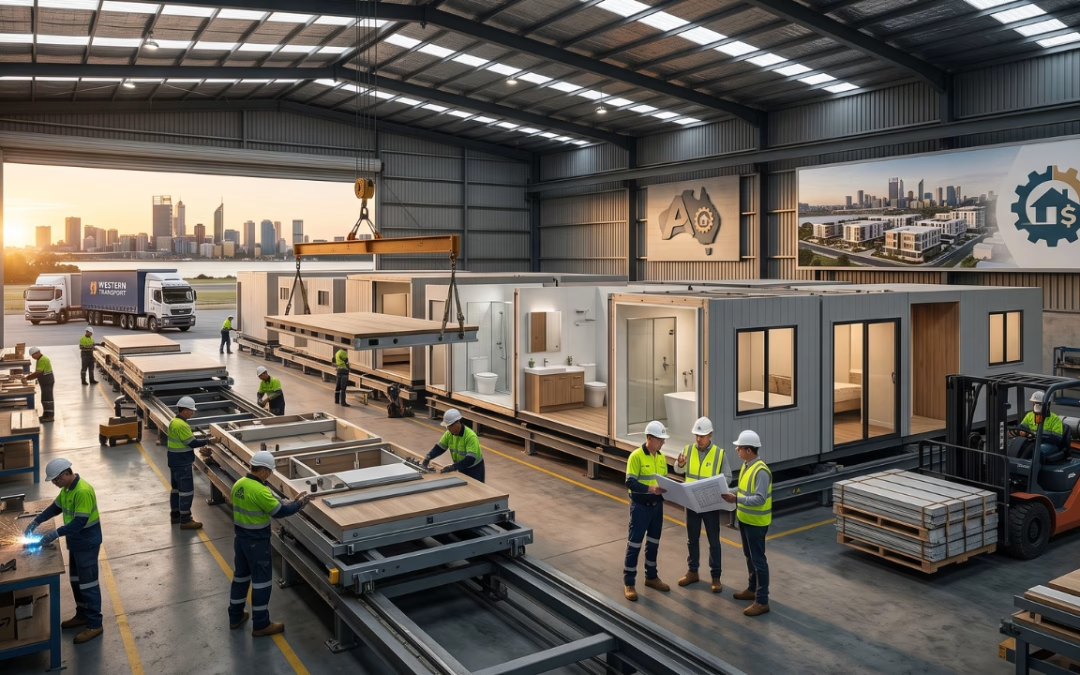
This is not an incremental improvement to an existing operation. Colli has branded the project FrameForward WA, and the investment covers a substantial suite of automated and computerised systems.
The planned installation includes automated timber picking systems, computerised saw and cutting systems, automated timber delivery and material handling systems, automated wall frame manufacturing lines, roof truss automation upgrades, and finished product stacking and handling systems.
“We’re thrilled to be retaining our first-rate craftsmanship by embracing automation to enhance quality, safety, precision and scalability.” — Cesare Colli, Managing Director, Colli Timber & Hardware
The framing and truss sector has historically been labour-intensive work. The shift toward automated production lines does not eliminate skilled operators, but it reduces the reliance on manual throughput at every stage of manufacturing. For builders who have experienced inconsistent timber supply, delays in frame delivery, or quality variation across jobs, a more automated and controlled production environment represents a meaningful change to supply chain reliability.
Part of a Larger WA Government Push
The Colli investment sits within a broader funding announcement made by the Cook Government in May 2026. The WA Government has committed $49 million through the Housing Innovation Fund to 15 local housing manufacturers, all focused on prefabrication and modern methods of construction.
The fund requires grant recipients to co-contribute a minimum 50 per cent of their project costs, meaning the total capital being deployed across the 15 projects substantially exceeds the government’s direct contribution.
Projects were assessed on their ability to increase housing supply, support local industry, deliver regional benefits and improve construction efficiency. Colli’s focus on timber wall frame and roof truss manufacturing, two of the most consistent inputs across residential construction, aligns directly with those criteria.
The announcement also sits alongside a separate $48 million state government investment in Built Living and Atlas Precast, who are developing advanced manufacturing facilities in Neerabup and Kwinana.
Why Framing Capacity Matters Right Now
Builders working in Western Australia’s residential market are operating against a backdrop of sustained demand pressure. The state’s housing targets are substantial, labour availability remains tight, and the sequencing of a build makes framing a critical early dependency.
If frames are not available on time, every downstream trade is pushed out. Site-specific production under traditional models can be susceptible to scheduling variability, weather disruption, and individual capacity constraints. Factory-based production, when operating at scale and with automated systems, offers a more predictable supply cadence.
Colli’s stated goal of supplying up to 960 homes annually in framing capacity is a meaningful number in that context. It does not solve WA’s housing supply challenge on its own. But it removes one friction point from the supply chain for builders managing multiple active projects.
“Through this, we’ll play a part in improving housing affordability and make scalability easier for large residential developments and builders.” — Cesare Colli
The company also projects an approximate 25 per cent increase in direct and indirect employment in the local truss and framing sector as a result of the investment. This is a relevant signal for an industry where skilled workforce supply remains a persistent constraint.
The Prefab and MMC Context
This investment is part of a broader national story. Australia’s prefabricated construction market has been shifting from niche to mainstream over recent years, driven by a combination of housing supply pressure, labour constraints, and improving factory-based quality control.
Framing and truss manufacturing sits at the more established end of this spectrum. These are not experimental construction methods. Prefabricated wall frames and roof trusses have been standard inputs in residential construction for decades. What is changing is the scale, the precision of automated production, and the integration of these supply chains into the broader housing delivery system.
The WA Government’s international reference point is notable. Government data suggests large-scale prefabrication can deliver homes around 20 per cent cheaper and up to 50 per cent faster than traditional construction. Those figures apply primarily to fully modular and volumetric production, but the efficiency logic carries through to component manufacturing as well.
Builders operating through a period of constrained trades supply and tight margins, supply chain reliability is as important as what happens on site. Knowing that a key input is available, consistent, and delivered to schedule changes the risk profile of a project.
What Builders Should Watch
The Cardup facility is expected to be fully operational within 24 months. In the near term, the practical signal for builders operating in Western Australia is that additional locally manufactured framing and truss capacity is coming into the market.
For larger volume builders and developers working on staged residential projects, it is worth understanding how Colli’s expanded output will be allocated and distributed. For smaller builders managing a handful of starts at any one time, increased manufacturing capacity from a local supplier generally means better product availability and potentially more competitive pricing.
More broadly, the WA Government’s Housing Innovation Fund represents one of the more concrete attempts by any Australian state government to move housing supply intervention upstream. Rather than targeting approvals or land release alone, the fund is investing directly in the manufacturing capability needed to build homes faster once projects commence.
| THE GOOD BUILDER TAKE The framing bottleneck is a real problem in residential construction. Builders know it. If Colli’s Cardup upgrade delivers what it promises, 960 additional framing sets per year is not a headline number. It is a meaningful reduction in one of the more persistent sequencing problems builders face. WA’s approach here, co-investing with manufacturers rather than just backing demand-side incentives, is worth watching. The proof will be in whether the output actually reaches builders at the scale and consistency the investment suggests. |
FREQUENTLY ASKED QUESTIONS
What is the WA Housing Innovation Fund?
The WA Housing Innovation Fund is a $50 million program established by the Cook Government to support local housing manufacturers in adopting modern methods of construction, including prefabrication, modular systems, and automation. The inaugural grant round awarded $49 million across 15 manufacturers, with recipients required to provide a minimum 50 per cent co-contribution.
How much framing capacity will Colli Timber & Hardware produce after the upgrade?
Once fully commissioned, the Cardup facility is expected to produce 20 standard four-by-two home framing systems per week, representing the capacity to supply framing and truss systems for up to 960 homes annually. This compares to the current output of five framing systems per week.
What is FrameForward WA?
FrameForward WA is the name Colli Timber & Hardware has given to its Cardup facility upgrade project. The $5.5 million investment covers the installation of automated timber picking, computerised saw and cutting systems, automated wall frame manufacturing lines, roof truss automation upgrades, and finished product handling systems.
How does prefabricated framing help builders with housing supply?
Prefabricated framing systems are produced in a controlled factory environment, which reduces variability in quality and delivery timing compared to site-based or manually intensive manufacturing. For builders, this means more predictable supply, fewer delays caused by production constraints, and potentially lower waste and production costs as manufacturing scale increases.
Which WA manufacturers received Housing Innovation Fund grants?
The WA Government’s $49 million Housing Innovation Fund was distributed across 15 manufacturers. Among the larger recipients were Pique Mod Pty Ltd, Kimberley Manufacturing Pty Ltd, Home Group WA Pty Ltd, and Limestone Building Blocks Company Pty Ltd. Colli Timber & Hardware’s parent company, Cardoso Pty Ltd, received $2.734 million toward the Cardup facility upgrade.
This article is intended for general information purposes only and does not constitute legal, financial, or professional advice. Laws, regulations, and industry requirements vary by state and territory and change over time. Builders and trades professionals should seek independent advice relevant to their specific circumstances before making business, legal, or financial decisions.

Author: TGB Editorial

0 Comments