


Australia’s first new city in more than a century has taken a decisive step from planning vision to physical reality, with the NSW Government finalising a more than $1 billion development agreement that will kickstart large-scale residential and commercial construction at Bradfield City.
The agreement, announced in late December, brings global Australian development and investment firm Plenary on as the long-term development partner for Bradfield’s first “Superlot”, a 5.7-hectare parcel of land positioned next to the city’s First Building, Central Park, and the new Metro station.
For an industry grappling with housing targets, workforce shortages, and planning bottlenecks, the deal represents one of the most concrete signals yet that Western Sydney’s long-promised aerotropolis is moving into a delivery phase.
A foundational precinct for a new city
The Superlot will deliver the first 1,400 homes in Bradfield City, with at least 10 per cent allocated to affordable housing, alongside a dense mix of commercial, education, and community infrastructure.
Around a quarter of the site has been earmarked for non-residential uses, including advanced industries, a hotel, a university campus, retail, childcare, health services, and a 1,500-square-metre food and beverage venue overlooking Central Park.
While the scale is significant in its own right, the project’s importance lies in what it represents: the first major private development underpinning a city designed to support 10,000 new homes and 20,000 jobs over coming decades, anchored by the Western Sydney International Airport.
In a national housing market dominated by incremental infill and fragmented greenfield estates, Bradfield stands out as a deliberately planned urban centre, with employment, education, transport and housing being delivered in parallel rather than as afterthoughts.
Bradfield City’s First Land Release development partner appointed
Why this deal matters for builders and suppliers
For builders, trades and suppliers watching from across New South Wales and beyond, the Plenary agreement signals more than just another masterplanned precinct.
First, it provides long-term project certainty. Development will roll out in stages over multiple years, generating thousands of construction jobs and sustained demand across civil works, residential construction, commercial building, and fit-out trades.
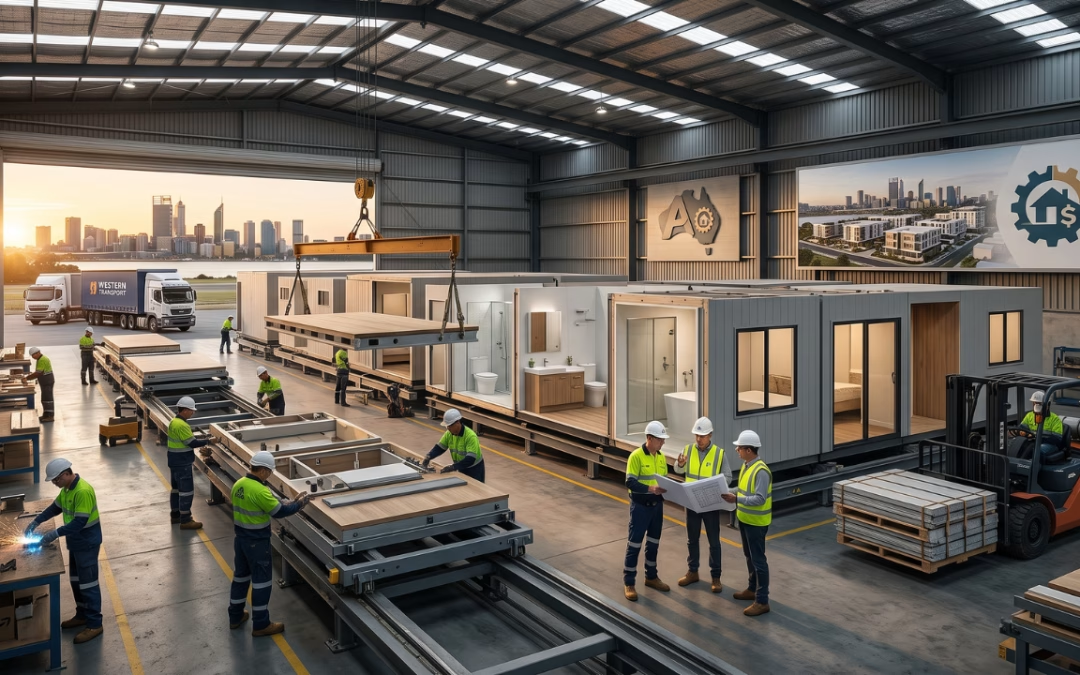
Stage 1 alone, scheduled to be delivered over the next five years, includes the “essentials of a great city”: public spaces, childcare, affordable housing, a university presence, and commercial hubs. That breadth of scope creates opportunities not just for volume builders, but for specialist contractors, modular and prefab providers, advanced manufacturing suppliers, and service trades.
Second, the project introduces a highly coordinated planning pathway. All developments within Bradfield City will be assessed by the NSW Department of Planning, Housing and Infrastructure as State Significant Developments, streamlining approvals and reducing the risk of localised planning delays that have plagued many large housing projects elsewhere.
For builders who have spent years navigating inconsistent council processes, this centralised approach may prove just as valuable as the land supply itself.
Government positioning: homes, jobs and confidence
The Minns Government has been explicit about the broader intent behind the agreement.
Minns Labor Government sees Bradfield as a cornerstone of its strategy to increase housing choice while rebuilding economic confidence in Western Sydney.
Minister for Planning and Public Spaces Paul Scully described the release of the Superlot as a moment where Bradfield begins to “come to life,” pointing to the delivery of homes, education facilities, and essential services as the foundations for future growth.
Importantly for industry, Scully linked the deal to momentum already created by the opening of Bradfield’s first building, the Advanced Manufacturing Readiness Facility, which is already hosting innovation-focused tenants.
That sequencing matters. Too often, large housing precincts lead with rooftops and chase jobs later. Bradfield is attempting the opposite: anchoring employment, education and advanced industry from the outset.
Acting Minister for Western Sydney Courtney Houssos reinforced this framing, positioning the city as a 24-hour, globally connected hub designed to support new industries for the next century.
Plenary’s role as long-term partner
For Plenary, the agreement cements its role not as a short-term developer, but as a long-term partner in shaping Australia’s newest city.
Plenary Chair Paul Oppenheim said the company’s focus would be on delivering a masterplanned precinct that integrates housing with education, commercial uses, childcare, retail and hospitality, all centred around the two-hectare Central Park and adjacent transport infrastructure.
The emphasis on integration is notable. Rather than carving up parcels for isolated uses, the Superlot approach encourages mixed-use density, a model increasingly favoured by planners but still challenging to execute at scale.
Plenary’s experience delivering complex infrastructure and precinct projects, both domestically and internationally, was a key factor in its selection. For the construction industry, this increases confidence that the project will maintain continuity through market cycles rather than stalling when conditions tighten.
What comes next in 2026
While the agreement is now finalised, much of the delivery work begins in earnest in 2026.
Plenary will commence the market process to secure a university partner and a major commercial anchor tenant, both of which will influence the skills mix, employment profile and long-term economic character of the city.
State Significant Development Applications will also be lodged for the food and beverage venue, alongside a Concept Plan covering housing, commercial space and a hotel on the northern portion of the site.
For builders and suppliers, these milestones will determine when specific work packages come to market — from early enabling works and structural construction through to services, interiors, landscaping and long-term maintenance.
A broader signal for housing delivery
Beyond Bradfield itself, the deal sends a broader signal about how governments may approach housing delivery in the years ahead.
Large, coordinated precincts with streamlined approvals, mixed-use density, and long-term private partners are increasingly being positioned as a solution to Australia’s housing shortfall, particularly in growth corridors tied to major infrastructure.
For smaller builders, this raises strategic questions. Participation may come through subcontracting, joint ventures, or specialisation rather than standalone detached housing delivery. For larger builders and suppliers, it reinforces the value of systems, scale and long-term partnerships.
What is clear is that Bradfield City is no longer just a planning diagram or political talking point. With capital committed, partners appointed, and approvals pathways defined, it is entering the phase that matters most to the building industry: delivery.
As the first cranes move in and contracts are let, Bradfield will become a live test case for whether Australia can still plan and build cities that balance housing supply, economic opportunity and long-term liveability and whether industry can rise to meet that challenge.



0 Comments