


Robert Redlich and Deborah Glass, two of the most senior figures to have run Victoria’s integrity bodies, want a royal commission into the $109 billion Big Build. The government has said no again. Beneath the headlines, much of what is being reported remains allegation, not proven fact.
Two of the most senior figures ever to oversee Victoria’s integrity system have called for a royal commission into corruption on the Big Build. The government has refused, again. That standoff is the news.
What sits beneath it is harder to pin down. The state’s largest infrastructure program has become the subject of serious claims about public money, union conduct and political accountability. But the headline figures are contested, the most damaging findings have been formally questioned by the person appointed to clean up the union, and individuals named in the coverage have denied wrongdoing.
For builders, the line that matters runs between what is alleged and what is established. This is where it falls.
What is the Big Build?
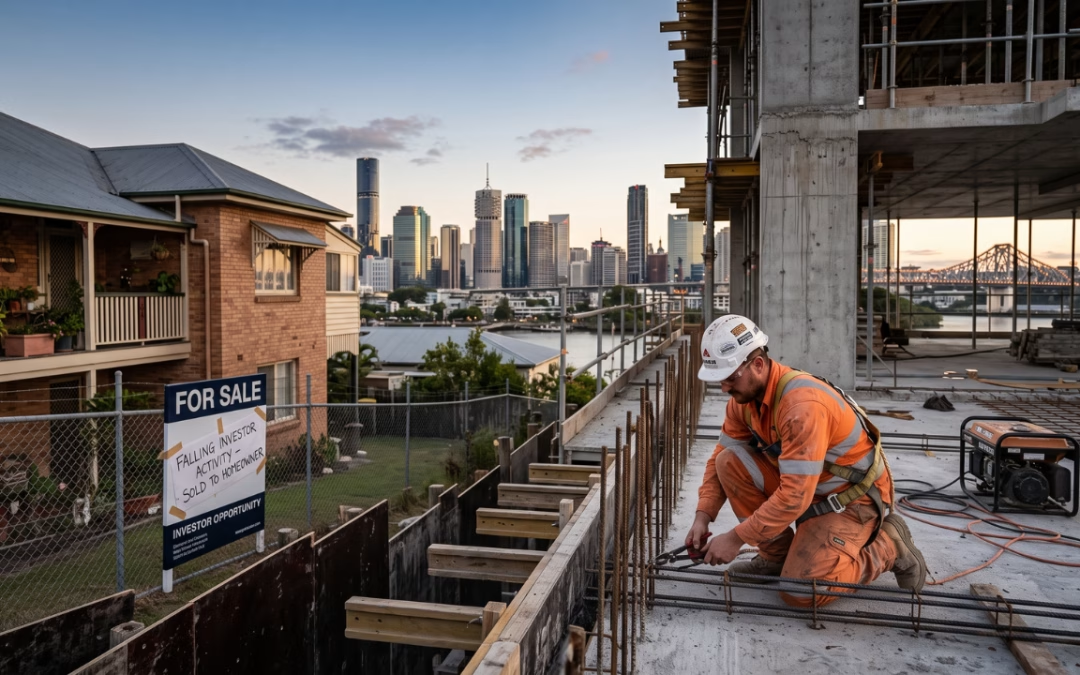
The Big Build is the Victorian Government’s program of major road and rail infrastructure projects, launched in 2015. It includes work such as the Metro Tunnel and level crossing removals.It is frequently valued in current coverage at around $109 billion. Because it requires large volumes of construction labour, the program has been closely connected to the construction workforce and the unions that represent it.
What are the former integrity chiefs asking for?
In the past week, two figures with deep credibility on integrity matters have publicly backed a royal commission. Robert Redlich is a former Commissioner of Victoria’s Independent Broad-based Anti-corruption Commission. Deborah Glass is a former Victorian Ombudsman. Both have spent years inside the state’s accountability system.
Redlich told The Age that a royal commission was, in his words, desperately needed to properly examine the past decade of culture within the industry. The argument from both is essentially the same: that the existing bodies were not built to follow money through a web of private subcontractors, and that only a commission with full coercive powers can see the whole picture.
That last point is the crux of the disagreement. It is not really about whether problems exist. It is about which tool is the right one to investigate them.
Where does the $15 billion figure come from?
Much of the current coverage leans on a single, striking number: a claim that cost blowouts linked to misconduct added around $15 billion to the Big Build. That figure originates with barrister Geoffrey Watson SC, who examined the Victorian branch of the CFMEU under its former leadership.
Two things need to be said about it plainly.
First, it is an estimate produced by an investigator, not a finding made by a court. Watson has said he considers the figure conservative. Others dispute it. It has not been tested through a judicial process.
Second, and this is the part most tabloid coverage omits, parts of Watson’s Victorian findings were redacted by the CFMEU’s court-appointed administrator, Mark Irving KC, before release. Irving has said he removed sections he was not satisfied were well-founded or properly tested. Watson has said he was unhappy about that redaction but has continued to back Irving’s leadership. So the headline number sits inside a genuine, on-the-record dispute between two senior lawyers about what the evidence supports.
The figure is an investigator’s estimate, not a court’s finding. It has not been tested through a judicial process, and parts of the underlying report were redacted before release.
What has the union been through already?
This does not come from nowhere. The CFMEU’s construction division was placed into administration in 2024 after reporting by Nine newspapers and 60 Minutes alleged criminal infiltration of the union. The High Court later upheld the validity of that administration. The union has been operating under an externally appointed administrator since then, with a stated reform agenda.
In other words, the question now is not whether the union had serious problems. That is largely accepted, and a national process is already underway to address it. The question is whether Victoria specifically needs its own royal commission on top of everything else that is happening.
What is the government’s position?
Premier Jacinta Allan has again rejected the royal commission calls. Her argument has three parts, and builders should understand all of them rather than just the refusal.
She points to enforcement that is already happening. Victoria Police, through a dedicated taskforce, has laid dozens of charges. The state’s Labor Hire Authority has cancelled scores of construction industry licences. The government has also given an in-principle commitment to review the powers of its anti-corruption commission, including the follow-the-money powers that the watchdog itself has said it lacks.
Her position, in short, is that action through police and regulators is faster and more concrete than a multi-year commission. Her critics argue that none of those bodies can examine the whole system the way a royal commission could. Both points can be true at once, which is part of why this is genuinely contested rather than clear-cut.
What does this actually mean for builders?
For most builders and subcontractors, the immediate relevance is not the political fight. It is the operating environment that all of this is reshaping.
Regulators across the country are now alert to the methods described in these reports, and they are scrutinising payments, labour-hire arrangements and site practices more closely than before. Builders tendering on or working near major government projects should expect tighter licensing and compliance obligations, more documentation, and more questions about who is being paid and why.
This is a moment to make sure your own house is in order. Clean records, properly documented subcontractor arrangements, and clear payment trails are no longer just good practice. They are protection. The businesses most exposed in an environment like this are the ones relying on informal arrangements and handshake deals.
It is also worth watching how this plays out alongside the wider conditions builders are already managing, because integrity reform tends to arrive at the same time as cost pressure and tighter procurement. Keeping an eye on how these forces track conditions across the wider market will matter more over the next year than the day-to-day political back and forth.
Where this goes next
The government has not moved, and at this stage shows no sign of moving. The opposition is committed to a commission. The former integrity chiefs have added weight to the case but cannot compel a decision. Police and regulator action continues in parallel.
For builders, the sensible posture is neither alarm nor indifference. The scandal headlines will keep coming, and many will outrun the proven facts. What is worth tracking calmly is the practical end of it: where regulation tightens, where enforcement lands, and what new obligations follow for businesses doing legitimate work. That is the part that will reach your site, whatever happens with the royal commission question.
The noise on this story is loud. The job, as always, is to separate what is alleged from what is known, and to focus on the part you can actually control.
Frequently asked questions
What is the Victorian Big Build?
It is the Victorian Government’s major road and rail infrastructure program, launched in 2015 and frequently valued in current coverage at around $109 billion. It includes projects such as the Metro Tunnel and level crossing removals.
Has a royal commission into the Big Build been called?
No. A royal commission has been called for by the state opposition and, more recently, by two former integrity officials. The Victorian Government has so far rejected those calls, arguing that police and regulators are better placed to act quickly.
Is the $15 billion corruption figure proven?
No. It is an estimate produced by barrister Geoffrey Watson SC. It has not been tested by a court, and parts of his Victorian report were redacted by the union’s administrator, who said he was not satisfied those sections were properly tested.
What is Taskforce Hawk?
It is a Victoria Police taskforce set up to investigate alleged criminal conduct connected to the construction sector. It has laid charges against a number of individuals. Those matters are before the courts.
What does this mean for builders and subcontractors?
Expect closer scrutiny of payments, labour-hire arrangements and compliance, especially on or near major government projects. Clean records and well-documented subcontractor arrangements are the best protection in a tightening environment.
Last updated: 29 June 2026. This is a developing story and details may change.
This article is intended for general information purposes only and does not constitute legal, financial, or professional advice. It reports on allegations and public statements that have not been tested in court, and all individuals are entitled to the presumption of innocence. Laws, regulations, and industry requirements vary by state and territory and change over time. Builders and trades professionals should seek independent advice relevant to their specific circumstances before making business, legal, or financial decisions.
Related Articles:
Calls for a Royal Commission Into Victoria’s Big Build Are Growing. Where the Claims Stand.




0 Comments