


An independent capability assessment released with the appointment of a new Housing Australia chair puts dates on when the largest HAFF funding round clears approval, and when construction has to start.
Treasury has released an independent capability assessment of Housing Australia, and inside it sits a set of dates that matter to anyone chasing social and affordable housing work. Housing Australia expects more than 100 Funding Round 3 projects to require approval by early 2027. Approval activity is expected to peak between October 2026 and January 2027 at more than 20 projects a month.
The assessment describes that load as more than four times the 2025 transaction volume, in half the timeframe.
The report was commissioned by Treasury in July 2026, conducted over six weeks by Ken Kanofski with support from KordaMentha, and is dated 28 August 2026. It was released alongside the appointment of Ann Sherry AO as chair of Housing Australia. It carries 13 recommendations and describes itself as a rapid, top down assessment rather than a detailed review of every function.
Why the approval peak matters more than the approval count
Funding Round 3 is the largest of the three rounds run under the Housing Australia Future Fund Facility and the National Housing Accord Facility. It commenced in January 2026 and is intended to close out a target of 20,000 social and 20,000 affordable dwellings by 30 June 2029.
That end date does not move. Every week absorbed at the approval end comes out of the construction period. The assessment puts it in similar terms, stating that delays in approval, contracting and project progression reduce the available construction period and the options available to respond to project attrition or market disruption.
The gap between funding commitments and homes on the ground has already drawn scrutiny across the completed homes across the first two rounds. What the assessment adds is a forward view of where the bottleneck sits next. Almost all facility contracts to date have been approved by the Board Investment Committee and then the Board. With four or five Board meetings scheduled across the peak period, the assessment estimates roughly 20 projects would need approval at each meeting.
Where the weeks go between application and contract close
The assessment sets out several contributors. Standardised Round 3 contracts are expected to reduce time to contract close by two to four weeks. Working against that, valuation discussions can add three to four weeks and may trigger further approval requirements. Board approval of individual transactions adds a minimum of 14 days to relevant senior debt transactions.
Stakeholders consulted for the assessment also pointed to repeated requests for application information and clarifications, sequential rather than parallel review processes, limited delegations, and variable capability among community housing providers during contract negotiation and valuation.
The consequences are described in commercial terms. Protracted approvals and negotiations expose proponents to construction cost escalation, interest rate and valuation movements, higher legal and transaction costs, changed project circumstances and the possibility of withdrawal. They also compress the period available for planning, financial close and construction.
Every week absorbed at the approval end comes out of the construction period.
Stream 5 is the only part of Round 3 with a published construction start date
Round 3 is being managed through streams covering First Nations housing, housing diversity, state and territory partnerships, and partnerships at scale, where applications must cover at least 500 dwellings. The assessment also describes a newly established pathway, Stream 5, Release 1.
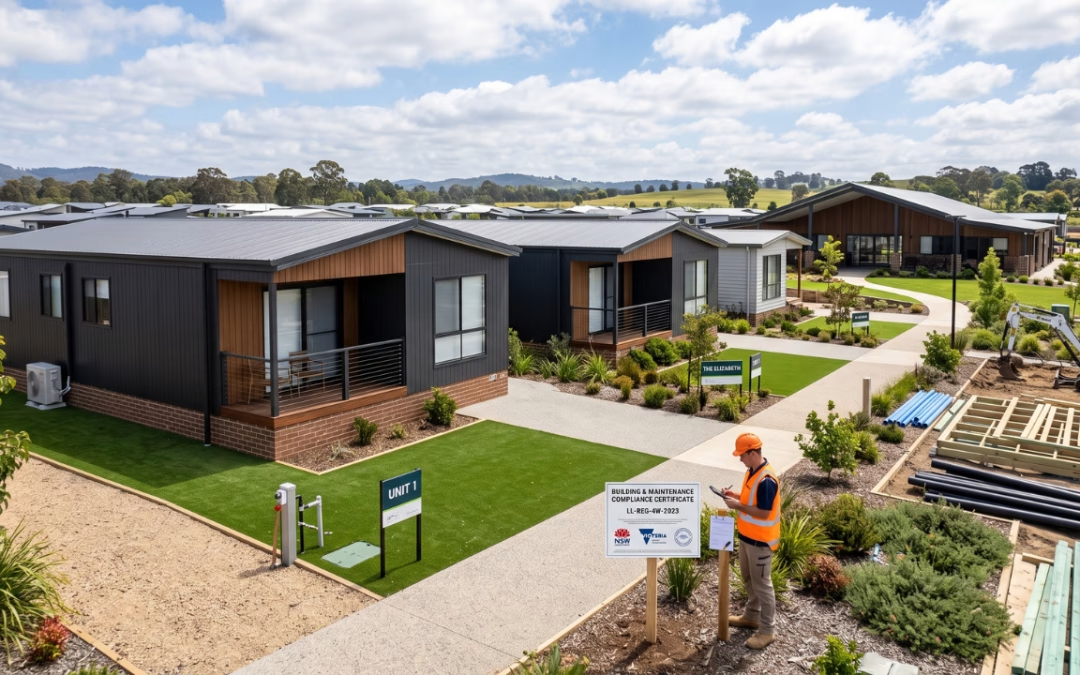
Stream 5 supports projects that are ready to go, well located and low density, described in the report as class 1. Funding approvals must be in place by 1 February 2027 to enable main works construction to commence by 1 May 2027.
That is the only construction start date published in the document. It also sits in the part of the program closest to detached and low rise residential work, rather than the apartment and medium density projects that dominate the larger streams.
What is a class 1 building?
Under the National Construction Code, Class 1a is a single dwelling. That covers a detached house, or one of a group of attached dwellings such as a row house, terrace house, townhouse or villa unit, each separated from the next by a fire resisting wall. Class 1b covers small boarding houses, guest houses and hostels within defined size and occupancy limits. Low density social and affordable housing generally falls within Class 1.
The funding envelope is capped while construction costs are still rising
Round 3 applies maximum prices to availability payments, which are the indexed quarterly payments made per dwelling for 25 years once a dwelling becomes occupiable. The assessment states that existing program settings may not fund every project if costs move materially beyond the limits established in round design.
It also names the downstream risk directly. Where funding gaps open after applications are submitted or after funding is approved, projects require restructuring, and the assessment lists default, delay and builder solvency among the consequences.
Cost movement over the relevant period has not been flat. Australian Bureau of Statistics producer price index data shows input prices to house construction rose 3.8 per cent in the twelve months to June 2026. Output prices for house construction rose 5.9 per cent over the same twelve months, the largest annual rise since the June quarter of 2023. The ABS attributed the June quarter movement to fuel prices feeding into material transport, PVC and other petroleum based products, alongside continuing shortages of bricklayers, carpenters and concreters.
The longer a project sits between application and contract close, the more of that movement lands inside a fixed funding envelope. For the proponent and the builder behind it, that shows up as cash flow exposure on long lead projects rather than as a line item at tender.
What the assessment recommends changing about approvals
The assessment recommends Housing Australia revise its transaction approval delegations on a risk based approach that reflects the controls built into Round 3, the maturity of its systems and expertise, and portfolio level risk. Its stated preference is that Board approval be reserved for exceptional transactions, with the Board otherwise relying on assurance, exception and performance reporting.
If delegations are not changed before the peak period, the assessment says the frequency or duration of Board and Investment Committee meetings should be increased as an interim measure.
Its other recommendations include establishing a Housing Delivery Unit that absorbs the existing Program Delivery Unit, appointing a deputy chief executive with experience delivering complex construction or infrastructure programs in a public sector context, and delivering a monthly whole of program report on delivery and financial performance to management and the Board. The report notes that the decision to implement any of its recommendations sits with government.
What the approval calendar signals for forward workload
Delivery information on funded projects flows upward from delivery partners. The assessment describes a self reporting tool revised in May 2026, with 91 per cent of expected data submitted in July 2026, in what was then its second month of use. Program forecasting is being built on that data while the tool is still bedding in.
The central finding of the assessment is organisational. It concludes that Housing Australia is not yet aligned in its accountability for delivery, and must move from executing transactions to actively stewarding the delivery of the homes it funds.
The narrower signal for anyone downstream of that is a calendar. Approvals for the largest round in the program peak across the four months from October 2026. One stream requires main works to begin by 1 May 2027. A target date of 30 June 2029 sits behind all of it, which means work clearing approval late is competing for the same trades and the same materials inside a shorter window than work clearing early. That compression, rather than the total number of homes committed, is what will shape how the construction pipeline tracks against national targets over the next three years.
Frequently asked questions
The capability assessment states Housing Australia expects more than 100 Round 3 projects to require approval by early 2027, with approval activity peaking between October 2026 and January 2027 at more than 20 projects a month. Almost all facility contracts to date have required approval by the Board Investment Committee and then the Board, and four or five Board meetings are scheduled across that peak period.
Stream 5 is described in the assessment as a newly established pathway supporting projects that are ready to go, well located and low density, referred to as class 1. Funding approvals must be in place by 1 February 2027 so that main works construction can commence by 1 May 2027. It is the only stream in the round with a published construction start date.
Housing Australia has been tasked with delivering 20,000 social and 20,000 affordable dwellings by 30 June 2029 through the Housing Australia Future Fund Facility and the National Housing Accord Facility. The assessment notes that completion risk is concentrated late in the program.
The assessment records stakeholder observations that delays arise from repeated requests for application information and clarifications, sequential review processes, limited delegations, and variable capability among community housing providers during contract negotiation and valuation. It notes that valuation discussions can add three to four weeks, and that Board approval adds a minimum of 14 days to relevant senior debt transactions. Standardised Round 3 contracts are expected to recover two to four weeks.
Yes. The assessment states that maximum prices apply to availability payments for Round 3 to strengthen the focus on value for money, and that existing program settings may not fund every project if costs move materially beyond the limits established in round design. Availability payments are indexed quarterly payments made per dwelling for 25 years, commencing once the dwelling becomes occupiable.
Related articles
Last updated: 1 September 2026. Sources: Capability Assessment of Housing Australia, Ken Kanofski with the support of KordaMentha, 28 August 2026, published by the Australian Government Treasury. Australian Bureau of Statistics, Producer Price Indexes, Australia, June 2026. National Construction Code building classifications.
General information only. This article reports on published government material and statistical releases and is provided for general information purposes. It does not take into account the circumstances of any particular business or project. Program terms, dates and funding settings can change. Readers should refer to the primary sources named above and seek their own professional guidance before making commercial decisions.




0 Comments