


A Melbourne builder has grown annual deliveries from 215 to 402 homes in five years after moving almost its entire book into townhouses. The growth is the headline. How the work now arrives, and what it does to output per person, is the part other builders can use.
Nostra Homes grew deliveries 87 per cent in five years
Nostra Homes has been building in Melbourne since 2006. According to figures the company has released, it delivered 215 homes in FY21 and 402 in FY26. That is an increase of 87 per cent.

Over the same period its team grew from 49 to 82 positions. The company is targeting 450 starts in FY27 and says it plans to hold between 400 and 500 homes a year from here.
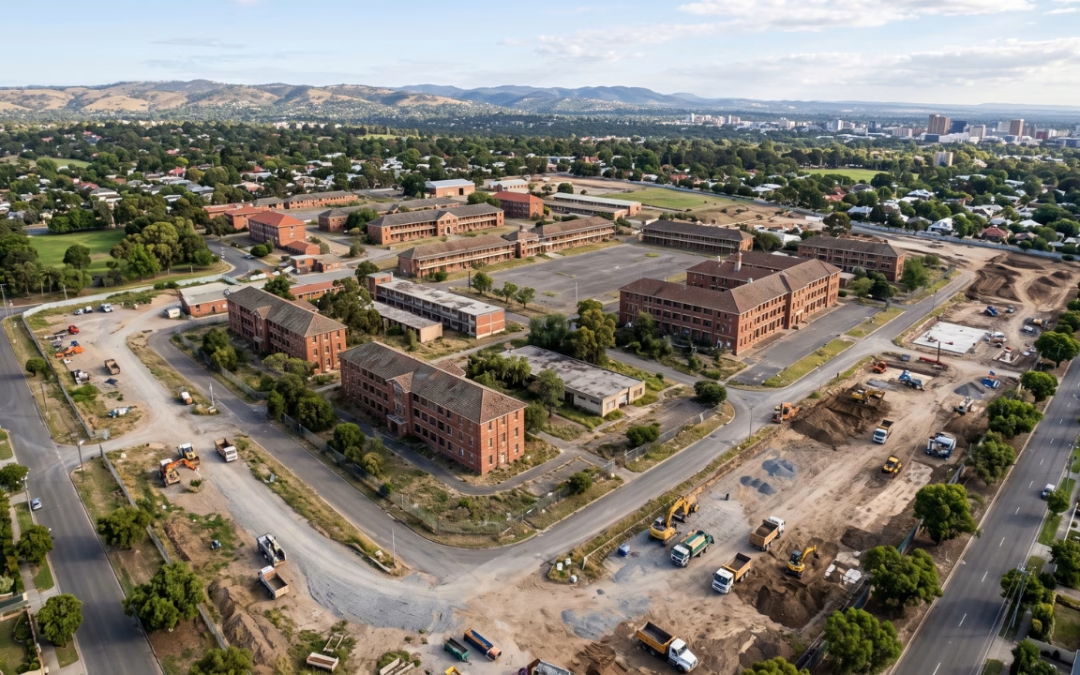
The change behind those numbers is the mix. In 2019 and 2020, medium density made up about half of what Nostra built, with detached homes at 45 per cent and knockdown rebuilds at five. Today the company puts medium density at about 90 per cent of its projects.
These are company figures. They have not been independently audited, and we have reported them as the company stated them.
Output per person rose as the mix shifted
Growth on its own is not unusual. Plenty of builders added volume over the past five years. What stands out here is that output grew faster than the team.
On our calculation, 215 homes across 49 positions is roughly 4.4 homes per position. 402 homes across 82 positions is roughly 4.9. That is an improvement of a little under 12 per cent in homes delivered per role.
The company has not attributed that gain to anything specific, and a count of positions is not the same as full time equivalent staff. But the direction is consistent with how repeat townhouse product tends to behave. Fewer one off designs. Floorplans used again and again. Several dwellings on one site sharing one set of site setups, inspections and trade visits.
Output grew faster than the team. That is the part of this story most builders will recognise, or wish they could.
Townhouse work arrives through developers, not display homes
Nostra’s own developer page sets out how the medium density side of the business works. It offers developer partners a suite of predetermined designs to suit medium density lots in estates, along with marketing and sales support, dedicated finance brokers and in house client management through to handover.
The same page lists more than a dozen land developers the company has worked with, including several of the large greenfield estate operators in Victoria.
That is a different business from selling one home to one family through a display centre. The builder is packaging a product for a developer’s lots, helping sell it, and managing buyers through settlement under a house and land arrangement.
The implications cut both ways. A developer relationship can deliver work in batches, with a pipeline that is visible well ahead. It also concentrates the book. When a large share of starts depends on a handful of land developers, their release timing and sales rates become the builder’s timing too.
What medium density means in this context
Medium density usually refers to townhouses, terraces, duplexes and low rise apartments that sit between a detached house and an apartment tower. In Victoria, the Townhouse and Low Rise Code covers developments of two or more dwellings on a lot and residential buildings up to three storeys. Nostra’s figures do not separate townhouses built in greenfield estates from infill projects in established suburbs.
The growth was measured through a downturn
The FY21 starting point matters. That year sat inside the HomeBuilder period, when approvals spiked nationally.
ABS trend data shows total dwelling approvals peaked at about 20,700 a month in March 2021 and fell to about 13,250 by February 2024. Nostra’s growth was not measured from a quiet year. It was measured from a busy one and carried through one of the tightest stretches of the cycle in recent memory.
The national picture has not moved neatly toward density since. In trend terms, private sector house approvals were up 14.4 per cent in the year to August 2026. Private sector dwellings excluding houses, a category that includes townhouses and apartments, rose 3.3 per cent.
Nostra’s result is a business decision that has worked for one builder in one market. It is not evidence of a broad swing away from detached housing.
Victoria’s planning settings now favour this type of product
Victoria’s policy settings have moved in the same direction since Nostra made its call. The Townhouse and Low Rise Code, introduced through planning scheme amendment VC267, commenced on 31 March 2025. It created a deemed to comply pathway for townhouses and apartment buildings up to three storeys.
Where an application meets a standard in the code, it cannot be refused on the basis of that standard. Where every standard is met, objectors lose the right to take the decision to VCAT.
Nostra’s shift predates the code by several years. But the code changes the risk picture for any builder weighing the same move now, particularly on infill sites where planning time has historically been the biggest unknown.
Trade relationships carry more weight on multi dwelling sites
Founder and managing director Anthony Caruana put payment at the centre of the company’s approach. “We’ve always believed that if someone does the work, they should be paid properly and on time,” he said in a statement.
On a townhouse project that is more than a values point. Trades move through several dwellings on one site, often in sequence, and a delay in one trade flows into the next across every unit. Keeping reliable trades on a medium density program is closer to a production problem than a courtesy.
It also changes the cash picture. Several dwellings in progress at once means more money committed to trades before claims come back in, which is part of why this model tends to suit builders with a strong balance sheet.
What Nostra’s numbers tell other builders
The lesson is not that every builder belongs in townhouses. The capability, the developer relationships and the cash position this model needs are real, and Nostra built them over a number of years.
What the numbers do show is that product mix is a lever on capacity, not only on sales. A builder repeating the same product for developer partners can grow volume without growing headcount at the same rate.
That is a question for any building business, whatever it builds and however long it has been going. Which parts of the book let the team do more each year, and which parts ask it to start from scratch every time?
The Good Builder Take
The 87 per cent is the number in the release. The number we would watch is the gap between output growth and team growth. It is modest, it is company reported, and it will be tested as the business aims for 450 starts. But it points at something that matters more than any single year of volume: repeatable product is one of the few ways a builder can grow without stretching the same people thinner.
For more conversations with builders who have changed how their business works, listen to The Good Builder Podcast and subscribe to our weekly eNewsletter.
Frequently asked questions
According to figures released by the company, Nostra Homes delivered 215 homes in FY21 and 402 in FY26, an increase of 87 per cent. Its team grew from 49 to 82 positions over the same period. Medium density now makes up about 90 per cent of its projects, up from about half in 2019 and 2020.
It is a set of standards in clause 55 of every Victorian planning scheme, introduced through amendment VC267 and in operation since 31 March 2025. It creates a deemed to comply pathway for townhouses and apartment buildings up to three storeys. Where an application meets a standard, it cannot be refused on the basis of that standard, and third party appeal rights to VCAT do not apply to a compliant application.
In greenfield estates, developers set aside lots for medium density product. Builders such as Nostra supply predetermined designs to suit those lots and support marketing, sales, finance and client management through to handover. The builder receives work in batches with visible timing, but its pipeline becomes tied to the developer’s release and sales rate.
Not at the moment. ABS trend data for August 2026 shows private sector house approvals up 14.4 per cent over the year, while private sector dwellings excluding houses, a category that includes townhouses and apartments, rose 3.3 per cent.
Related articles
- Australia Could Unlock One Million New Homes If It Embraces “Gentle Density”
- What the West’s Land Releases and Fitzroy’s Urban Renewal Tell Builders About What Comes Next
Last updated: 30 September 2026. ABS figures from Building Approvals, Australia, August 2026.
General Information Only: This article provides general information only and does not constitute legal, financial or professional advice. Company figures are as reported by the company and have not been independently verified. Readers should seek advice specific to their circumstances before making business decisions.

Author: TGB Editorial





0 Comments