

Three projects just got a Prescribed Project declaration. It is a coordination tool with a two year clock on it, not an approval, and it does not put a single tonne of reinforcing bar on a Queensland site any sooner than 2028.
Queensland has just declared three steel and metal recycling projects worth a combined $1.905 billion as Prescribed Projects. Two of them are reinforcing bar mills. If both get built, a state that currently has no rebar rolling mill of its own ends up with two before the end of the decade.
That is the headline. The part worth understanding is what a Prescribed Project declaration actually does, because it is not what most people assume, and the gap between the announcement and the steel is longer than the number suggests.
What the three Queensland steel projects actually are
The declarations cover three separate proposals, and the government has stated each will be assessed on its individual merits.
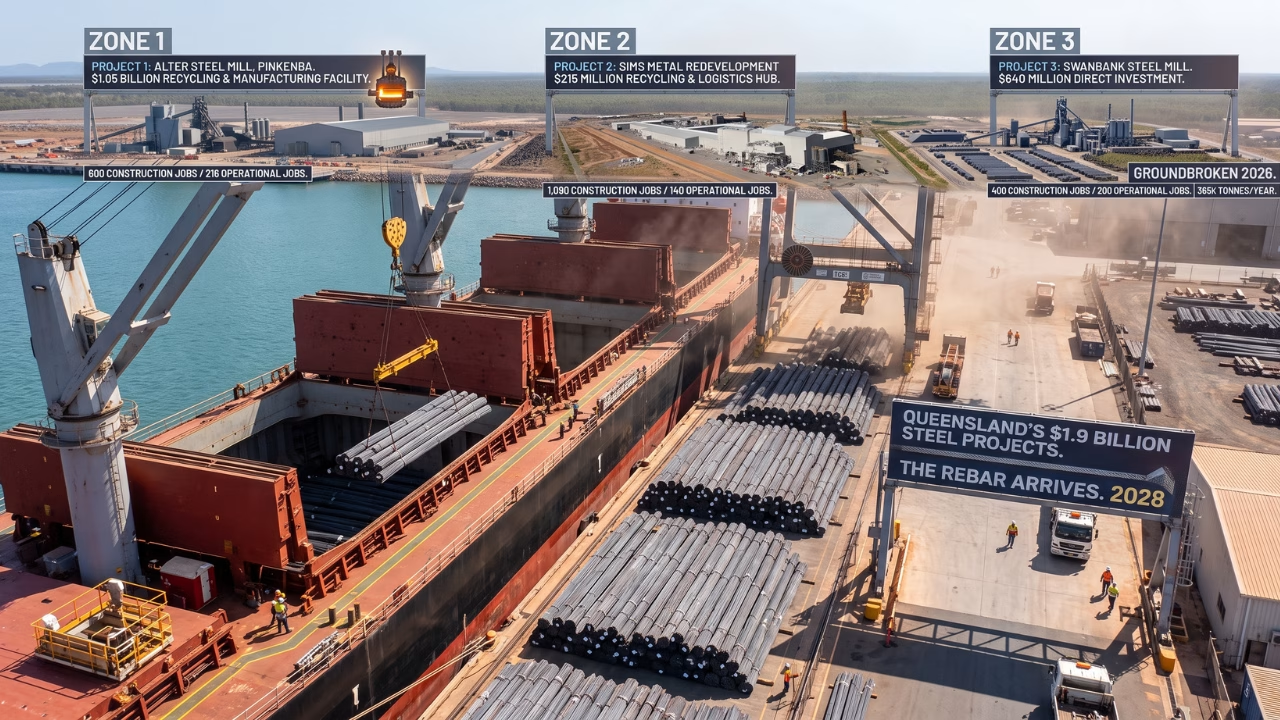
The Alter Steel Mill Project is a proposed $1.05 billion investment by Equest Steel Pty Ltd, which trades as Alter Steel, to build a steel recycling and manufacturing facility on a 23 hectare site at Pinkenba. The government release puts it at up to 600 construction jobs and 216 operational jobs. Alter Steel’s own published project milestones have main construction beginning in 2027 and first steel produced in 2028 or later.
The Swanbank Steel Mill Project is a $640 million direct construction investment by Future Forgeworks Pty Ltd inside the NewGen Business Park industrial estate at Swanbank, in the City of Ipswich. More than 400 construction jobs and up to 200 operational jobs. This one is furthest along. It broke ground in March 2026, and the company describes an SMS group mill design producing 365,000 tonnes of reinforcing bar and coil a year.
The Sims Metal Pinkenba Redevelopment Project is an approximately $215 million staged redevelopment of Sims’ existing waterfront site at Pinkenba into an integrated metal recycling, processing and logistics hub. It carries the biggest construction workforce of the three at roughly 1,090 jobs, and 140 operational roles.
Add them up and you get $1.905 billion, a little over 2,000 construction jobs and a little over 550 operational roles. Those job figures are a mix of ceilings and floors rather than firm numbers, which is why the government has stated them as ranges rather than totals. The three projects are also connected. Sims and Alter Steel signed a memorandum of understanding in 2025 covering the supply of up to 550,000 tonnes of ferrous scrap a year to the Pinkenba mill, roughly a kilometre away. The feedstock project and the mill that consumes it are being coordinated together.
A declaration is a coordination instrument with a clock on it, not a green light.
What a Prescribed Project declaration does and does not do
This is the part that gets misread every time one of these is announced.
A Prescribed Project declaration is made under Part 5A of the State Development and Public Works Organisation Act 1971. It is made by the Minister, by gazette notice, not by the Coordinator-General, and it does not grant anything. It does not approve a development application, issue a permit, or remove a single assessment requirement. The Queensland Coordinator-General made that point directly in the announcement, describing the status as a framework for progressing efficiently while all relevant assessment requirements stay in place.
What the declaration does is switch on a set of statutory powers held by the Coordinator-General over the entities doing the deciding.
Under the Act, the Coordinator-General can issue a progression notice requiring a decision maker to complete an administrative process within a stated period. A notice to decide requires a decision maker to actually make a decision within a stated period and report back within five business days. And a step in notice, which needs the Minister’s approval, hands the decision itself to the Coordinator-General, who then holds all the powers of the original decision maker. That transfer runs only until the Coordinator-General decides, and the Act lets him send the decision back to the original decision maker, with or without conditions.
The step in power has teeth. Once the Coordinator-General makes a decision under it, the Act says a person may not appeal against that decision under the Act or under the relevant law. Any appeal or review already on foot is of no further effect. Where the decision is on a development application, a referral agency’s role is cut back to giving advice only, until the Coordinator-General decides.
Part 5A also applies despite any other law.
Prescribed Project, in plain terms
A Prescribed Project is a project declared by the Queensland Minister for State Development under section 76E of the State Development and Public Works Organisation Act 1971. The declaration does not grant approval. It activates the Coordinator-General’s powers to set deadlines on other decision makers, and in defined circumstances to take over a decision entirely, with no right of appeal against the resulting decision. A declaration ends two years after it is made, or at a later stated time, and the Minister can extend it by gazette notice for no longer than the original period.
Why the two year clock on the declaration matters
Section 76F of the Act puts an end date on it. A declaration ends two years after the day it is made, or at a stated later time if one is specified. The Minister can extend it by gazette notice, but not for longer than the initial period.
Put that against the project timelines. Alter Steel has main construction planned for 2027 and first steel in 2028 or later. Future Forgeworks has said it intends to supply reinforcing steel locally from 2028. Sims is staging a redevelopment.
So the coordination window and the delivery window do not sit neatly on top of each other. The declaration is aimed squarely at the approvals and infrastructure interface work happening now, the energy connections, the road and rail interfaces, the utility agreements. It is not a standing arrangement for the life of the build.
What this changes for builders buying steel
Nothing before 2028. That is the honest read.
Queensland does not currently produce its own reinforcing bar. The state government’s own release acknowledges Queensland imports a significant proportion of its reinforcing steel and other steel products from interstate and overseas. Builders have felt what that exposure costs, through the anti dumping duties applied to imported steel through 2026 and through the disruption when a single ageing blast furnace goes offline.
Two local mills would change the structure of that market. Pinkenba sits about 10 kilometres from the Brisbane CBD and Swanbank about 43. Rebar rolled at either is a different supply proposition to rebar on a ship.
There is a detail worth noting before anyone prices that in. Alter Steel lists supply agreements secured for 100 per cent of annual production among its completed 2025 milestones, alongside letters of support from five Tier 1 builders. If that holds through to commissioning, the Pinkenba mill’s output is spoken for before it makes anything, and the volume reaching the general market is a question about what happens after those agreements, not on day one. Future Forgeworks has not published an equivalent offtake position for Swanbank.
The practical horizon for a builder is that steel priced and delivered from a Queensland mill is a 2028 conversation at the earliest, and a 2029 or 2030 one for volume outside committed contracts. Fixed price work being tendered now sits entirely inside the old supply structure. So does most of the Olympic and hospital pipeline work already in procurement.
The thing to actually watch
Declarations are cheap. Final investment decisions are not.
Swanbank has broken ground, which is the strongest signal of the three. Alter Steel has secured a site, technology supply, offtake agreements and an engineering partner, but main construction is still a 2027 item. Sims is redeveloping an operating site in stages.
The useful indicator over the next twelve months is not another government announcement. It is whether the Coordinator-General issues progression notices or notices to decide on any of the three, and whether any of them is escalated again to a State strategic project, which unlocks a further set of powers under the same Part. Those notices are the mechanism doing real work, and they are the difference between a declaration that coordinated something and a declaration that sat there until the clock ran out.
That, rather than the $1.9 billion, is the number that tells you whether these mills are coming.
THE GOOD BUILDER TAKE
Two rebar mills in one state is a genuine structural shift for Australian construction supply, and Queensland has spent years importing something it now proposes to make. But a declaration is a process tool, not a commitment, and Alter Steel has already contracted all of its planned output. Work priced for 2027 and 2028 sits inside the supply chain that exists, not the one that has been announced. If the mills land, that is upside. It is not a plan.
Frequently asked questions
A Prescribed Project is a project declared by the Queensland Minister for State Development under section 76E of the State Development and Public Works Organisation Act 1971, by gazette notice. The declaration activates the Coordinator-General’s powers to require other decision makers to complete processes and make decisions within set periods, and in defined circumstances to step in and make a decision directly. It is not an approval.
No. The declaration does not remove any statutory approval or assessment requirement. The Queensland Coordinator-General stated as much when the three steel projects were declared. The relevant laws continue to apply to the decisions and processes involved. What changes is that the Coordinator-General can set deadlines on those processes and, with the Minister’s approval, take over a specific decision until he makes it or sends it back.
Not under the Act or the relevant law. Section 76P provides that a person may not appeal against a Coordinator-General decision made under the step in power, and section 76N provides that any appeal or review already started in relation to that decision or process is of no further effect.
Future Forgeworks has said the Swanbank mill is intended to supply reinforcing steel locally from 2028, and the project broke ground in March 2026. Alter Steel’s published milestones have main construction beginning in 2027 and first steel produced in 2028 or later. Neither affects steel supply or pricing before then.
The government release describes no state funding. The three projects are stated as $1.905 billion in private sector investment: $1.05 billion by Equest Steel Pty Ltd at Pinkenba, $640 million by Future Forgeworks Pty Ltd at Swanbank, and approximately $215 million by Sims at Pinkenba. What the government has provided in this announcement is the Prescribed Project declaration and the coordination that comes with it.
Related articles
- Australia Just Built a Tariff Wall Around Chinese Steel. Here Is What It Adds to Your Build Costs in 2026
- The Whyalla Blast Furnace Is Down Again. For Builders, the Question Is How Prepared They Are.
Last updated 23 September 2026.
General information only. This article does not constitute procurement, legal or financial advice. Readers should seek independent guidance for specific supply chain and contracting decisions.


0 Comments