

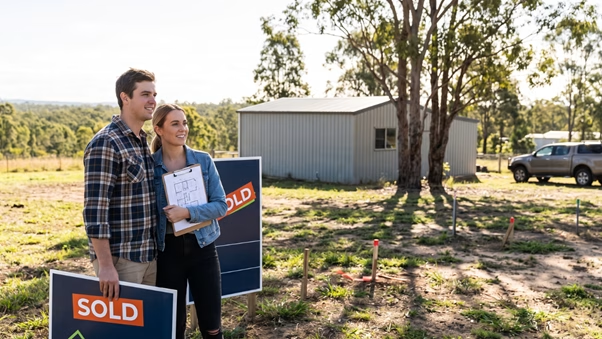
New laws passed this week mean a shed on the block no longer automatically rules out the first home vacant land concession, and homes built under builders’ terms arrangements are confirmed as new for both the grant and the duty concession.
A garden shed could cost a Queensland first home buyer their transfer duty concession. Under legislation passed by State Parliament on 13 October, that is about to change.
The Home Ownership and Other Legislation Amendment Bill 2026 is mostly a technical clean up of revenue law. But two of its fixes sit right where builders do business: blocks with existing structures, and homes built under builders’ terms arrangements.

What does the Home Ownership and Other Legislation Amendment Bill change?
Treasurer David Janetzki introduced the Bill on 23 April. It was examined by Parliament’s Governance, Energy and Finance Committee and passed with amendments on 13 October, according to the parliamentary record.
As introduced, it amends five revenue Acts. Amendments made in debate added unrelated competition policy changes to four other Acts, none of them touching the housing clauses. The explanatory notes describe the revenue changes as technical, with costs met within existing budgets.
Why could a shed rule out the vacant land concession?
Queensland gives first home buyers a transfer duty concession when they buy vacant land to build and live in their first home. Since 1 May 2025, the Queensland Government says that concession can reduce duty to nil.
The catch was the definition. Under the Duties Act, land only counted as vacant if there was no building, or part of a building, on it when it was bought. A garden shed or carport was enough to fail the test.
The new law changes that. Land will count as vacant if every existing structure is what the Act now calls an eligible building. In plain terms, a structure only rules the land out if it is fixed to the land and is either designed or council approved as a single family home, or is a Class 1 to 9 building under the Building Code of Australia.
The explanatory notes confirm Class 10 structures, which include sheds, are not excluded on their class alone. Revenue Office officers told the Committee in April that sheds and carports are the target.
Officers said many other jurisdictions assess vacant land administratively rather than defining it in law. Queensland has drawn the line using Building Code classes and whether a structure is designed or approved as a home.
A garden shed or carport was enough to fail the test.
What still rules a block out?
The buyer still has to build a new home, separate from anything already on the land, and live in it. Renovating or moving into the existing structure does not count.
Land with an existing house, or a commercial or industrial building, stays ineligible. Officers said a shed with living quarters should be fine if those quarters are not designed or approved as a home, and a condemned dwelling would be assessed case by case.
Timing matters. The vacant land change applies only where duty liability arises on or after the law commences, which is on assent. The old definition still applies where a contract replaces one signed before assent, where an option granted before assent is exercised after it, or where another arrangement was made before assent mainly to delay the purchase.
How does a builders’ terms arrangement affect a first home buyer?
Builders’ terms is a familiar estate structure. A licensed builder contracts to buy a lot from a developer, builds on it, and settles on the land once the home is finished. Revenue Office officers told the Committee it is normally used to help builders with cash flow.
The problem sat in the definition of a new home. A home only counts as new if it has not previously been occupied or sold as a place of residence. When the developer transfers the finished house and land to the builder, that first sale can technically take the home out of the new category before the first home buyer ever signs.
Since December 2020, the Queensland Revenue Office has handled this for the First Home Owner Grant through an administrative arrangement, set out in Public Ruling FHOGA006.2.1.
The new law writes that position into the Act for the grant. For the first home (new home) duty concession, which the ruling never covered, the same protection is new. A home previously sold only under a builders’ terms arrangement can still be a new home, provided the builder is licensed under the QBCC Act and the home is ready to occupy, with a final inspection certificate issued, before the land contract settles.
For the grant, the change is backdated to transactions from 1 December 2020. For the first home (new home) duty concession, it applies to liabilities arising from 1 May 2025, when that concession began.
What is a builders’ terms arrangement?
Under Queensland’s new definition, a builders’ terms arrangement is one where a builder licensed under the Queensland Building and Construction Commission Act 1991 contracts with a land developer to buy a vacant lot, is allowed to enter the land and build a home before settlement, and the home is ready for occupation with a final inspection certificate under the Building Act 1975 before the land contract settles. A home sold only under this kind of arrangement can still be a new home for first home buyer purposes.
What else in the Bill touches builders and their buyers?
Shared equity buyers are covered. Participants in the State’s Boost to Buy and the Commonwealth’s Help to Buy schemes are treated as full owners for transfer duty, the grant and the land tax home exemption, backdated to when each scheme opened in December 2025. Later buy backs will not attract duty.
The grant’s residence rules will tighten. Once the law commences, a reason to vary the requirement to live in the home must be outside the applicant’s control and actually prevent compliance, reversing a broader reading in a 2024 tribunal decision.
The Commissioner’s power to exclude two or more persons together from a payroll tax group, where their businesses run independently of the rest of the group, will be written into the Act. It has been applied administratively with effect from 31 October 2018.
How does Queensland’s building pipeline compare with other states?
The latest ABS Building Activity data shows 52,567 dwellings under construction in Queensland at the end of June 2026, in original terms. That is up 35.6 per cent on the 38,767 recorded two years earlier.
It is the fourth quarter in a row above the previous high of 42,625, set in September 2016.
Among the states, Queensland’s growth leads. Over the same two years, Western Australia rose 24.9 per cent, New South Wales 9.4 per cent and Victoria 1.1 per cent. Nationally, 248,733 dwellings were under construction, the highest in a series running back to 1984.
Most of Queensland’s construction pipeline is not detached houses. Of the June total, 18,288 were new houses and 34,099 were new townhouses, apartments and other residential dwellings.
On ownership, KPMG modelling puts Queensland’s owner occupier rate at 64.9 per cent in 2025, up from 63.9 per cent in 2021. KPMG describes the 2025 estimate as preliminary.
Which first home buyers are using the duty concession?
Government figures show where first home buyer duty relief has actually gone. In the 11 months to March 2026, 1,988 transactions that received relief were vacant land purchases, against 659 new homes, according to a ministerial statement issued in May.
The government later said more than 3,500 Queenslanders had benefited from stamp duty relief on new homes by June, saving more than $66 million. These are government figures.
The split is telling. Among first home buyers getting duty relief on a new build, land and build is the dominant path, and that is the concession the shed change widens.
Where this leaves builders
Neither change is large on its own. Both remove a way a concession could fall over on a technicality unrelated to the home being built.
For builders on acreage and lifestyle blocks, an existing shed stops being an automatic disqualifier once the law commences. For builders working builders’ terms in new estates, the grant protection that existed only by ruling now sits in legislation, and the duty concession gains the same protection, backdated to 1 May 2025.
Licensing, final inspection certificates and settlement timing are now written into the test itself.
We will report commencement once assent is confirmed. For more on Queensland housing, subscribe to The Good Builder and listen to the podcast.
Frequently asked questions
Once the new law commences on assent, generally yes. A structure only rules the land out if it is fixed to the land and is either designed or council approved as a single family home, or is a Class 1 to 9 building under the Building Code of Australia. Sheds and carports generally qualify unless designed or approved as a home. The buyer must still build a new, separate home on the land and live in it.
It is an arrangement where a licensed builder contracts with a developer to buy a vacant lot, builds a home on it before settlement, and the home is ready for occupation with a final inspection certificate before the land contract settles.
Yes. The Queensland Revenue Office has treated these homes as new for the grant since December 2020 under Public Ruling FHOGA006.2.1. The new law puts that into legislation, backdated to transactions from 1 December 2020, and extends the same treatment to the first home (new home) duty concession from 1 May 2025.
The vacant land change applies to transactions where duty liability arises on or after assent. The builders’ terms changes are backdated to 1 December 2020 for the grant and 1 May 2025 for duty. The shared equity changes are backdated to 15 December 2025 for Boost to Buy and 5 December 2025 for Help to Buy.
Related articles
- What Australia’s construction data really shows in 2026
- Queensland Budget 2026/27: a record build and a bigger housing bet
- Queensland abolishes stamp duty on new homes for first home buyers
Last updated 15 October 2026. Building activity figures are from ABS Building Activity, Australia, June quarter 2026, released 7 October 2026, and may be revised in the next release on 13 January 2027.
General Information Only: This article is for general information only and does not constitute legal, financial or tax advice. Eligibility for concessions and grants depends on individual circumstances. Readers should check with the Queensland Revenue Office or seek professional advice before acting on any information in this article.

Author: TGB Editorial





0 Comments