


The Commission has published Counsel Assisting’s submission backing a Building and Construction Code and an independent regulator, with draft implementation guidelines attached. Here is what it means and how to have your say.
The Queensland construction industry has spent months being asked a question. It is now being handed a draft answer.
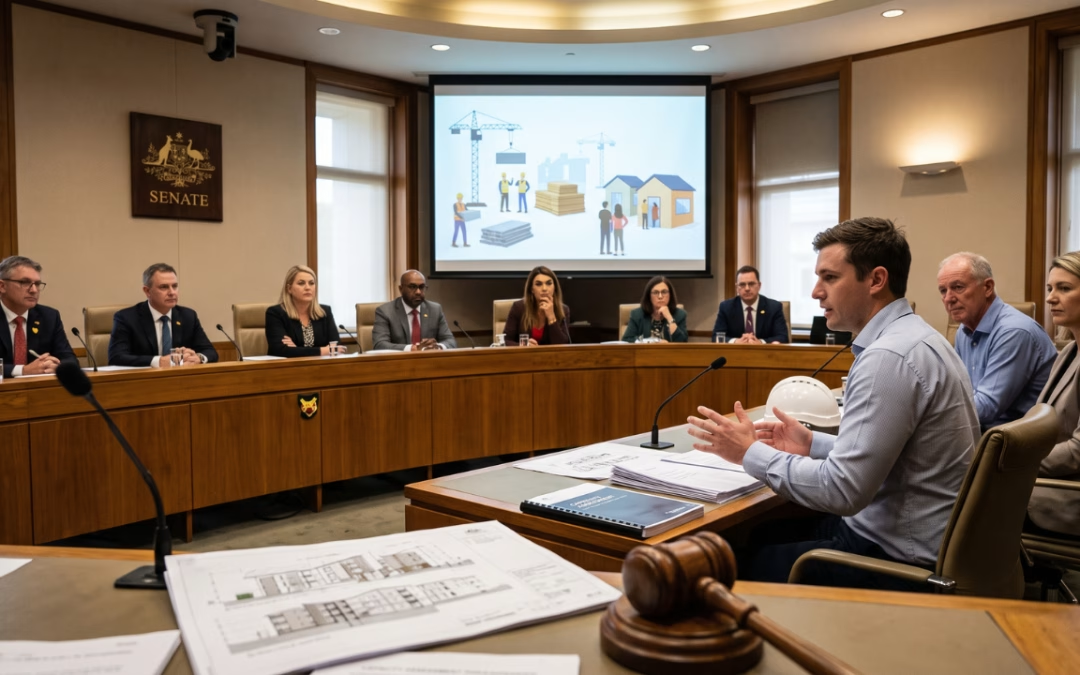
On 4 July 2026, the Commission of Inquiry into the CFMEU published a further submission from Counsel Assisting backing the introduction of a Building and Construction Code and the establishment of an independent regulator to enforce it. Unlike the earlier rounds of consultation, this submission comes with draft Implementation Guidelines attached at Annexure 2. That is the part worth paying attention to, because guidelines are where a policy stops being an idea and starts becoming a set of rules you have to work within.
The Commission is inviting written responses by 4pm on Friday, 24 July 2026, sent to [email protected].
If you tender for government work in Queensland, or you subbie to anyone who does, this is a process that could change the rules of who gets to bid. Here is where it sits, what a code and a regulator actually involve, and what to do before the window closes.
How we got here
This did not come out of nowhere. It has been a staged consultation, and each stage has narrowed the focus.
The starting point was the Commission of Inquiry into the CFMEU, which opened its public hearings in Brisbane in October 2025 and has since worked through block after block of evidence about conduct on Queensland worksites. That evidence is the backdrop to everything that follows. It is why a code is being discussed at all.
In March 2026, the Commission released a discussion paper canvassing the reintroduction of an amended building and construction code in Queensland. It asked the open questions: is a code desirable, what should it contain, when should it start, and how should it be enforced.
On 14 April 2026, Counsel Assisting made submissions supporting both a code and an independent regulator. The 4 July submission builds on that and adds the draft guidelines.
Read in sequence, the direction is clear. The industry started by being asked whether. It is now being asked to respond to a draft.
What a construction code actually is
First, clear up what this is not. A building and construction code in this sense is not the National Construction Code, and it is not a safety standard. It is a code of conduct attached to government money.
In plain terms, it sets standards of behaviour a business must meet to be eligible to tender for, or be awarded, government-funded building work. Meet the standards and you can bid. Breach them and you can be shut out of that work for a period.
Australia has run exactly this model before, federally. The Code for the Tendering and Performance of Building Work operated nationally until it was repealed in late 2022, and it was enforced by the Australian Building and Construction Commission. Under that framework, contractors had to prove their eligibility before winning Commonwealth-funded work, their enterprise agreements could not contain certain restrictive clauses, and a business found in breach could cop an exclusion sanction locking it out of government work for up to a year.
That federal code is gone. What the Commission is now weighing is a Queensland version, run by a state body, aimed squarely at the conduct the Inquiry has spent the past year documenting.
The March discussion paper gave a sense of the kind of measures on the table. It flagged restrictions on productivity-limiting clauses in enterprise agreements, limits on “jump-up” provisions that push obligations down the contracting chain, and clearer safeguards around right-of-entry so that safety concerns cannot be used as cover for industrial tactics. None of that is settled. But it tells you where the thinking is pointed.
Why the regulator is the other half of the story
A code without a regulator is a rulebook with no referee. That is why Counsel Assisting has paired the two.
The federal experience makes the point. When the national code existed, the ABCC assessed eligibility, monitored compliance, and referred breaches for sanction. When the ABCC was abolished, that enforcement work was folded into the Fair Work Ombudsman and safety regulators. The regulator is what gives a code its teeth. Without one, a code is just a document.
For Queensland, an independent regulator would be a new body with a defined remit over publicly funded construction. The draft Implementation Guidelines are where the shape of that remit begins to be spelled out, which is precisely why the response window matters. This is the stage where scope, powers and process are still open to input, before anything hardens into a recommendation in the final report.
What it could mean on the ground
For most residential builders who never touch government work, a code would not change your day to day directly. Its reach is government-funded projects, not private new builds.
But do not switch off, because the indirect effects are real.
Codes like this flow down the contracting chain. On federally funded work, head contractors had to make sure their subcontractors met the eligibility rules too. A Queensland code built on the same logic would mean that if you subcontract to a builder delivering state-funded housing or infrastructure, the code’s requirements could reach you through that head contractor’s obligations. You do not have to hold the head contract to be caught by it.
There is a competition angle as well. Being excluded from government work is a commercial event. A business locked out of state tenders for a period loses a pipeline while its competitors keep theirs. That is why the eligibility rules, and how a regulator applies them, are not dry procedure. They decide who gets to bid.
And there is an upside worth naming. A code sets a documented standard of conduct, and for builders who already run clean sites and compliant agreements, that formalises the gap between them and operators who cut corners. The businesses that keep their licensing and compliance obligations in order are the ones best placed to benefit rather than scramble if a code lands.
How this fits the reforms already underway
The code proposal is not happening in a vacuum. Queensland has been rewriting the rules of government construction for more than a year.
The state has already moved to permanently remove Best Practice Industry Conditions and scrap subcontractor pre-qualification on government projects, both confirmed in this year’s state budget and both flowing from the Queensland Productivity Commission’s construction review. Those changes stripped one set of conditions off state work. A code would add a different set, focused on conduct and eligibility rather than wages and labour arrangements.
The through-line is the same across all of it. The state is reshaping what it takes to work on government-funded construction. The BPIC changes came off the productivity review. The code proposal is coming off the CFMEU Inquiry. Different doors, same building.
The timeline just got a lot longer
One correction for anyone tracking this closely, because a lot of coverage still carries the old date. The Inquiry’s final report was originally due by 31 July 2026. That deadline has moved.
In late May 2026, the Queensland Government granted the Commission an 18-month extension, pushing the final report out to 3 December 2027. Commissioner Stuart Wood AM KC requested it, citing the volume of evidence and the time needed to cross-examine witnesses.
That changes how you should read the 24 July window. It is a near-term deadline sitting inside a process that now runs well into 2027. Responding to this submission is not the last word on a code. But it is an early one, and early input on a draft tends to carry more weight than a comment made after positions have set.
What to do now
If your business tenders for Queensland Government construction work, or you subbie to firms that do, the practical steps are straightforward.
Read the submission and the draft Implementation Guidelines on the Commission’s website. Work out where they would touch your eligibility, your enterprise agreements, or your subcontracting arrangements. If you have a view, put it in writing to [email protected] before 4pm on 24 July. Consultation windows on something this consequential do not come around often, and the businesses that engage now are the ones helping shape rules they will later have to follow.
THE GOOD BUILDER TAKE
A code and a regulator would not touch most private residential work directly. But if any part of your income comes off government-funded jobs, or off head contractors who chase them, this is your window to have a say before the rules are written.
The smart move is not to wait for the final report in December 2027. It is to read the draft now, work out where it touches your business, and put your view in before 24 July while the guidelines are still soft.
The bottom line
A Queensland construction code backed by an independent regulator would be one of the biggest changes to government construction procurement the state has seen in years. The draft is on the table. The shape of it is still up for grabs, and for once the industry has a real chance to shape it rather than just live with it.
Want to stay across how the Inquiry plays out from here? Follow The Good Builder and tune into the podcast, where we break down what the reforms actually mean for the people doing the work.
Last updated: July 2026
This article is intended for general information purposes only and does not constitute legal, financial, or professional advice. Laws, regulations, and industry requirements vary by state and territory and change over time. Builders and trades professionals should seek independent advice relevant to their specific circumstances before making business, legal, or financial decisions.
Related Articles:
The Construction Corruption Inquiries Are Heating Up Again, and the Focus Is Shifting to Victoria
Your Questions Answered
It is a code of conduct attached to government-funded building work. It is not a safety standard and it is not the National Construction Code. What it does is set the standards of behaviour a business has to meet to be eligible to tender for, or be awarded, state-funded construction work. Meet them and you can bid. Breach them and you can be locked out of that work for a period. Australia ran the same model federally through the Code for the Tendering and Performance of Building Work until it was repealed in late 2022. The version now on the table is a Queensland one, aimed at the conduct the CFMEU Inquiry has spent the past year documenting.
Anyone with an interest in Queensland’s construction industry can lodge a written response. The businesses with the most skin in the game are the ones that tender for government work, and the subbies who work for them, because a code like this flows down the contracting chain. Industry bodies, unions, head contractors, subcontractors and individual builders are all free to have their say.
4pm on Friday, 24 July 2026. Written responses go to [email protected]. The submission and the draft Implementation Guidelines are available on the Commission’s website.
It is the body that would actually enforce a code. A code on its own is a rulebook with no referee, which is why Counsel Assisting has proposed the two together. Under the old federal model, the Australian Building and Construction Commission assessed eligibility, monitored compliance and referred breaches for sanction. A Queensland regulator would be a new state body with a defined remit over publicly funded construction. It is the part that gives a code its teeth.
3 December 2027. It was originally due by 31 July 2026, but in late May 2026 the Queensland Government granted the Commission an 18-month extension, citing the volume of evidence and the time needed to cross-examine witnesses. A lot of older coverage still carries the 31 July 2026 date, so it pays to be precise.


0 Comments