


The referral itself is routine. What sits inside the ten point terms of reference is not.
On 20 August 2026, the Senate referred the question of social housing to its Economics References Committee for inquiry and report by 1 March 2027. Submissions close on 24 September 2026.
That much is ordinary. Parliament has run inquiries into housing supply, affordability, home ownership and tax settings repeatedly over the past decade. Most have landed with a report rather than a change.
The terms of reference are the part worth reading.
Ten matters, and two of them are about the industry
The Senate referred ten matters. Eight are what you would expect from a social housing inquiry: the economic and social benefits of investment, the historical decline of public housing as a share of national stock, the case for setting a target, the impact of current Commonwealth and state spending including the Housing Australia Future Fund and the Social Housing Accelerator, opportunities for further investment, governance and administrative arrangements, the efficacy of rent to buy schemes, and the standard catch all.
The fifth and sixth are different.
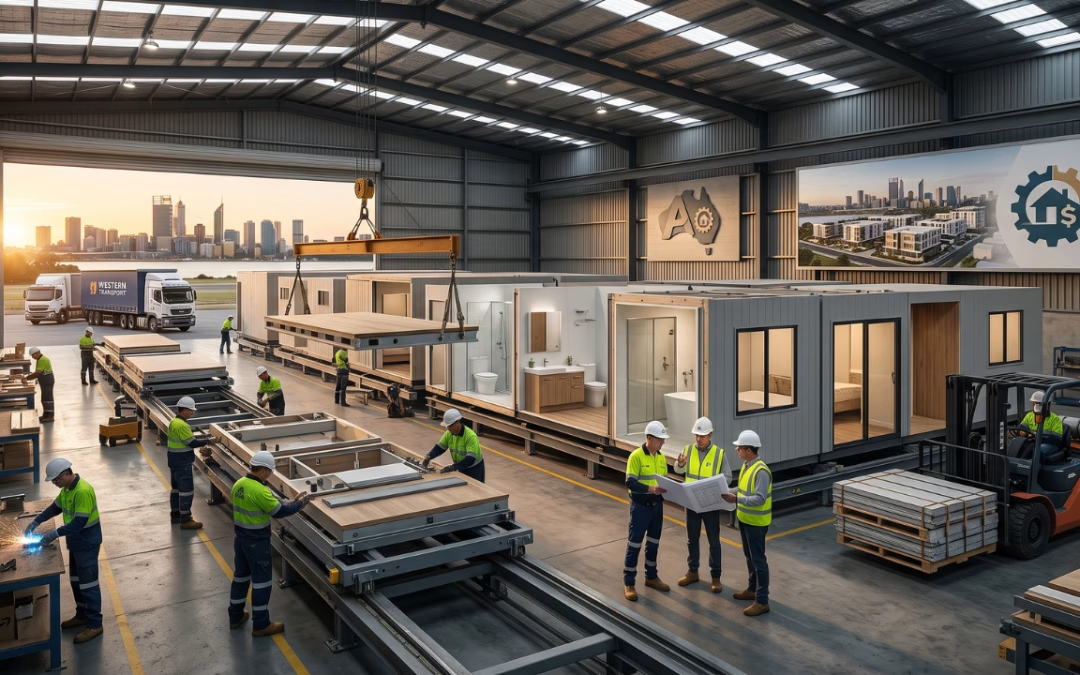
The fifth asks the committee to examine the role of modern methods of design and construction in building more social homes and creating communities with a high quality of life. It pairs volume with something governments do not always pair it with, which is improving build quality and construction methods rather than simply lifting output. Modelling published earlier this year put uptake of modern methods of construction in Australia at 5 to 8 per cent of building construction, well behind comparable economies.
The sixth asks the committee to examine the benefits of a steady pipeline of social housing investment for the development of Australia’s modern construction industry.
The Senate is not asking whether the industry can absorb the work. It is asking whether the work can be used to build the industry.
That is an unusual thing for a social housing inquiry to ask. It treats the build programme as industrial policy rather than welfare spending, and it puts the question of capacity on the record before the first submission is lodged.
The evidence already on the record
The committee does not start from a blank page. Five weeks before the referral, the Auditor General reported on Treasury’s design and delivery of the Housing Australia Future Fund and the National Housing Accord Facility.
Auditor General Report No. 3 of 2026 to 2027, released on 21 July 2026, found Treasury’s design of the fund was largely effective and its delivery arrangements only partly effective. It made five recommendations covering governance, risk management, and performance measurement and reporting. Treasury agreed to all five.
The audit also put a number on delivery. As at April 2026, 1,432 homes had been built against the 40,000 target. Under the current structure, 30,000 of those homes sit under the Housing Australia Future Fund and 10,000 under the National Housing Accord Facility, both due by 30 June 2029.
The composition of that 1,432 is the part builders should read closely. The audit records 762 as new homes constructed by housing providers. The other 670 were newly constructed homes developed by private industry and then purchased by a housing provider.
Just under half of everything delivered under the programme to date came from private builders building homes and community housing providers buying them.
That is a delivery route, not a footnote, and it sits directly inside the seventh term of reference, which asks the committee to consider direct public spending alongside different delivery and investment models.
The scale the committee is contemplating
The third term of reference asks whether Australia should set a target for social housing as a proportion of total housing stock. The arithmetic behind that question determines the size of the build, so it is worth setting out.
The Productivity Commission’s Report on Government Services, updated on 3 June 2026, counts 450,607 social housing dwellings nationally at 30 June 2025, housing 429,567 households. The Australian Bureau of Statistics counts 11,495,200 residential dwellings in Australia at the March quarter of 2026.
Those two figures carry different reference dates, so the ratio is approximate. It puts social housing at just under 4 per cent of national dwelling stock.
Lifting that to 5 per cent, holding total stock flat, would take roughly 131,000 additional social homes. Total stock will not hold flat, so the real figure is higher.
For comparison, the entire 40,000 home target across both programmes, delivered in full and on time by mid 2029, moves the share from just under 4 per cent to about 4.25 per cent. A target of any ambition therefore implies sustained build volumes well beyond what is currently contemplated, and sustained volume of that order would change the shape of the residential construction market.
Which is why the pipeline question in the sixth term of reference is not rhetorical. Predictable volume is the precondition for investment in automation, offsite manufacturing and workforce development. Without it, the capability the fifth term of reference asks about does not get built, because nobody funds a factory for a programme that might end.
The stock picture underneath
The Report on Government Services also shows what has been happening to the composition of social housing, and it is not a single trend.
Households in public housing fell from 312,219 in 2016 to 285,256 in 2025. Over the same period, households in community housing rose from 72,038 to 110,326. Part of that shift reflects the transfer of public housing stock, by management or by title, to the community housing sector.
State and territory net recurrent expenditure on social housing was $5.9 billion in the 2024 to 2025 financial year, up $0.4 billion on the year before. Capital expenditure was $4.9 billion. Commonwealth funding under the National Agreement on Social Housing and Homelessness was $1.9 billion.
On the demand side, half of newly allocated public housing households in 2024 to 2025 waited nine months or less. Three quarters waited 36 months or less.
Industry response
The Housing Industry Association has publicly welcomed the referral. Its stated position is that the central question is not whether Australia needs more social housing but how governments remove the barriers to building housing of all types, and that the inquiry should test whether current delivery models are making full use of the detached housing sector’s capacity. It also argues that social housing outcomes cannot be separated from the planning delays, infrastructure constraints, workforce shortages and construction costs affecting every part of the market.
What happens next
Submissions close on 24 September 2026. As at 24 August, the committee had published no submissions and scheduled no public hearings. The reporting date is 1 March 2027.
For context on what the inquiry is examining, the Social Housing Accelerator named in the fourth term of reference was a $2 billion payment announced on 17 June 2023 and paid straight to the states and territories, expected to produce around 4,000 new, refurbished and acquired homes.
The Good Builder Take
Most housing inquiries ask what governments should spend. This one also asks what the spending should build, and whether a predictable pipeline could leave the construction industry more capable than it found it.
The two industry facing terms of reference matter because they change what evidence is relevant. A submission about factory capacity, standardised design, or the lead time a manufacturer needs before committing capital is now squarely within scope. So is the observation that 670 of the first 1,432 homes came from private builders building and providers buying, which is the delivery model least discussed and, on the numbers, close to the most productive.
Whether the committee does anything with that is a separate question. Inquiries have a long history of naming problems and stopping there. But the questions on the paper are the right ones, and the window to answer them closes on 24 September.
Frequently asked questions
On 20 August 2026 the Senate referred the matter of social housing to the Senate Economics References Committee for inquiry and report. The committee is examining ten matters, including the economic and social benefits of social housing investment, the historical decline of public housing as a share of national stock, whether Australia should set a social housing target, the impact of the Housing Australia Future Fund and the Social Housing Accelerator, delivery and investment models, governance arrangements and the efficacy of rent to buy schemes. Two of the ten terms of reference deal directly with the construction industry.
Submissions close on 24 September 2026. The committee is due to report by 1 March 2027. As at 24 August 2026 no submissions had been published and no public hearings had been scheduled. Submissions are lodged through the committee page on the Parliament of Australia website.
Two of the ten terms of reference name the industry directly. The fifth asks about the role of modern methods of design and construction in building more social homes. The sixth asks about the benefits of a steady pipeline of social housing investment for the development of Australia’s modern construction industry. Together they open the inquiry to evidence about factory capacity, standardised design, procurement structure and the lead times manufacturers need before committing capital, which is not usually in scope for a social housing inquiry.
The Auditor General reported on 21 July 2026 that 1,432 homes had been built as at April 2026, against a combined target of 40,000 homes by 30 June 2029 across the Housing Australia Future Fund and the National Housing Accord Facility. Of those 1,432, some 762 were new homes constructed by housing providers and 670 were newly constructed homes developed by private industry and then purchased by a housing provider.
The Productivity Commission counted 450,607 social housing dwellings nationally at 30 June 2025. The Australian Bureau of Statistics counted 11,495,200 residential dwellings at the March quarter of 2026. The two counts carry different reference dates, but together they put social housing at just under 4 per cent of national dwelling stock. Public housing has been declining in absolute terms while community housing has grown, partly through transfers of stock from state housing authorities to community housing providers.
This article is general information only. It reflects the status of the Senate Economics References Committee inquiry into social housing as at 24 August 2026 and does not take into account the circumstances of any particular business. Inquiry timelines, submission arrangements and government programme details can change. Readers should confirm current details with the relevant committee or agency before acting on anything set out here.



0 Comments