

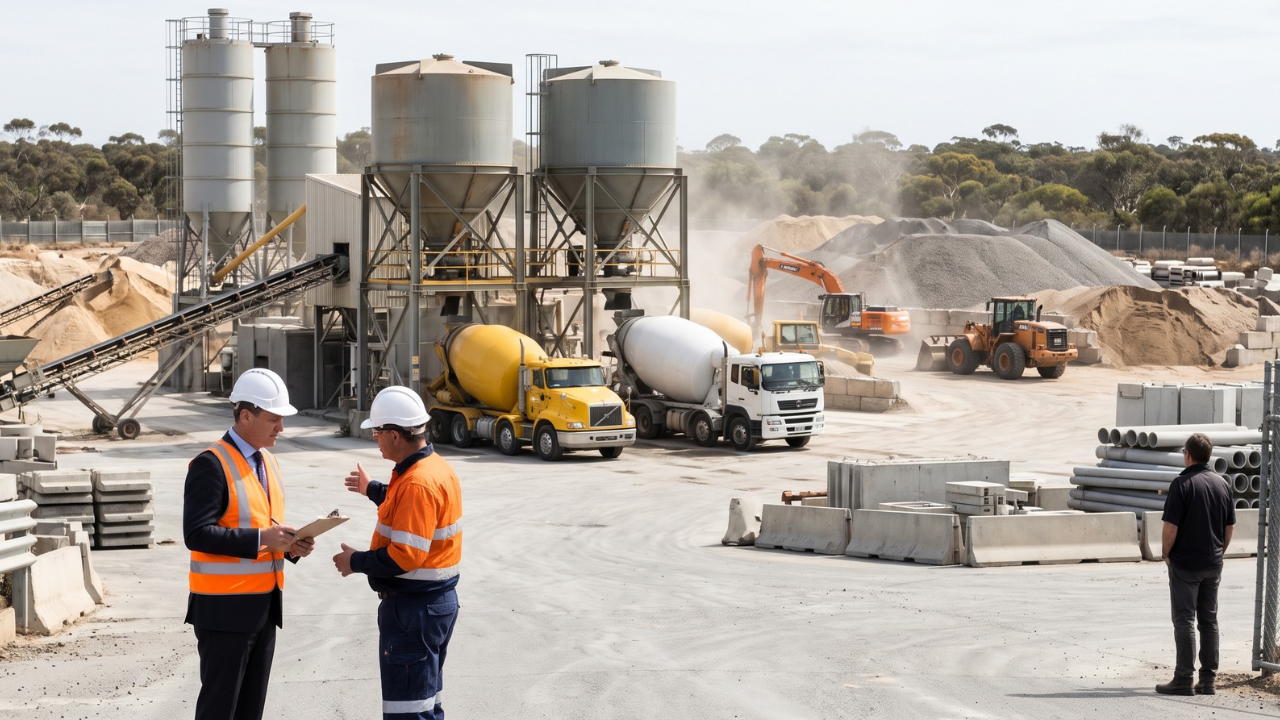
Concrete, cement and quarry products run through the competition regulator’s record in construction. Its newest decisions show exactly where supply is thinnest.
Building materials keep turning up in the competition regulator’s work. In 2026 the ACCC approved a concrete and quarry deal worth up to $1.703 billion only on condition that plants and a quarry were sold in three areas, and its chair has named construction among the sectors where it is running cartel cases.
Behind that sits a history in construction materials going back more than thirty years. For anyone ordering a slab pour, it says a lot about where supply is thin.
The ACCC has put construction cartels on its public agenda
Cartel conduct is one of the regulator’s enduring priorities, the conduct ACCC Chair Gina Cass-Gottlieb described in February as striking at the competitive process itself. Announcing the ACCC’s compliance and enforcement priorities for the year, she said the ACCC had four cartel cases before the courts, with mobile crane hire first on her list.
That case alleges four Sydney crane hire companies and four executives used WhatsApp groups to agree not to supply cranes to certain building sites or customers between 2020 and 2024, according to the ACCC’s September 2025 release. The allegations have not been proven and the matter is before the Federal Court.
In an October speech, she used Heidelberg Materials’ purchase of the Maas Group business as her example of targeted merger intervention.
Concrete, cement and steel have been in court before
In south east Queensland, Pioneer, Boral and CSR ran a premixed concrete cartel from 1989 until 1994 that involved bid rigging, price fixing and market sharing.
The ACCC’s guide for government procurement professionals records more than 50 meetings and phone calls, and an accountant engaged to monitor market shares. Each company was penalised $6.6 million.
Cement Australia, owned jointly by Holcim and Heidelberg, was taken to court over exclusive flyash supply contracts in south east Queensland. The Full Federal Court lifted the penalties against the Cement Australia companies to a total of $20.6 million in October 2017.
In August 2025 the Full Federal Court dismissed appeals in the BlueScope cartel case, leaving a $57.5 million penalty in place over an attempt between 2013 and 2014 to draw eight Australian distributors and an overseas manufacturer into a flat steel pricing arrangement.
The regulator’s own risk list reads like a description of concrete
The same guide lists the market conditions the ACCC says make cartels easier to run. They include a small group of suppliers controlling most of a market, industries that are capital intensive and costly to enter, and competitors kept out by geographic isolation, with regional Australia given as the example.
The guide also lists stable, predictable demand, naming construction and bricks, and standard products that are the same across suppliers. Its example of a standard product is premixed concrete.
Heavy materials match most of that list. Quarries and cement plants take heavy capital to build, and concrete has to be placed soon after it is batched, which ties every plant to the sites its trucks can reach.
National names, local markets
Nationally, heavy materials sit with a short list of groups. Seven Group Holdings took full ownership of Boral in 2024 and describes it as Australia’s largest integrated construction materials business. Heidelberg’s Australian brands include Hymix, Alex Fraser, Elvin, Pioneer North Queensland, High Quality Concrete and Midway Concrete. Adbri is owned by CRH and the Barro Group.
The ACCC does not publish national market shares for concrete or aggregates, and its decisions show why. Competition in heavy building materials is decided town by town, not nationally.
Competition in heavy building materials is decided town by town, not nationally.
Perth shows the pattern. In September 2025 the ACCC decided not to oppose a restructured carve up of BGC’s cement and concrete business between Cement Australia, Holcim, Heidelberg and Adbri, after raising preliminary concerns about the original deal.
Its published reasons refer to “both cement suppliers in Greater Perth” once the deal completes. The regulator relied on both holding significant excess capacity, and on Boral, WA Premix and Adbri continuing to compete in concrete.
Heidelberg and Maas show where competition is thinnest
Maas Group announced in February it would sell its construction materials division to Heidelberg Materials Australia for up to $1.703 billion, including $120 million in contingent payments. Heidelberg notified the ACCC in May under the mandatory merger regime that began on 1 January 2026.
The ACCC approved the deal on 31 July, its first Phase 1 approval with conditions under the new regime. Across the other markets it assessed, it was not satisfied competition was likely to be substantially lessened. In three places it had concerns.
In Blackwater in Central Queensland, Heidelberg and Maas were the only two ready mix concrete suppliers, so the deal would have left one. In the Illawarra, it would have combined major concrete suppliers and left customers with few effective alternatives. Around Biloela, it would have cut the number of quarry operators supplying coarse aggregates.
Heidelberg offered to sell concrete plants at Blackwater, North Wollongong and Bass Point, and the Yalkara quarry at Biloela. The ACCC accepted the sales as preserving an independent competitor in each affected market.
What is a Phase 1 approval with conditions?
Since 1 January 2026, acquisitions that meet government thresholds must be notified to the ACCC and cannot proceed without approval. In Phase 1 the ACCC has 15 to 30 business days, subject to extensions, to approve a deal or send it to an in depth Phase 2 review. It can approve in Phase 1 with conditions where the parties offer remedies, such as selling specific plants, that address the competition concerns it has identified.
One detail matters for anyone buying from integrated suppliers. The ACCC also examined whether Heidelberg would end up supplying or buying from its competitors in some of those locations. In heavy materials, the business selling a builder concrete can also be the quarry selling a rival batching plant its aggregate.
What this means for builders and subcontractors buying materials
For a regional builder pricing a job, the real market is the number of plants and quarries within delivery range, and the Heidelberg decision shows that number can be two. A merger remedy keeps that count where it was. It does not add a supplier.
Rising prices are a separate question from competition. ABS producer price data for the September 2026 quarter shows input prices to house construction up 1.0 per cent in the quarter and 3.9 per cent over the year, which the ABS put down to raw material, freight and fuel costs and supply chain disruption.
Plastic pipework and fittings rose 9.0 per cent in the quarter on higher global PVC costs. The ACCC’s construction materials cases have turned on evidence of meetings, messages and contracts, not on prices going up.
The merger process is also more visible than it was. Every notified deal now appears on the ACCC’s public Acquisitions Register before it can complete, with stakeholders invited to comment.
On cartels, the ACCC takes reports of suspected cartel activity, including anonymously through a secure third party platform. It also offers immunity to the first cartel participant who reports and cooperates with its investigation.
The regulator’s attention is not new. Its visibility is
The ACCC has been taking concrete suppliers to court since the 1990s. What changed in 2026 is how easy the record is to read. Merger decisions now set out, town by town, where supply is down to two names, and the regulator has said publicly that construction is among the markets where it is running cartel cases.
For builders, the places with the fewest options are already on the public record.
Frequently asked questions
Yes. In February 2026 the ACCC said it had four cartel cases before the courts, with mobile crane hire first on the list. That case alleges four Sydney crane hire companies agreed not to supply cranes to certain building sites or customers between 2020 and 2024. The allegations have not been proven and the matter is before the Federal Court.
The ACCC found the deal could reduce competition in ready mix concrete in Blackwater and the Illawarra, and in coarse aggregates around Biloela. In Blackwater the two companies were the only suppliers. Heidelberg agreed to sell three concrete plants and the Yalkara quarry, and the ACCC approved the deal on 31 July 2026.
Yes. Pioneer, Boral and CSR ran a premixed concrete cartel in south east Queensland from 1989 until 1994, involving bid rigging, price fixing and market sharing. Each company was penalised $6.6 million and six executives were also penalised.
The ACCC accepts reports of suspected cartel activity through its Infocentre, and also through an anonymous reporting platform. Businesses involved in a cartel that are first to report and cooperate may be eligible for immunity through the ACCC Immunity Hotline on 02 9230 3894.
Related articles
- Concrete Surcharges Are Back, and the Cost Indexes Are Not Picking Them Up
- What’s Going Up and By How Much: A Builder’s Materials Price Tracker
- WA’s Cheapest Input Is Getting Expensive. What the Sand Shortage Means for Perth Builders.
- Victorian Build Prices Have Fallen Behind Materials. Why a Cheaper Subbie Quote Is Not a Windfall
Last updated: 24 November 2026. ABS figures are from Producer Price Indexes, Australia, September 2026, released 30 October 2026.
General information only. This article is general information only and does not constitute legal, financial or professional advice. It reports on regulatory decisions, court outcomes and published data as at the date of publication. Allegations in proceedings that have not concluded have not been proven. Readers should obtain advice specific to their circumstances before acting on any information in this article.


0 Comments