


Why the strongest builders are focusing inward as the market gets louder
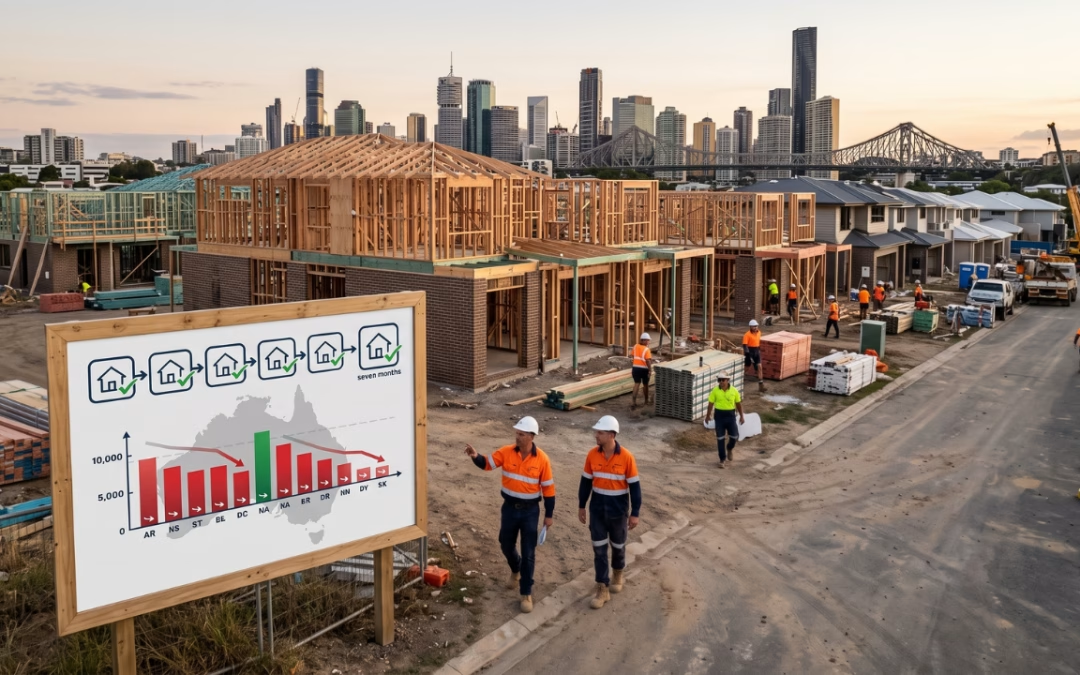
Spend enough time reading construction headlines and you’d be forgiven for thinking 2026 is a year builders simply have to endure.
Interest rates move.
Regulation shifts.
Labour remains tight.
Housing targets loom large.

Much of that is real. But it is also largely outside a builder’s control.
What separates the builders who survive and grow from those who struggle is not an ability to predict the market. It is their ability to control what happens inside the fence line of their business.
Across conversations with builders, suppliers and operators through The Good Builder Podcast, one theme keeps coming up. The strongest businesses are not chasing certainty. They are tightening fundamentals.
Here are the five areas home builders in Australia can still control in 2026, and why they matter more than ever.
1. Cashflow Discipline
Cashflow remains the quiet killer of construction businesses.
Most builders do not fail because they build poor homes. They fail because money arrives too late, work starts too early, or variations are agreed informally and never recovered.
In practice, cashflow pressure usually shows up in small, familiar ways. Progress claims go out days or weeks late. Variations are discussed on site but not documented. Jobs commence before finance is fully confirmed because “it should be fine”.
Individually, none of these feel fatal. Together, they compound fast.
The builders staying upright in 2026 are firm on cashflow discipline. Progress claims are issued the moment a stage is completed. Variations are priced, documented and signed before work starts. Builds do not commence without written finance approval in place.
This is not about being difficult with clients. It is about being professional. Cashflow discipline gives builders options. It provides breathing room when conditions tighten and allows clear decisions instead of reactive ones.
2. Process and Documentation
Building homes today is more complex than it has ever been.
Houses are more airtight. Compliance requirements are higher. Tolerances are tighter. The margin for misunderstanding has almost disappeared.
Many of the builders under pressure are not careless operators. They are experienced builders relying on memory, verbal agreements and informal processes in an environment that no longer supports that approach.
Process and documentation sit entirely within a builder’s control.
Clear written scopes.
Signed selections before ordering.
Standard details reused consistently.
Site photos captured at key stages and stored properly.
Variations documented every time.
In 2026, documentation is no longer administration. It is insurance.
When disputes arise, clarity beats recollection every time. Builders who document well spend less time defending decisions and more time delivering work.
3. Reputation and Trust
The way clients choose builders has changed.
Price still matters, but risk matters more.
Before making contact, most clients now check reviews, websites and social media. They are looking for signs of stability, consistency and professionalism. They want to know who feels safe to build with.
Reputation is not something builders have to leave to chance. It is something they can actively manage.
That starts with asking every satisfied client for a review, not just the easy ones. It means showing real projects instead of stock images. It means explaining the build process clearly, not just showcasing finishes. It means maintaining a visible presence, even if it is simple and understated.
If a builder’s work and process are not visible, clients fill the gaps themselves. In 2026, silence is rarely neutral.
4. Time, Energy and Mental Health
Building is mentally demanding work.
Long project timelines.
High financial exposure.
Emotionally charged client decisions.
Constant problem-solving.
Burnout in builders often arrives quietly. It shows up as delayed decisions, missed details, or taking on the wrong work just to keep cash moving.
Mental health is no longer a side issue. It is an operational one.
Builders have more control here than they often realise. Capping the number of live jobs. Delegating administration earlier. Replacing memory with systems. Asking for support before problems escalate.
Looking after time and energy is not weakness. It is leadership. Healthy builders run clearer businesses, make better decisions and build more sustainable operations.
5. Tools That Reduce Friction
Technology and AI are not replacing builders. But they are replacing wasted effort.
The builders pulling ahead in 2026 are not chasing every new tool. They are focused on reducing friction.
That includes job management systems used properly, client portals that reduce email chaos, digital estimating that links scope directly to price, and AI tools that help draft emails, summarise meetings or standardise explanations.
The goal is not technology for its own sake. The goal is fewer mistakes, clearer communication and more time spent on high-value decisions.
If a tool genuinely gives time back and reduces friction, it earns its place.
The Good Builder Takeaway
Strip away the noise and 2026 comes down to five controllable fundamentals:
Cashflow discipline.
Clear process and documentation.
Reputation and trust.
Time, energy and mental health.
Tools that reduce friction.
None of these depend on interest rates. None rely on government policy. All depend on how a builder chooses to run their business.
These are the levers that protect builders when conditions tighten and allow growth when opportunities appear.
Looking Ahead
The construction industry will continue to face pressure in 2026. That is unlikely to change.
What can change is how builders respond.
The strongest operators are not trying to outguess the market. They are controlling what they can, tightening fundamentals and building businesses designed to last.
Those are the builders who will still be standing when the noise fades.

Author: TGB Editorial



0 Comments