

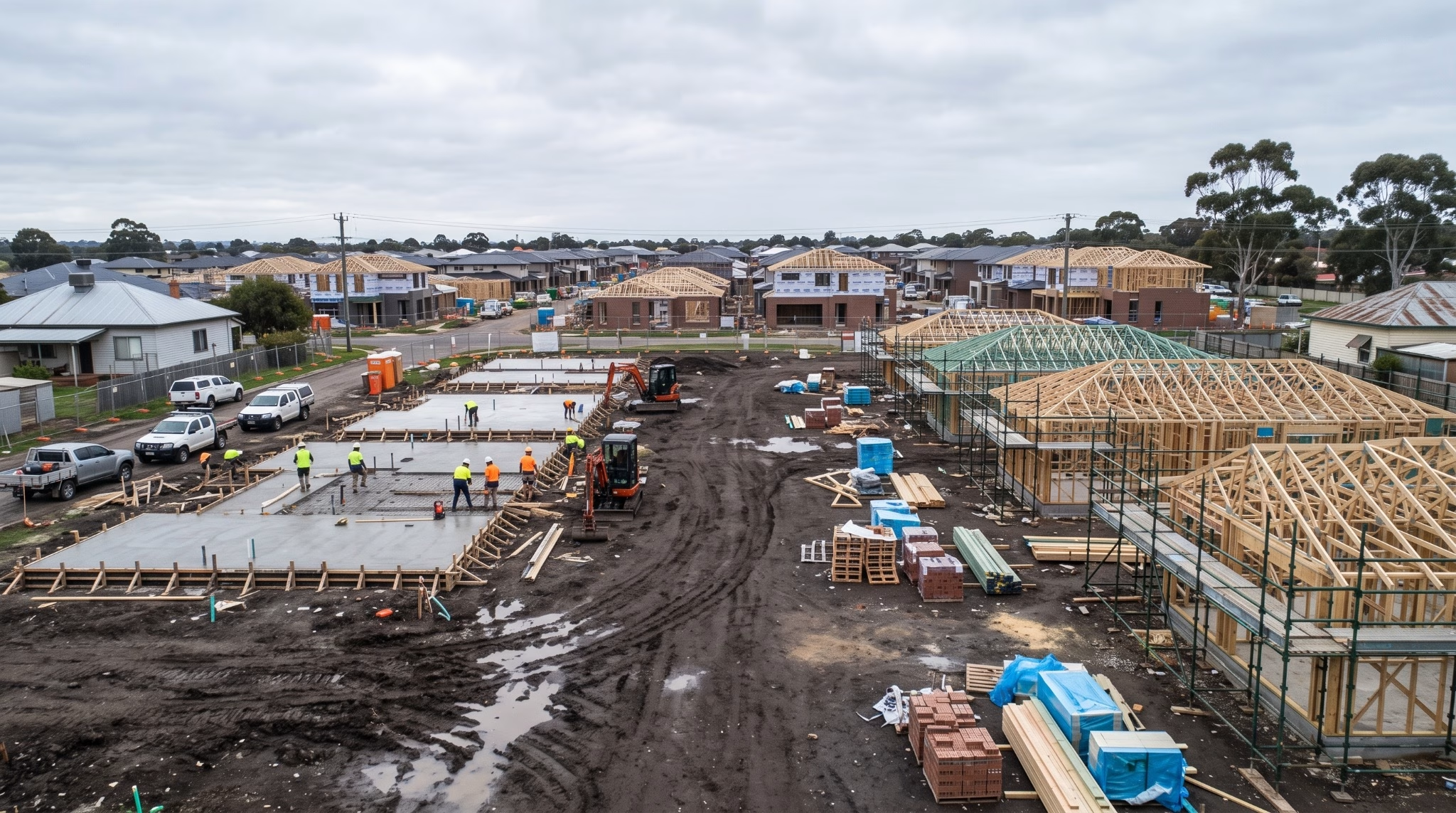
Victoria started more homes in the June quarter than in any quarter of the past three years. It finished no more over the year than it did the year before. Victorian developer and builder Kincaid says the gap will not close while capacity, feasibility and buyer confidence pull in different directions.
Victorian dwelling commencements rose 14.9 per cent in the June quarter to 16,239, according to ABS Building Activity data released on Wednesday. That is the strongest quarter in the three years of state data published in the release, in seasonally adjusted terms.
Completions went the other way. Victoria finished 14,191 dwellings in the quarter, down 2.3 per cent. Across the full year to June 2026 it completed 56,303, almost exactly the 56,296 it completed in the year before.

The state’s Housing Statement calls for 800,000 homes in the decade to 2034, or about 80,000 a year. On the latest figures, Victoria is running nearly 24,000 homes a year short.
Kris Burt, founder and director of Victorian developer and builder Kincaid, says lifting that number takes more than land and planning reform.
“The industry is being asked to deliver more homes, but you need the whole housing system working together to achieve that. Builders need the capacity to build, developers need projects to be feasible, financiers need confidence and, critically, buyers and investors need the confidence to commit,” he said.
Starts are up. Completions have not moved
Starts lead completions, so a strong June quarter should flow through to finished homes over the next year or two. Over the full year, Victorian commencements rose 2.8 per cent to 57,551.
Nationally the picture was similar. Total commencements rose 7.0 per cent to 52,201 and completions rose 5.8 per cent to 47,168. There were 248,733 dwellings under construction across the country at the end of June.
More starts help only if those homes get finished. A start is a commitment, and every one of them has to make it through the gap between approvals and completions before it houses anyone. In Victoria, part of what decides that is how much work each builder is now allowed to hold.
Victoria now caps how much work a builder can carry
Since 1 July 2026, every Victorian domestic builder has been subject to Minimum Financial Requirements set by the Building and Plumbing Commission. They fix each builder’s Maximum Construction Capacity, the total value of domestic work it can hold at any one time.
For capacity up to $20 million, a builder needs adjusted net tangible assets of at least 5 per cent of that capacity. A builder with $400,000 in eligible assets can carry $8 million of work. To go higher, it has to apply before it signs the contract that would take it over.
DEFINITION: MAXIMUM CONSTRUCTION CAPACITY
Maximum Construction Capacity is the maximum total value of domestic building work a Victorian registered builder can hold at any point in time. It is set by the Building and Plumbing Commission from the builder’s adjusted net tangible assets. Up to $20 million, those assets must equal at least 5 per cent of the capacity. Staying within it has been a condition of registration since 1 July 2026. Source: Minimum Financial Requirements and Administrative Guidelines 2026, Victoria Government Gazette S 365.
Kris said strong financial safeguards were important, but the framework should also recognise the trading history, demonstrated delivery and operational capability of established builders seeking to grow.
A balance sheet is not the only measure, Kris says
“A balance sheet is an important measure, but it is not the only measure of whether a builder can safely and responsibly deliver more homes.”
“We need a system that protects consumers while giving proven, financially sound builders a practical and timely pathway to scale,” he said.
The gazetted guidelines bear out the first half of that. A builder’s history shows up only as a disqualifier: a recent insolvency or bankruptcy, unpaid judgment debts, or more than $1 million in insurance claim payments over six years. There is no equivalent credit for years of homes delivered on time. Goodwill and customer relationships are excluded from the asset test as intangibles.
Timing is the second half. Capacity is counted on the full contract price of every live job until the occupancy permit or final inspection. For developer builders, the market value of speculative work under Home Warranty counts too. A builder winning work quickly can reach its ceiling on the day it signs. An application to lift the ceiling needs two years of accounts and tax returns and a 12 month forecast of work, and the guidelines set no timeframe for a decision.
That matters more in a quarter like June. When starts rise, the value of contracts sitting on builders’ books rises with them. How many Victorian builders are now close to their ceiling is not public.
Builder capacity means little if buyers are not signing
Kris said the other side of the equation was demand, with higher interest rates and ongoing regulatory change contributing to uncertainty among buyers and investors and making it harder for developers to achieve the presales needed to get projects underway.
“When buyer and investor confidence falls, sales slow. That has a direct impact on development feasibility because many projects rely on presales to secure finance and move into construction. You can have a viable site and a builder ready to deliver it, but if the sales aren’t there, the project can’t proceed. That ultimately means fewer homes being delivered,” he said.
He wants government to consider the cumulative impact of property taxes and regulatory changes on investment decisions.
“If government wants more housing delivered, we need to make it attractive for people to invest in new housing. Greater policy consistency, targeted investor incentives and a more competitive tax environment would help rebuild confidence, support presales and improve the feasibility of new projects. Give the market the opportunity to stabilise and builders will be in a stronger position to deliver higher volumes,” he said.
Prefab speed meets regulatory speed
Kincaid also argues that regulatory processes need to evolve alongside modern methods of construction if Victoria is to see their productivity benefits.
The company says it recently completed five prefabricated double storey townhouses, with approximately 85 to 90 per cent of each home manufactured off site.
“Our first five prefabricated townhouses took approximately eight weeks to manufacture and construct. There is limited value in finding ways to build homes significantly faster if the systems around construction continue to operate at the same speed,” Kris said.
Some of those systems are moving. The Australian Building Codes Board consulted until 15 September on a national voluntary certification scheme for manufacturers of prefabricated construction, expected to be available from mid 2028. As more housing factories come online, approvals, inspections and finance will decide how much of that speed reaches buyers.
The full equation
“If Victoria wants to increase housing supply, we need to look at the full equation. Create confidence for buyers and investors, improve feasibility, give capable builders a pathway to scale and allow the industry to get on with delivering the homes we need,” Kris said.
THE GOOD BUILDER TAKE
The June quarter is the best news Victorian housing has had in a while, and it lands in the first full quarter of the new capacity rules. That timing is the point. Starts turn into completions only if the builders holding them can keep taking on work, and in Victoria that now depends on the regulator as much as the bank.
The guidelines are clear about how a builder loses capacity and silent on how quickly one can gain it. For anyone growing a building business in Victoria, that means the application has to go in well before the pipeline needs it. The rules run to 30 June 2028. A published decision timeframe for capacity increases would cost government little and would tell builders exactly how far ahead to plan.
We regularly talk to builders and developers on The Good Builder Podcast. If your business has applied to lift its Maximum Construction Capacity, we would like to hear how it went.
Frequently asked questions
Victoria recorded 16,239 dwelling commencements in the June quarter 2026, up 14.9 per cent on the March quarter in seasonally adjusted terms, according to ABS Building Activity data released on 7 October 2026. Over the year to June 2026, Victorian commencements totalled 57,551, up 2.8 per cent on the previous year.
Not on current figures. The Housing Statement target works out to about 80,000 homes a year between 2024 and 2034. Victoria completed 56,303 dwellings in the year to June 2026, in seasonally adjusted terms, almost unchanged from the year before and nearly 24,000 short of the annual pace the target requires.
Maximum Construction Capacity is the total value of domestic building work a Victorian builder can hold at any one time. It is counted on the full contract price of every live contract until completion, plus speculative work under Home Warranty. Up to $20 million, a builder needs adjusted net tangible assets of at least 5 per cent of its capacity.
A builder applies to the Building and Plumbing Commission before entering a contract that would take it over its current capacity. The application includes two years of financial statements and tax returns and the value of work expected over the next 12 months, verified by an independent qualified accountant where the capacity sought is $2 million or more. No decision timeframe is set.
Last updated: 9 October 2026. ABS figures are seasonally adjusted, from Building Activity, Australia, June 2026, and are subject to revision. Annual totals are our sums of the published quarterly figures.
General Information Only: This article is intended for general informational purposes and does not constitute legal, financial or accounting advice. Comments from Kincaid reflect that company’s views. Financial capacity requirements differ between states and territories and change over time. Readers should seek appropriate professional guidance before acting on any information contained herein.

Author: TGB Editorial


0 Comments