


Australia has a housing supply problem. You already know that.
We have been talking about it for years. Planning reform. Zoning changes. Infrastructure levies. Approval timelines. Build rates. Housing targets. The National Housing Accord. State-level housing strategies. The commentary is relentless.
But here is what almost nobody is talking about: the industrial land that makes housing delivery physically possible in the first place.

Because you cannot build homes faster if the supply chain feeding those builds has nowhere to operate.
What the Housing Debate Gets Wrong
The housing supply conversation tends to start and end with residential land. How many blocks are approved. How many builds are started. How many homes are completed.
What it skips is the entire delivery system that sits behind a housing project.
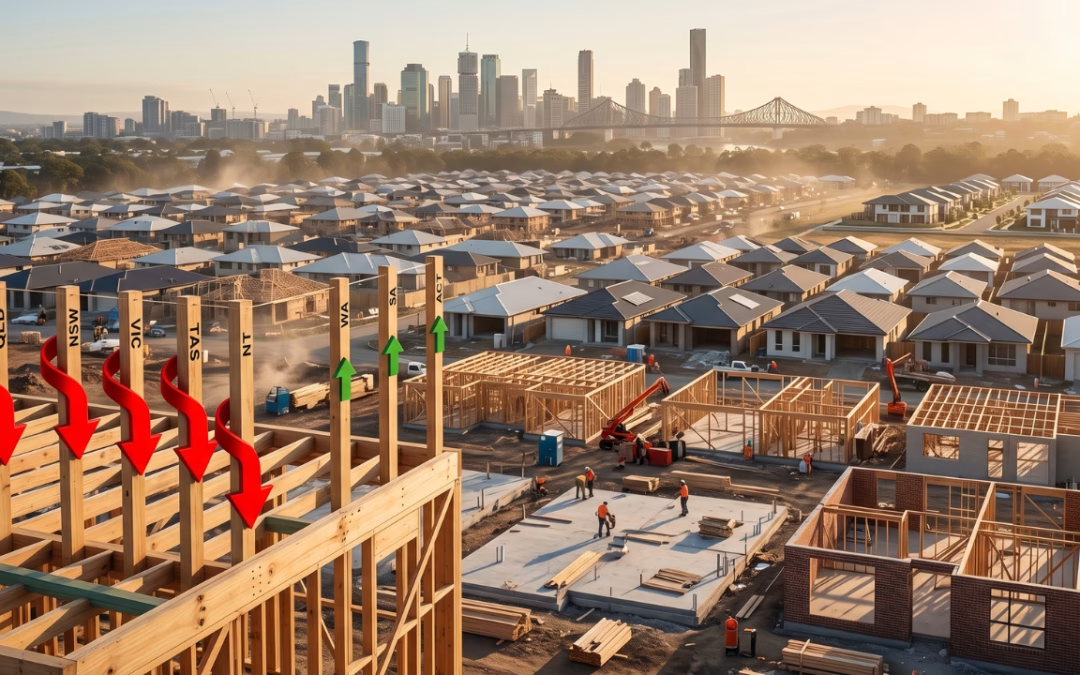
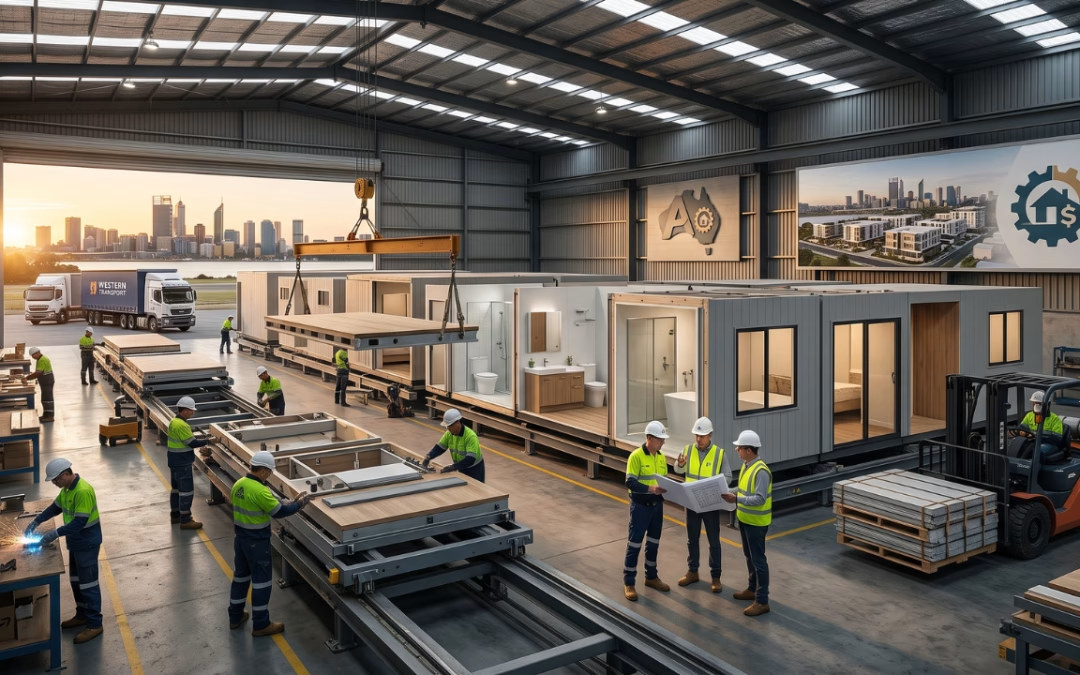
The frames come from a timber mill or fabrication facility on industrial land. The concrete comes from a batching plant on industrial land. The windows, fittings, electrical gear, and plumbing products all move through distribution centres and warehousing on industrial land. The precast concrete panels for the townhouses going up across SEQ are stored in laydown yards on industrial land before they hit the site.
You remove the industrial supply chain and the housing delivery machine stops. Not slows. Stops.
Yet when governments talk about unlocking housing supply, industrial land rarely rates a mention.
The Numbers Are Already Telling a Story
The Property Council of Australia’s No Room to Grow report, published in 2025 and prepared by SA1 Property, documents a crisis building quietly beneath the surface of the Queensland economy.
Greater Brisbane has less than five years of industrial land supply remaining at current absorption rates. Some precincts will run out in three to four years. Between 2019 and 2024, the region absorbed 1,084 hectares of industrial land. The five-year average absorption rate is now around 210 hectares per year. To put that in terms that land up in the imagination: the equivalent of the entire Wacol, Richlands, Darra, and Carole Park industrial precincts wiped off the map over five years.
Industrial outdoor storage sites, the yards where construction materials are staged and held before delivery, are the only industrial asset class actively decreasing in stock. Once converted to warehouse use, those yards do not return.
Brisbane’s industrial sector employs around 332,000 full-time workers and contributed over $34 billion to Queensland’s economy in 2022-23. It is not peripheral infrastructure. It is load-bearing.
And it is running out of room.
You cannot build homes faster if the supply chain feeding those builds has nowhere to operate.
Now Add the Olympic Build
If the housing delivery challenge alone is not enough to force the conversation, the Brisbane 2032 Olympic and Paralympic Games should be.
Venue construction is now formally underway. The Games Independent Infrastructure and Coordination Authority has appointed a major international consortium to deliver 17 new and upgraded venues across Queensland. The full Games procurement program has around $2.5 billion in supply chain opportunities on offer, spanning construction, logistics, and materials supply.
Preparing those venues will require years of sustained construction activity, millions of tonnes of materials, and substantial staging and laydown space close to the city.
That demand is arriving simultaneously with housing construction targets, a $120 billion state infrastructure pipeline, and an industrial land market that is already at record absorption rates. Construction Skills Queensland projects a shortfall of around 50,000 construction workers in Queensland by 2026-27 under current trajectories. The workforce that builds homes and the workforce that builds Olympic venues are competing for the same people, from the same industrial precincts, on the same tightening land.
The system was already under strain. The Olympic build is arriving on top of it.
Pushing Industry Further Out Has Real Costs
When the land debate does surface, the usual response is to point at fringe locations with large parcels and say the supply is out there.
The No Room to Grow report models exactly what happens when businesses move to those fringe locations. The data is clear.
A business relocating from an established Wacol site to an outlying Willowbank location faces materially higher freight costs to service the same customer and retail networks. The workforce available within a 30-minute commute is less than half that of the established location. Access to the broader industrial network is significantly weaker.
Those inefficiencies are not absorbed quietly. They flow into the price of every material that passes through that facility. They flow into the cost of every delivery. They flow, eventually, into the cost of building a home.
The Property Council puts it plainly: the further away we push industrial development, the more costly everything becomes for all of us. That includes housing.
The Policy Response Is Underway, But Not Fast Enough
To be fair to the Queensland Government, the issue is not being completely ignored. The SEQ Regional Plan, ShapingSEQ 2023, acknowledges the industrial land challenge and commits to establishing a regional framework to monitor supply. The state’s planning department is developing that framework now, with delivery expected by mid-2026.
The Crisafulli Government has also launched a $180.6 million Sovereign Industry Development Fund targeting strategic manufacturing capabilities. And the 2025-26 budget includes a $2 billion Residential Activation Fund and a range of housing-linked infrastructure programs.
But none of that is a direct response to the industrial land supply crunch. The Property Council called specifically for a $500 million Industrial Infrastructure Fund to unlock employment land. That has not materialised. The regional industrial land framework is still being built. Meanwhile, City of Moreton Bay Mayor Peter Flannery noted at the No Room to Grow launch that his council was already turning away 60 percent of industrial land inquiries due to lack of available supply.
You cannot monitor your way out of a supply problem. At some point, the land needs to actually be unlocked.
The Conversation We Are Not Having
Queensland has a record infrastructure and development pipeline. The Olympics. Significant state and federal housing commitments. Transport projects. Schools and hospitals. All of it requires construction materials to be manufactured, stored, and delivered from industrial land across the region.
At the same time, the land that enables that activity is being absorbed at record pace, with less than five years of supply remaining in key precincts.
If we want to build more homes faster, we need to ask honest questions about the conditions that make that possible. Not just approvals and zoning. The whole system.
Where are the materials going to be made and stored? Where are the distribution facilities going to operate? What happens to construction costs and timelines when the industrial supply chain gets squeezed out of the areas it needs to be in? And how does any of that interact with a 50,000-person workforce shortfall arriving at the same time as the biggest construction program in Queensland’s history?
Those are not peripheral questions. They sit right at the centre of the housing delivery challenge, and they are going largely unasked.
What Needs to Change
Industrial land is not a nice-to-have addendum to housing policy. It is a prerequisite. The supply chain that builds homes needs industrial land to function. The workers who build homes need industrial precincts that are close enough to where they live to actually get to work.
Until that is treated as a first-order planning and policy priority, the housing supply conversation will keep running in circles, well-funded, well-intentioned, and missing the most basic question: where does the stuff that builds the houses actually come from?
Sources: No Room to Grow, Property Council of Australia (Qld Division) / SA1 Property, 2025. Brisbane 2032 / GIICA procurement announcements. Queensland Government ShapingSEQ 2023 and regional planning review. Construction Skills Queensland Horizon 2032 Report. Quarry Magazine, March 2026. Property Council Queensland Budget response, June 2025.
General information only. This article does not constitute financial, legal, or professional advice. Readers should seek independent guidance suited to their specific circumstances.

Author: TGB Editorial


0 Comments