


Australia’s residential construction pipeline ended 2025 with a sharp monthly pullback in approvals, according to the latest data released by the Australian Bureau of Statistics (ABS). However, when viewed across the full calendar year, total dwelling approvals finished materially higher than in 2024, underscoring the continued tension between short-term volatility and longer-term housing demand.
The ABS Building Approvals release for December 2025 shows total dwellings approved fell 14.9 per cent month-on-month to 15,542 dwellings, seasonally adjusted. The decline followed a strong increase in November and was driven almost entirely by a steep reduction in multi-unit approvals, while detached housing remained broadly stable.
Multi-unit approvals drive monthly volatility
Approvals for dwellings other than houses, which include apartments, townhouses and semi-detached housing, fell around 30 per cent in December. This segment has historically shown higher month-to-month volatility, reflecting the project-based nature of higher-density development and the sensitivity of these projects to financing conditions, pre-sales, and planning approvals.
In contrast, detached house approvals edged up slightly, increasing by less than one per cent for the month. While modest, this result points to continued resilience in the detached housing segment, particularly in established growth corridors and regional markets.
The December figures illustrate a familiar pattern in the approvals data: large apartment projects can materially skew monthly results, while underlying demand trends often become clearer when viewed over longer timeframes.
2025 approvals finish higher year-on-year
Despite the December slowdown, the ABS data confirms that 2025 was a stronger year for dwelling approvals overall.
Across the full calendar year, total dwelling approvals reached just under 196,000 homes, representing a double-digit increase compared to 2024. Growth was led by a significant rebound in multi-unit approvals, while detached housing approvals also recorded a modest annual lift.
Multi-unit dwellings accounted for more than 82,000 approvals in 2025, marking a substantial increase on the previous year. This reflects a renewed pipeline of medium- and high-density projects, particularly in major metropolitan areas where affordability pressures and population growth continue to drive demand for attached housing.
Detached housing approvals totalled more than 113,000 homes for the year, a smaller increase but one that indicates steady improvement rather than contraction. While detached approvals remain below previous cycle highs, the upward trend suggests improving buyer confidence and a gradual return of owner-occupiers to the new-build market.
Interest rates, employment and demand dynamics
The approvals uplift through 2025 occurred alongside easing monetary conditions. Interest rate cuts earlier in the year improved borrowing capacity for households and reduced some of the cost pressures that had previously sidelined buyers.
At the same time, employment conditions remained relatively stable, providing income certainty for many households considering a new build. Combined with ongoing population growth and constrained housing supply, these factors have supported demand for new dwellings despite elevated construction costs.
Established home prices continued to rise above inflation across much of the country during 2025, reinforcing the supply-demand imbalance in the housing market. As resale prices increased, new housing became a more attractive pathway for some buyers, particularly first-home buyers and households seeking design flexibility or energy-efficient homes.
Renovations also on the rise
The ABS data also highlights a parallel trend in residential construction activity: growth in renovation approvals.
Council-approved alterations and additions increased in value across 2025, suggesting that some households opted to improve existing homes rather than enter the competitive established housing market. This trend reflects both affordability constraints and the difficulty many households face in securing suitable properties in undersupplied markets.
For builders and trades, this continued strength in renovations provides an important offset to fluctuations in new-build approvals, particularly during periods of apartment market volatility.
State-by-state performance varies
Dwelling approval outcomes for 2025 differed significantly across states and territories.
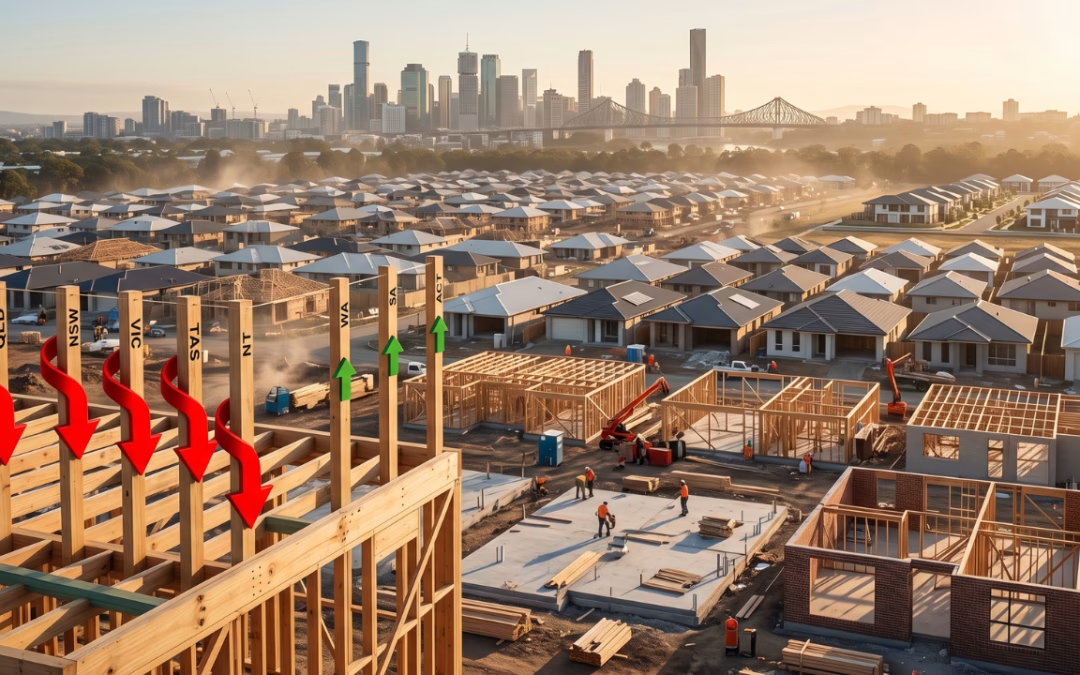
South Australia recorded the strongest annual growth in total approvals, followed closely by New South Wales and Western Australia. Queensland also posted solid gains, reflecting continued population inflows and housing demand across both metropolitan and regional areas.
Victoria recorded more modest growth over the year, while Tasmania was the only state to see an overall decline in approvals across 2025.
In trend terms, the Australian Capital Territory and Northern Territory showed particularly strong growth, albeit from smaller base volumes. These increases highlight how government-led projects, defence housing, and infrastructure-linked development can materially influence approvals in smaller jurisdictions.
Monthly declines versus structural supply needs
While December’s monthly fall is notable, the ABS cautions that approvals data should not be interpreted in isolation. The underlying trend series shows approvals broadly stabilising rather than collapsing, reinforcing the view that the December result reflects short-term volatility rather than a structural downturn.
However, even with the improvement seen across 2025, total approvals remain below the level required to meet Australia’s long-term housing targets. National housing policy frameworks estimate that more than 240,000 new homes per year are required to address supply shortages and population growth.
Approvals alone do not guarantee delivery. Projects must still progress through financing, infrastructure provision, labour availability, and construction capacity before homes are completed. Delays at any point in this chain can materially reduce actual housing output.
What approvals data does – and does not – tell us
Building approvals are a leading indicator of future construction activity, but they are not a measure of homes delivered. There can be a significant lag between approval and commencement, particularly for large multi-unit developments.
Infrastructure costs, planning conditions, developer contributions, and labour availability continue to influence whether approved projects move forward. As a result, strong approval numbers do not automatically translate into immediate increases in housing supply.
For builders, developers and suppliers, the approvals data provides insight into future workload potential, but not certainty. Detached housing trends remain more stable and predictable, while multi-unit construction continues to be characterised by bursts of activity followed by pauses.
Outlook heading into 2026
The ABS December 2025 release closes the year with a clear message: housing demand remains elevated, confidence has improved compared to the prior year, but volatility persists, particularly in higher-density approvals.
As 2026 begins, the approvals data will be closely watched for signs of whether the annual momentum seen in 2025 carries forward or whether economic uncertainty, construction costs and planning constraints re-emerge as stronger headwinds.
For the industry, the challenge remains unchanged: approvals are improving, but the gap between what is approved, what is built, and what is required to meet housing demand remains significant.



0 Comments