

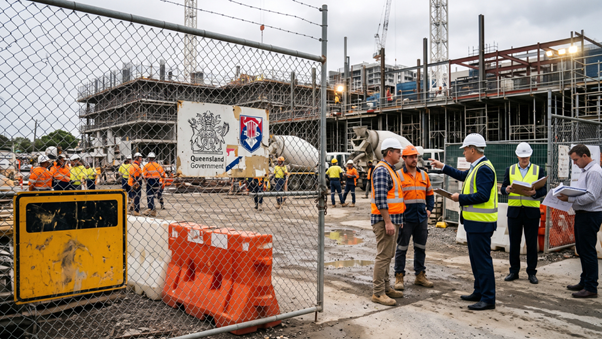
The Commission of Inquiry into the CFMEU has asked the Queensland Government to bring back a construction code and a dedicated regulator. The draft attached to the report goes well past the government site gate, and the dollar figures that decide who is in are still blank.
Queensland’s CFMEU Commission of Inquiry has decided not to wait for its final report. In an interim report dated 30 October and made public on 11 November 2026, Commissioner Stuart Wood AM KC makes two recommendations: that the Queensland Government introduce a code of practice for the building and construction industry, and that it establish a suitably resourced regulator to monitor and enforce it.
The final report is not due until 3 December 2027. The Commissioner says these matters cannot wait, pointing to an estimated $119 billion in government funded capital works over the next four years.
The code is written as a procurement policy, with exclusion from government work as the stick. But the draft reaches well beyond the major contractors who build rail lines and stadiums.
The code is a condition of winning government work, not a new law
Contractors and subcontractors who want Queensland Government funded construction work would have to comply, and the risk of losing future government work is what gives the code force.
It is modelled on Queensland’s 2013 Implementation Guidelines, removed in 2015. For now, the Commissioner recommends the code and regulator be administrative rather than legislated, allowing flexibility while the system beds down.
Sanctions run from a formal warning to full exclusion from tendering and publication of the breach.
What is the Recommended Code?
The Recommended Code is the draft Queensland Code of Practice for the Building and Construction Industry attached as Annexure D to the CFMEU Commission of Inquiry’s interim report. It sets conduct standards that contractors must meet to tender for and perform Queensland Government funded construction work. It is separate from the National Construction Code, which sets technical building standards.
The Commissioner puts the cost of BPIC at around 20 per cent
Much of the case rests on BPIC, the Best Practice Industry Conditions applied to state projects until it was suspended on 14 November 2024 and abolished from 1 January 2026.
On the evidence heard so far, the Commissioner estimates BPIC added cost increases in the order of $500 million on Cross River Rail (around 10 per cent), around $21 million on the Centenary Bridge Upgrade (around 15 per cent) and between $150 million and $468 million on Gold Coast Light Rail (22 to 67 per cent).
Across government projects delivered while BPIC operated, he puts the impact at 10 to 30 per cent, with 20 per cent as the best available estimate. He calls that conservative and subject to refinement in the final report.
His concern is that the policy has gone but its arrangements may live on in agreements, so the draft requires tenderers to show how they will improve on any BPIC era arrangement they were subject to.
The draft bans a long list of site arrangements
The draft defines a workplace arrangement as any agreement, practice or understanding, written or not. Among those it treats as inconsistent with the code:
- ratios or limits on the number of workers a company can engage
- one in all in arrangements, such as for overtime, and last on, first off redundancy clauses
- restrictions on casual, labour hire or contract labour, or on substituting an RDO for another day
- project agreements that set terms for every employer on a project, though single enterprise greenfields agreements remain available
- pressure on another party to make payments above award
It also prohibits no ticket, no start signs and show card days, and head contractors would have to report a suspected union breach of right of entry within 24 hours.
The code would follow contractors onto their private Queensland work
Under clause 2.4 of the draft, a party that tenders for covered public work must also comply with sections 3, 4, 7, 8 and 9 on privately funded building and construction work in Queensland, where tenders or expressions of interest are called after a commencement date yet to be set.
Those sections cover legal obligations, workplace arrangements, dispute settlement and industrial action, safety, and freedom of association.
The value threshold decides which government jobs trigger it, and the private work clause decides how far it follows a business home.
Related entities are caught as well. A company that controls the tenderer, is controlled by it, shares a director with it or is financially interested in its success must comply on any building and construction work it does in, or connected with, Queensland. The draft’s definition of a tenderer includes subcontractors and suppliers.
The Commissioner calls the private work extension a key ingredient for sustained benefits. The heaviest paperwork is narrower: the Workplace Relations Management Plan requirement does not extend to privately funded work.
Master Builders Queensland told the Commission the code’s administrative, reporting and auditing obligations should apply only to major private projects above a clear threshold.
The dollar thresholds that decide who is covered are still blank
Every project value threshold in the draft reads [insert]. In its submission, the Queensland Major Contractors Association described the management plan thresholds in the draft as $10 million for building and $20 million for civil, and argued they should be closer to $100 million.
The Commissioner suggests doubling or tripling the dollar values for inflation might be appropriate, but leaves the final figure to government, noting higher thresholds dilute the code’s benefits.
Olympic infrastructure gets no run in: the code would apply from the day it takes effect, including to parties already under contract.
Down the chain, head contractors would have to require and actively ensure compliance by anyone they contract with. Master Builders Queensland argued that is unworkable to the extent it requires builders to ensure, rather than promote, subcontractor compliance. How obligations flow to subcontractors on Queensland projects remains one of the most contested details.
Unions argue the evidence for a code does not stack up
The CFMEU Administrator, the Queensland Council of Unions and the ETU, CEPU and PGEU all opposed a code and regulator. The Administrator argued the only evidence of benefit was the impression of two former regulators who are not economists. The QCU argued existing laws are adequate.
Expert evidence filed for the electrical and plumbing unions put Queensland construction productivity growth over the three decades to the 2025 financial year at 13.5 per cent, against 10.6 per cent nationally.
The Commissioner gave no weight to either side’s econometric or statistical evidence, finding it near impossible to isolate the effect of past codes. He relied instead on the clauses themselves and on former regulators Nigel Hadgkiss and Wayne Jenkinson. He said it is too early to tell whether the Administrator’s cultural change efforts will last.
The regulator would start with 20 to 30 staff and a presence in the north
The report recommends starting with 20 to 30 people, including investigators and lawyers, with an office in Townsville or Cairns as well as Brisbane. The 2013 branch began with five staff, which the report says constrained what it could deliver.
As at 12 November, no formal government response had been released. The commencement date, thresholds and home of the regulator are all left to government.
The real fight is over two numbers
Where the lines fall now matters more than whether a code arrives. The value threshold decides which government jobs trigger it, and the private work clause decides how far it follows a business home.
A builder running a modest government refurbishment alongside private work could land on either side of figures that do not yet exist. Across the state of the industry, those two numbers will shape who keeps bidding for public work.
Has a government job ever changed how you run your private sites? Get in touch and tell us how a code would land on your projects.
Frequently asked questions
In its interim report dated 30 October 2026 and made public on 11 November, the Commission recommends that the Queensland Government introduce a code of practice for the building and construction industry and establish a suitably resourced regulator to monitor and enforce it. The final report is due on 3 December 2027.
Under clause 2.4 of the draft, a party that tenders for covered public work would also have to comply with sections 3, 4, 7, 8 and 9 of the code on its privately funded building and construction work in Queensland, where tenders are called after a commencement date yet to be set. The Workplace Relations Management Plan requirement does not extend to private work.
Based on three projects, the Commissioner estimates BPIC’s impact on government infrastructure costs at 10 to 30 per cent, with 20 per cent as the best available estimate. He says the figures are subject to refinement in the final report.
The draft leaves the thresholds blank. The Commissioner suggests doubling or tripling earlier dollar values to account for inflation, and leaves the final figures to the Queensland Government. Olympic infrastructure would be covered from the day the code takes effect.
Related articles
- Queensland’s CFMEU Inquiry Just Put a Draft Construction Code on the Table
- Queensland Has Scrapped BPIC and Subcontractor Pre Qualification for Good
Source: Commission of Inquiry into the CFMEU and Misconduct in the Construction Industry, Building Queensland’s Future: Interim Report on a Queensland Construction Code, 30 October 2026.
General information only. This article is general information and does not constitute legal, financial or industrial relations advice. The Recommended Code is a recommendation to government and has not been adopted. Seek professional advice about your own circumstances.




0 Comments