


A major housing development in Melbourne’s inner south has been fast-tracked through the Victorian Government’s streamlined planning pathway, paving the way for more than 400 new homes on the former Cadbury factory site along St Kilda Road.
Victorian Planning Minister Sonya Kilkenny confirmed that approval had been granted for a project at 636 St Kilda Road, which will deliver 402 new residential dwellings in one of Melbourne’s most connected urban corridors. The development will include a mix of one, two and three-bedroom homes, designed to accommodate a range of residents including young professionals, downsizers and families seeking access to central city amenities.
The project has been approved under the state government’s Development Facilitation Program (DFP), a planning mechanism designed to accelerate housing delivery by streamlining the approvals process for projects deemed strategically important to the state’s housing supply.
Government figures indicate that projects approved through this pathway are now being processed in approximately four months, significantly faster than the average council approval timeframe, which typically takes around 14 months.
The fast-tracked approval reflects broader efforts by the Victorian Government to increase housing supply and address affordability pressures across Melbourne’s metropolitan area.
A strategic inner-city location
The redevelopment site sits within a well-established urban precinct along St Kilda Road, one of Melbourne’s primary commercial and residential corridors.
Residents of the new development will have direct access to a wide range of public transport options, with five tram routes running through the area. The site is also located near St Kilda Junction, providing strong connectivity to the CBD and surrounding suburbs.
Beyond transport, the project sits within close proximity to major employment hubs and community infrastructure. Nearby destinations include The Alfred Hospital, the recreational spaces of Albert Park Lake, and retail and hospitality strips along Chapel Street and St Kilda Road.
Urban planners often highlight the importance of building higher-density housing in areas with established infrastructure, arguing that it allows cities to accommodate population growth without placing additional pressure on outer suburban development.
From a planning perspective, developments such as the St Kilda Road project align with broader urban consolidation strategies designed to support more compact, transit-oriented cities.
Minister Kilkenny said the location made the project particularly suitable for increased housing density.
“This is about making sure more Victorians have the opportunity to live in great locations close to the public transport, jobs and services they rely on,” she said.
Planning reforms aimed at increasing housing supply
The Development Facilitation Program has become a central tool in the Victorian Government’s housing strategy.
Originally introduced to help accelerate major projects, the program has increasingly been used to fast-track residential developments as housing affordability and supply constraints continue to dominate policy discussions across Australia.
Under the program, qualifying developments can bypass some traditional planning steps and move through a more streamlined state-level assessment process.
The intent is to reduce delays often associated with local planning approvals, which can involve extended consultation processes, multiple review stages and appeals.
Proponents of the program argue that planning delays have become a major barrier to housing delivery in major Australian cities.
Housing industry groups frequently point to lengthy approvals as a contributing factor to constrained housing supply, particularly in established suburbs where redevelopment opportunities are often contested.
By accelerating the approval process, the government hopes to bring new housing projects to market more quickly.
State officials say the program has already supported numerous housing developments across Victoria, helping to increase the pipeline of new homes in both metropolitan and regional areas.
Political debate over planning changes
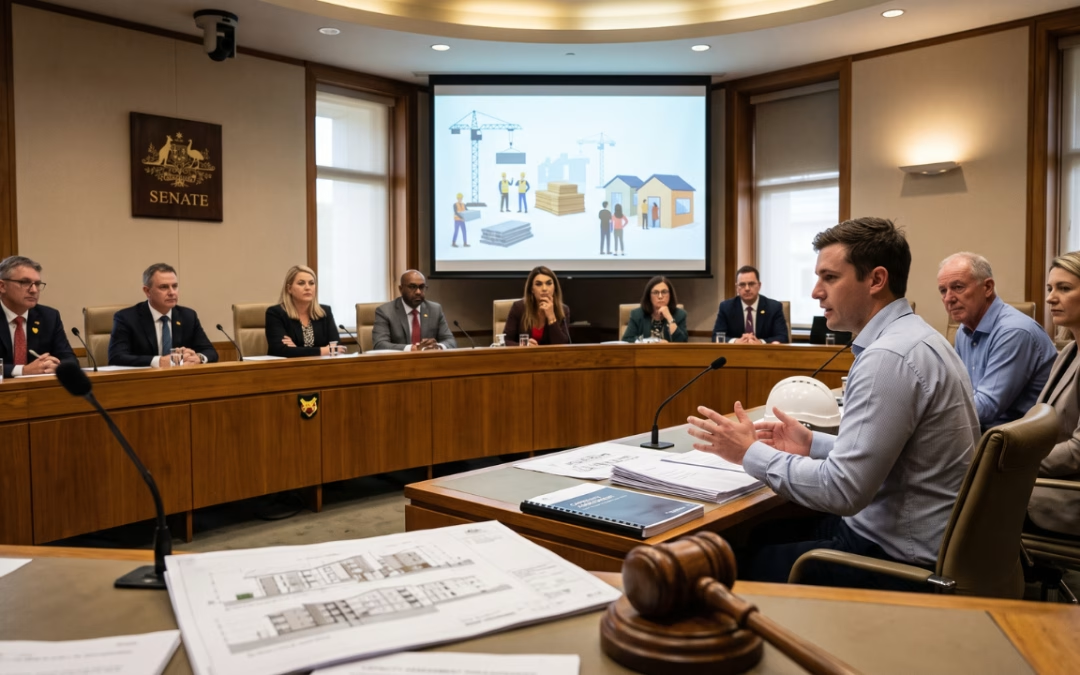
The planning reforms have also become a point of political debate in Victoria, with differing views on how the planning system should balance housing supply, local input and urban character.
Government representatives argue that reforms are necessary to ensure enough housing is delivered to meet growing demand, particularly in areas close to transport and employment.
Opposition representatives have raised concerns about the potential impact of centralised planning decisions on local communities and neighbourhood planning processes.
The debate reflects a broader national discussion about how planning systems can respond to housing shortages while maintaining transparency and community engagement.
Across Australia, several state governments have introduced similar reforms aimed at speeding up housing approvals.
These measures have included state-led assessment pathways, housing supply targets and incentives for higher-density development in well-connected urban areas.
The fast-tracked St Kilda Road project sits within this broader policy context.
Transforming a historic site
The redevelopment of the former Cadbury site also represents a significant transformation of an industrial landmark.
The site previously housed a confectionery manufacturing facility that formed part of Melbourne’s industrial landscape for decades. As manufacturing activity declined or relocated, many former industrial sites across inner Melbourne have been repurposed for residential and mixed-use developments.
Urban redevelopment of former industrial land has become a key strategy in accommodating population growth within established metropolitan areas.
These sites often offer large land parcels in locations that already benefit from transport infrastructure and established services.
Redevelopment projects typically involve significant planning considerations, including building design, traffic impacts, heritage considerations and integration with surrounding neighbourhoods.
While detailed design plans for the St Kilda Road development have not yet been publicly released in full, projects of this scale often include shared facilities, landscaping and public realm improvements designed to integrate with the surrounding urban environment.
Housing supply pressures remain a national challenge
The approval of the 402-home development comes at a time when housing supply continues to dominate economic and political discussions across Australia.
Population growth, construction costs, labour shortages and planning constraints have all contributed to a challenging housing environment in recent years.
Industry analysts have repeatedly highlighted the need for increased housing delivery across major cities, particularly in locations where infrastructure already exists.
Inner-city projects such as the St Kilda Road development can play an important role in expanding housing supply without relying solely on greenfield expansion at the urban fringe.
At the same time, housing affordability remains a key issue for many Australians, particularly younger buyers and renters attempting to enter the property market.
Government policy responses have increasingly focused on improving supply, with a growing emphasis on planning reform and faster approvals.
While the impact of individual projects may appear modest relative to national housing demand, the cumulative effect of multiple developments can contribute significantly to expanding housing stock.
Future development outlook
With planning approval now secured, the St Kilda Road project will move into the next phase of development, which typically includes detailed design, construction planning and financing arrangements.
Construction timelines have not yet been formally announced, but large residential projects of this scale generally involve multi-year build programs.
The redevelopment also reflects a broader trend of intensification along Melbourne’s key transport corridors, where planners see opportunities to deliver higher-density housing near public transport.
Such projects are likely to remain a central feature of Victoria’s housing strategy as governments continue searching for ways to increase supply while managing urban growth.
For Melbourne, which remains one of Australia’s fastest-growing cities, the challenge of balancing population growth with housing availability is expected to remain a defining issue for years to come.
The St Kilda Road development represents one example of how planning policy and redevelopment opportunities are being leveraged to help address that challenge.



0 Comments