


Amid a global oil shock and rising cost pressures, the federal government has handed down a budget with meaningful measures for the construction sector.
The federal government handed down the 2026-27 Budget on the backdrop of a global oil shock triggered by the ongoing conflict in the Middle East. Disrupted fuel supply chains, rising fertiliser costs and inflationary pressure have shaped the economic context for this Budget, and the government’s response flows through into areas that will directly affect builders, tradies and construction businesses across Australia.
The Big Picture: A Budget Under Pressure
Australia’s economy is growing faster than every major advanced economy, unemployment remains low and wages growth is solid. That is the government’s position heading into this budget. Despite those foundations, the oil shock has forced spending in new directions and economic growth is forecast to slow from 2.25 per cent in 2025-26 to 1.75 per cent in 2026-27 before recovering to 2.25 per cent in 2027-28.
Inflation is forecast at 5 per cent through the year to June quarter 2026, driven largely by rising oil prices. That is a number builders will feel on the tools and in the yard before they read it in a forecast.
The underlying cash deficit is projected at $31.5 billion for 2026-27. Gross debt is expected to reach $1.051 trillion. The government says the budget position is stronger than the mid-year update across the forward estimates, underpinned by $63.8 billion in savings and reprioritisations.
Inflation is forecast at 5 per cent through the year to June quarter 2026, driven largely by rising oil prices. That is a number builders will feel on the tools before they read it in a forecast.
Housing: Infrastructure Money and Tax Reform
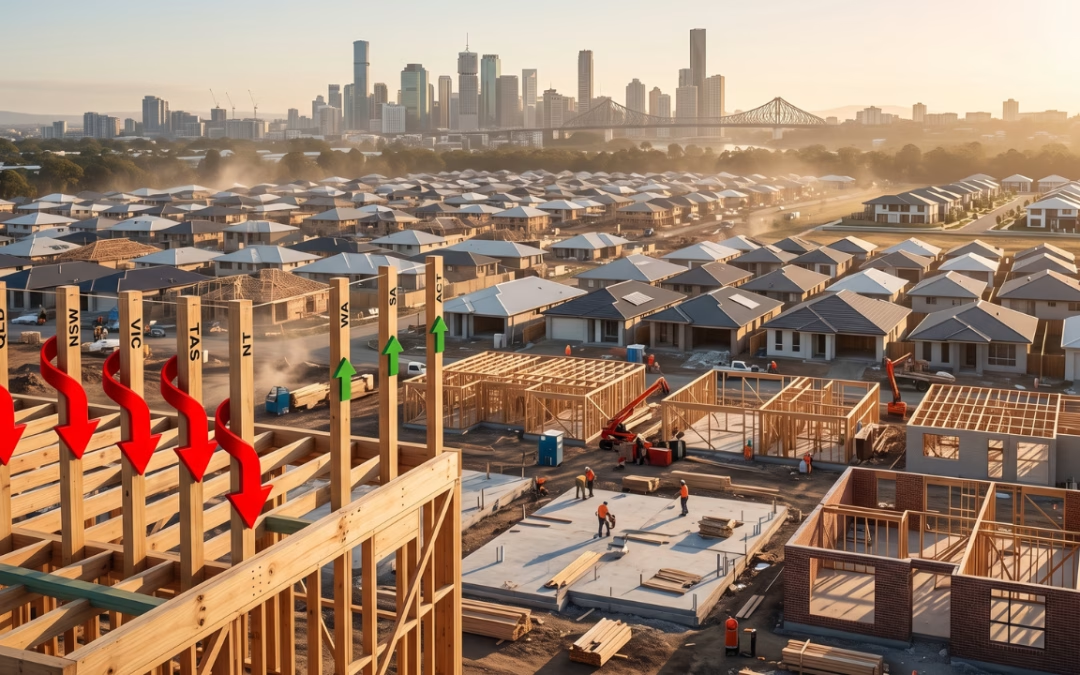
The headline housing commitment is a new $2 billion Local Infrastructure Fund to help local governments and state utilities build the essential infrastructure that supports new housing development. Think connections for water, power, sewerage and roads. The government says this will support up to 65,000 new homes over the decade. States and territories must commit to pro-housing supply reforms to access the funding, which includes speeding up and simplifying approvals, making more land available and simplifying the National Construction Code.
For builders, that last condition is the one worth watching. Approval delays remain one of the most consistent constraints on pipeline certainty. If the funding mechanism actually drives faster approvals at state level, it has real operational value.
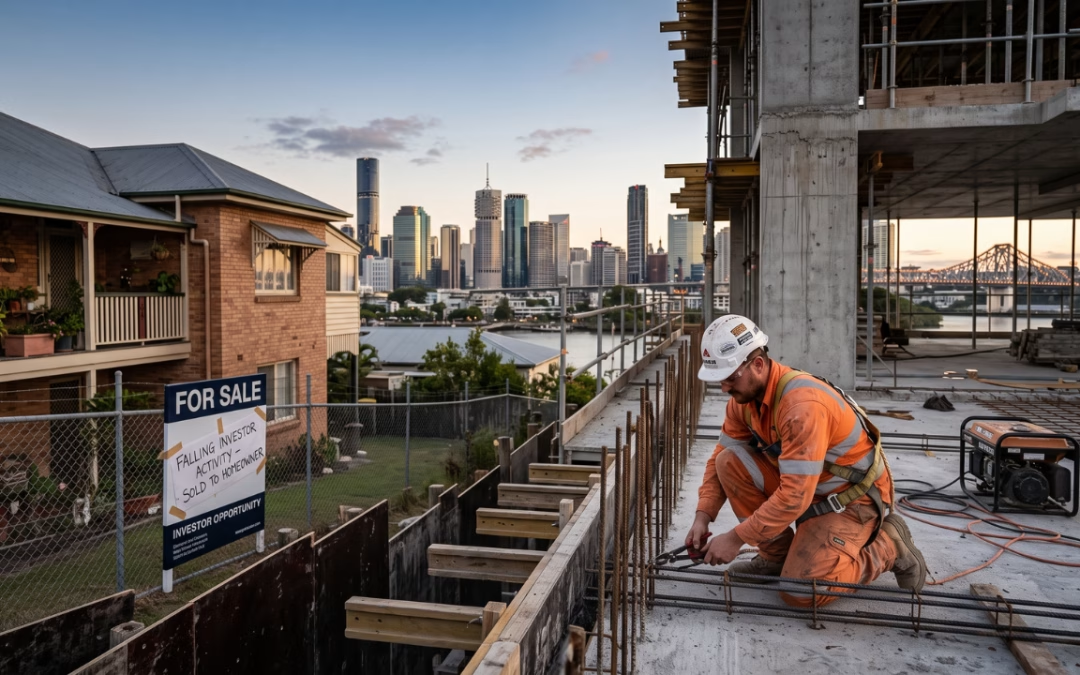
The government is also reforming negative gearing and capital gains tax concessions from 1 July 2027. The 50 per cent CGT discount will be replaced with an inflation-based discount, with a minimum 30 per cent tax on gains. Negative gearing will be limited to new builds only from the same date, with existing properties held before budget night grandfathered. The stated aim is to push investor activity toward new construction rather than existing stock.
83 per cent of new investor loans in 2025 were for existing property. Whether redirecting that capital toward new builds plays out as intended remains to be seen, but the intent is clearly to use the tax system to stimulate supply rather than simply constrain demand.
The government is also extending its ban on foreign buyers purchasing established homes until mid-2029 and has committed a further $59.4 million to support housing for young Australians at risk of homelessness.
Small Business Tax Measures
There are several practical measures for small construction businesses embedded in the tax package.
The $20,000 instant asset write-off has been made permanent from 1 July 2026 for businesses with turnover up to $10 million. This is not new, but making it permanent removes the annual uncertainty that made it difficult to plan purchases around. For a tradie looking at a new piece of equipment or a builder upgrading site gear, that certainty has real value.
Loss carry back is being reintroduced from 2026-27. Eligible companies that make a loss in the current income year can apply it against tax paid in the prior two years, generating a refund. The government says this will benefit up to 85,000 companies, mostly small businesses. Construction businesses operating in a sector with volatile revenue and high project-level exposure should understand this one.
For start-up builders in their first two years of operation, loss refundability is being introduced from 2028-29. Start-ups will be able to get a refund for tax losses up to the value of fringe benefits tax and withholding tax paid on wages.
There is also a $1,000 instant tax deduction for workers from 2026-27, allowing them to claim a work-related expense deduction without keeping receipts. For subcontractors and employees with tools and equipment costs, this simplifies what is otherwise an annoying compliance task.
The $20,000 instant asset write-off has been made permanent. For a tradie looking at new equipment, that certainty has real value.
Fuel: Real Relief for Fleet-Dependent Businesses
This is one of the most immediately practical measures in the budget for construction businesses.
The government has halved the fuel excise for three months from 1 April 2026, cutting it from 52.6 cents per litre to 20.6 cents per litre. The heavy vehicle road user charge has been reduced to zero for the same period. This is a direct cost reduction for businesses running work vehicles, plant equipment and logistics. The package cost is $2.9 billion.
There is also $1 billion in interest-free loans for manufacturing and logistics businesses facing cashflow pressure from higher fuel costs, provided through the National Reconstruction Fund’s Economic Resilience Program.
Longer term, the government is building a $14.8 billion fuel resilience package that includes a $3.2 billion Australian Fuel Security Reserve, a $7.5 billion Fuel and Fertiliser Security Facility and measures to build domestic refining capacity. For businesses that depend on diesel and logistics, the structural supply question matters as much as the short-term excise cut.
The ATO has also been given flexibility to support businesses unable to meet tax obligations due to fuel supply issues, including payment plans, remission of interest and penalties, and a dedicated relief channel available until 30 June 2026.
Regulatory Burden: Standards Access and Building Reform
Buried in the productivity section but worth flagging is a commitment to provide free access to all Australian standards referenced in legislation. For small builders and tradies, this means they will no longer need to pay to access the technical standards they are legally required to comply with. The government estimates this will save small businesses and tradies up to $1,600 per year.
The government is also committing to remove barriers to modern methods of housing construction, which will be of interest to anyone working in or watching the prefab and volumetric modular space.
A broader package of productivity reforms will reduce the regulatory burden by a claimed $10.2 billion per year, with building more homes listed as the second-largest contributor at $3 billion annually. Faster environmental approvals and a Single National Market framework are the other major items.
The government is investing $85.2 million to accelerate skills assessments for migrant trades workers and speed up occupational licensing, addressing one of the persistent constraints on trades availability. Whether the pace of implementation matches the scale of the shortage is a separate question.
Aged Care Construction Pipeline
It is not the most obvious construction story in the budget, but the $1.7 billion committed to incentivise construction of up to 5,000 aged care beds per year represents a real pipeline for builders and developers with capacity in this space. The investment includes new capital subsidies for providers who build or expand residential aged care accommodation.
Combined with the broader infrastructure commitments, this is a reminder that construction demand is not limited to the residential housing market. Builders with the systems and experience to operate across sectors may find the aged care pipeline worth investigating.
Infrastructure Spending
The government is maintaining a rolling infrastructure pipeline of more than $120 billion over ten years. This budget adds over $8.6 billion for new and ongoing nationally significant road and rail projects.
Queensland builders will note the $812.5 million commitment for the Bruce Highway upgrade between the Gateway Motorway and Dohles Rocks Road. Victoria receives a further $3.8 billion for the Suburban Rail Loop East, bringing total government commitment to $6 billion. A further $1.75 billion in equity goes to the Australian Rail Track Corporation to upgrade the national freight rail network.
Community infrastructure spending of $841.7 million across libraries, parks, community centres and sporting facilities represents smaller-scale work relevant to local and regional builders.
What to Watch
The negative gearing and CGT reforms are the most contested elements of this budget in property circles. They come into effect from 1 July 2027, giving the industry 13 months to understand the impact on investor behaviour and new build demand. Builders working in investor-led markets should track this carefully.
The condition placed on the $2 billion Local Infrastructure Fund, that states must commit to planning reform to access it, is a structural lever. Whether state governments move quickly enough to unlock those funds will determine whether the promised 65,000 homes actually translate into work.
The fuel excise cut is immediate but temporary. The broader fuel resilience investment is structural but long-term. Businesses dependent on diesel should plan around both timeframes.
On tax, the permanent instant asset write-off and reintroduction of loss carry back are genuine improvements for small construction businesses navigating an uneven revenue environment. Neither is headline-grabbing, but both have operational value.
This is a budget shaped by external shock. The oil supply disruption has forced the government’s hand on fuel, supply chains and inflation management, and those pressures cascade directly into the cost base of construction businesses. The housing measures reflect sustained political pressure on supply, and the tax reforms for small businesses show a degree of practical understanding of how those businesses operate.
The detail matters more than the headline numbers. For builders, the questions worth asking are: what does the planning reform condition mean for land release timelines in my market? Does the tax package create any changes to how I should structure purchases or manage loss years? And does the fuel relief offset enough of my operating cost increase to matter?
The answers will depend on your business. But those are the right questions to start with.
For deeper analysis of the budget and its implications for the Australian building industry, stay tuned to The Good Builder.
General Information Disclaimer:
This article is based on the federal Budget 2026-27 overview document and is intended as editorial commentary for industry professionals. It does not constitute financial, tax or legal advice. Builders and business owners should seek qualified professional advice before making decisions based on budget measures.



0 Comments