

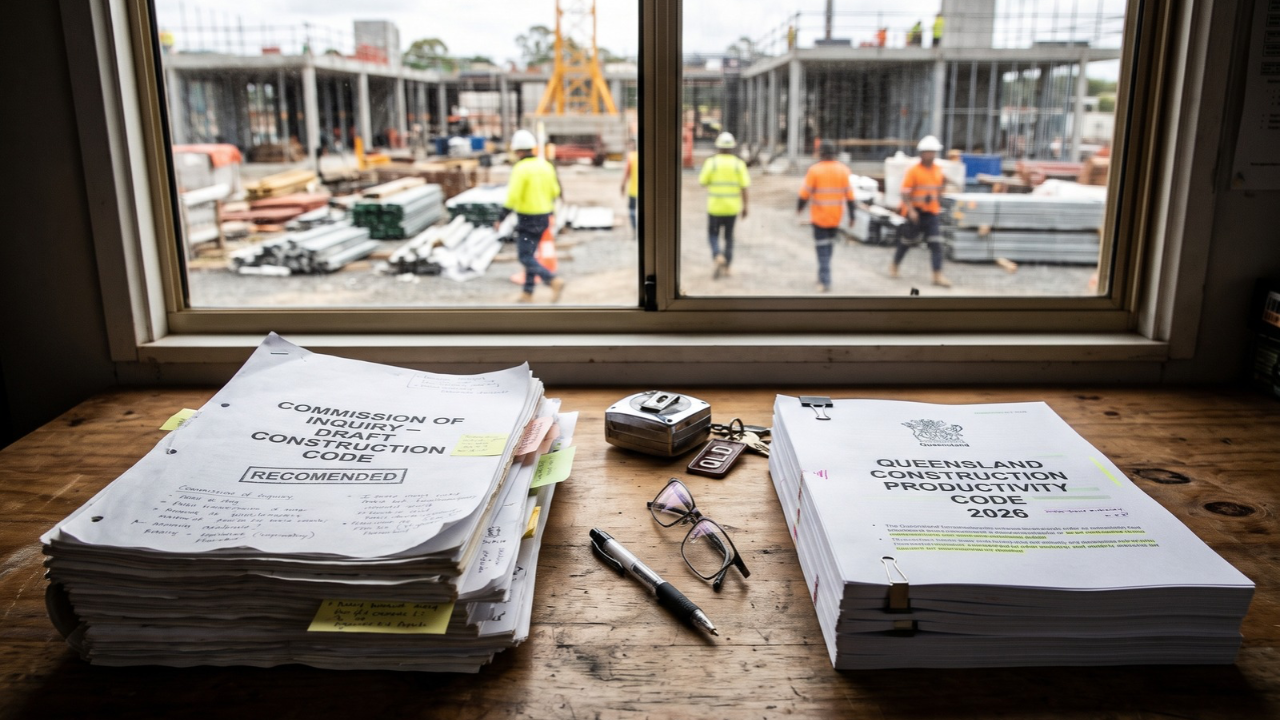
One week after the CFMEU Inquiry asked for a code, Queensland has one in force. Set it beside the Inquiry’s draft and the differences decide who it reaches, and how hard it bites.
Queensland’s new construction code took effect on Tuesday 17 November, less than a week after the CFMEU Commission of Inquiry asked for one. The speed is the headline. The detail matters more, because the code the government adopted is narrower and softer in several places than the one Commissioner Stuart Wood AM KC recommended.
The Queensland Construction Productivity Code 2026 applies to publicly funded construction contracts over $150 million where an expression of interest or tender is issued from that date. A day later, the 17 venues being delivered for the Brisbane 2032 Games were brought under it as well.
The code applies to new state funded contracts over $150 million
The code is a procurement condition, not a new law. Compliance is an ongoing condition of access to Queensland Government construction work.
It does not apply to procurements already released to market, contracts signed before commencement, or variations, extensions and options on those contracts. Rolling programs of upgrades or maintenance are excluded, as is work done by government’s own workforce, including QBuild and RoadTek, and by councils working on the state’s behalf. A client agency minister can ask to apply it to an existing procurement or to contracts under $150 million.
Tenderers do not need a full workplace relations management plan (WRMP) at expression of interest stage, only a written commitment to comply. The full plan is required if shortlisted, and the client agency must approve it before the contract is awarded. The plan covers labour sourcing, subcontractor management, industrial relations risks and measures to recruit and retain women.
The threshold sits above what major contractors asked for
The Commissioner left the dollar thresholds to government, suggesting that doubling or tripling the values in Queensland’s 2013 guidelines might be appropriate.
The Queensland Major Contractors Association told the Inquiry the draft’s WRMP thresholds of $10 million for building and $20 million for civil were too low, and should be closer to $100 million. The government has gone to $150 million, so most residential and mid sized commercial builders will not hold a head contract under the code.
Subcontractors on site are bound, with softer wording for head contractors
Exposure for smaller businesses comes through the supply chain. The code defines a subcontractor as any party providing goods or services to a contractor or subcontractor, and applies to parties who take part in on site activities.
Subcontractors must comply as far as reasonably practicable from the time they tender for or enter a covered contract, but only with the requirements relevant to their work. Their contracts must include a warranty to comply and allow the department to inspect work, records and documents and interview people. Subcontractors, like principal contractors, must report suspected breaches and threatened or actual unlawful industrial conduct to the department within 24 hours.
The obligation on head contractors is where the wording shifted. The Recommended Code said a party must require and actively ensure compliance by anyone it contracts with. Master Builders Queensland told the Inquiry that was unworkable to the extent it made builders ensure, rather than promote, subcontractor compliance. The adopted code asks principal contractors to take reasonable steps within their contractual influence and practical control, and defines reasonable by reference to factors including a party’s position in the contracting chain.
Private work is out
The Commissioner’s draft would have applied key sections to contractors’ privately funded Queensland work once they tendered for covered public work. He called that extension a key ingredient in sustaining the code’s benefits.
The adopted code says plainly it does not apply to any privately funded construction work. In Parliament, the Deputy Premier said that was the position at this stage.
Banned clauses became clauses to disclose
The list of productivity limiting clauses survived largely intact: employee ratios, one in all in arrangements, last on first off redundancy, restrictions on labour hire and casuals, bans on all in payments and restrictions on substituting rostered days off.
What changed is the consequence. Under the Recommended Code, those clauses would be non compliant. Under the adopted code, a tenderer whose Fair Work approved agreement contains one must identify it in its WRMP and explain how the impact on cost, productivity and delivery will be managed. The code states that the presence of such a clause is not, of itself, a ground for sanction.
The clause the Commissioner described as new, requiring tenderers to show improvements against BPIC era arrangements, now asks only what workplace arrangements a contractor will put in place to improve productivity or cost outcomes. The adopted code does keep firm lines elsewhere: payments by contractors to union officials or union controlled funds are a breach, and union logos and flags on site or on employer supplied equipment are listed among practices the code does not support.
The presence of such a clause is not, of itself, a ground for sanction.
A team of six will enforce it, with sanctions run through procurement rules
The Commissioner considered 20 to 30 staff an appropriate starting point for a regulator, noting Queensland’s 2013 compliance branch began with five and was constrained as a result.
The Deputy Premier told Parliament the new compliance and assurance function inside the Department of State Development, Infrastructure and Planning starts with a team of six, reporting to the director general, as a scalable response.
The Recommended Code set out sanctions ranging from a formal warning to full exclusion from tendering and publication of the breach. The adopted code instead aligns sanctions, as far as reasonably practicable, with the Queensland Procurement Policy 2026 assurance framework, which favours targeted support over default penalties for low and moderate non compliance. The department recommends sanctions for proven breaches to the Minister for Industrial Relations, and that procurement policy prevails if the two documents conflict.
Olympic venues were added a day later
The Recommended Code singled out Games infrastructure for immediate application, citing the $7.1 billion program for 17 new or upgraded venues. On 18 November, the Deputy Premier told Parliament the Games Independent Infrastructure and Coordination Authority had asked for all 17 venues to be covered, and he had agreed.
The 20 per cent and $24 billion figures come from the interim report
In the interim report, the Commissioner estimated BPIC added 10 to 30 per cent to the cost of government projects delivered under it, with 20 per cent his best and, in his words, conservative estimate, based on three projects.
The $24 billion is a projection, not a measured cost. It is 20 per cent applied to the $119 billion capital program forecast over the next four years, showing what could be at stake if BPIC era arrangements carried into new agreements. The final report is due 3 December 2027.
Recommended Code or Construction Productivity Code?
The Recommended Code is the draft attached to the CFMEU Inquiry’s interim report as Annexure D. The Queensland Construction Productivity Code 2026 is the version the Queensland Government adopted on 17 November 2026. They are different documents, and neither is the National Construction Code, which covers technical building standards.
Unions and industry remain split on the evidence
Industry bodies including Master Builders, the Queensland Major Contractors Association and the Civil Contractors Federation welcomed the code. In submissions to the Inquiry, the Queensland Council of Unions argued existing state and federal law is adequate and that the productivity evidence from two former regulators was anecdotal. The Commissioner gave no weight to the econometric evidence on either side.
The real test is in the decisions still to come
As adopted, the code sits inside procurement rules rather than above them. Its real reach will be decided by calls not yet made: whether ministers opt in smaller projects, whether a team of six grows, and how the department treats the clauses tenderers disclose.
Counsel Assisting warned that enterprise agreements on many of the state’s largest projects are due for renegotiation, with the risk of unproductive practices being locked in for another four years. Under the adopted code, those agreements will be disclosed and explained rather than ruled out. For subcontractors on major state jobs, the warranty in the contract in front of them is now where the code starts.
Frequently asked questions
It is a procurement code setting the standards contractors and subcontractors must meet to win and deliver major Queensland Government construction work. It covers workplace relations management plans, safety, freedom of association, industrial disputes, reporting and compliance. It took effect on 17 November 2026.
Publicly funded construction contracts over $150 million where an expression of interest or tender is issued on or after 17 November 2026. It does not cover existing contracts or their variations, rolling maintenance programs, or work by QBuild, RoadTek or councils. Ministers can apply to bring in smaller or existing projects, and the 17 Brisbane 2032 Games venues were added on 18 November.
Yes, where they take part in on site activities on a covered project. Subcontractors must comply as far as reasonably practicable with the requirements relevant to their work, give a contractual warranty, allow the department access to work and records, and report suspected breaches within 24 hours.
No. The code states it does not apply to any privately funded construction work. The CFMEU Inquiry’s draft would have extended key sections to the private work of contractors tendering for covered public work.
A compliance and assurance function within the Department of State Development, Infrastructure and Planning, starting with a team of six. Sanctions for proven breaches are recommended to the Minister for Industrial Relations and align with the Queensland Procurement Policy 2026 assurance framework.
Related articles
- CFMEU Inquiry Wants a Queensland Construction Code. The Draft Reaches Further Than Government Jobs
- Queensland’s CFMEU Inquiry Just Put a Draft Construction Code on the Table
- Australian Construction Industry Trends Guide
Last updated: 20 November 2026
General information only: This article is general information only and does not constitute legal, financial or industrial relations advice. It reflects publicly available information at the time of publication. Requirements under the Queensland Construction Productivity Code 2026 depend on the code itself and on individual contract terms. Seek independent professional advice before making decisions based on this content.


0 Comments