

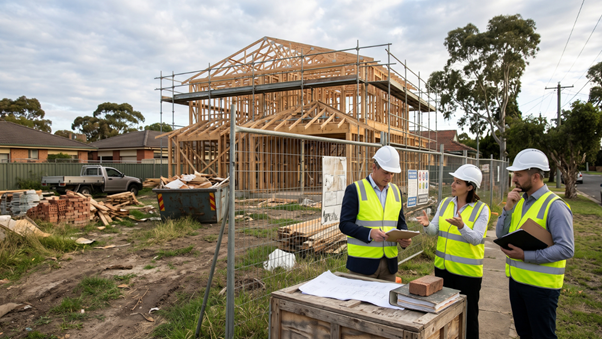
Construction barely rates a mention in the Commission’s interim report on business exit and insolvency. One of the questions it asks, though, could only have been written with builders in mind.
Construction has been the largest source of company collapses in Australia for years. On ASIC’s Series 1 data, more than 3,400 construction companies entered external administration or had a controller appointed for the first time in 2025/26.
So when the Productivity Commission released its interim report on insolvency reform on 5 November, the question for our community was simple. Has the Commission treated construction as a distinct case, or folded it into a general story about business exit?

The answer sits somewhere in between. The report, Unlocking business dynamism: removing barriers to entry, growth and exit, does not give construction a chapter of its own. But it identifies one problem that falls on residential builders more than almost anyone else, and several of its broader proposals land directly on the subcontractor chain.
Small business restructuring is where builders are singled out
Small business restructuring, or SBR, was introduced in 2021 to give eligible small companies a cheaper way to restructure debts and keep trading. Its use has grown from 12 appointments in 2020/21 to 1,719 in 2025/26, according to the Commission, or about one in ten practitioner appointments.
Small business restructuring (SBR)
A formal insolvency process introduced in 2021 for companies with total liabilities of no more than $1 million. Directors stay in control while a registered restructuring practitioner helps the company prepare a plan to deal with its debts. If creditors accept the plan, the company continues trading. To propose a plan, the company must be up to date with employee entitlements and tax lodgements.
The Commission found that entering SBR can cancel licences and insurances a business needs to keep operating. Without them a company cannot legally trade, which leaves it little option but liquidation. Its example is residential building in NSW.
Under the Home Building Act 1989 (NSW), residential building work above $20,000 must be covered by the Home Building Compensation Fund, for which icare is the sole insurer. The report says icare’s eligibility manual lists entry into external administration, including SBR, among the grounds for suspending or cancelling a builder’s eligibility.
The Commission says its inquiry heard that construction businesses are disproportionately excluded from restructuring pathways that other small businesses can use. It has asked whether any other industries face the same problem, and whether there is a compelling public policy reason for licensing bodies and insurers to cancel licences or cover when a company enters SBR.
The report cites a submission from Queensland University of Technology researchers, which argues that in residential construction “the key issue is not whether businesses can exit, but whether they can access timely and effective restructuring when they first encounter financial distress.”
The Commission does not set out how each state’s licensing and home warranty rules treat SBR. Its information request asks for exactly that.
Elsewhere, the report recommends keeping the SBR eligibility test as it is, apart from indexing the $1 million liabilities limit to inflation.
A proposed shield for subbies who keep supplying a struggling builder
Unfair preference claims allow a liquidator to recover payments a creditor received shortly before a company failed, so the money can be shared among all unsecured creditors.
The Commission found these claims can discourage suppliers and other unsecured creditors from continuing to trade with a business trying to recover, because they may have to hand the money back if the turnaround fails.
Its reform direction is to amend the Corporations Act 2001 and the Bankruptcy Act 1966 so that payments received in the ordinary course of business are exempt, regardless of whether the creditor ought to have suspected the debtor was insolvent.
For trades and suppliers who keep working for a head contractor that is slow to pay, that is the most direct proposal in the report.
The Commission has asked whether there is a compelling public policy reason for licensing bodies and insurers to cancel licences or cover when a company enters SBR.
The ATO’s role as a creditor is under the microscope
The Commission notes that the ATO has historically been a creditor in around three quarters of company insolvencies. Around 85 per cent of insolvent administrations in 2024/25 had unpaid taxes and charges, and small business collectable tax debt reached $35.9 billion.
Currently the ATO can report a business’s tax debt to credit reporting bureaus once it reaches $100,000, is more than 90 days overdue and the business is not effectively engaging with the ATO. The Commission is asking what a lower threshold would look like, which would give suppliers and subcontractors earlier visibility of a business in trouble.
It also supports the ATO consulting on and publishing “model creditor” guidelines setting out how it uses its powers as a creditor. The report notes that initial submissions closed before the ATO’s decision to stop accepting credit card payments for tax debts, so that change has not been considered.
Phoenixing is most prevalent in construction, and prosecutions are rare
The report cites earlier evidence that illegal phoenixing is most prevalent in construction, labour hire and security. ATO modelling from 2024 put the cost of illegal phoenixing in unpaid debts and compliance costs at about $4.9 billion a year.
Enforcement under the 2020 anti phoenixing laws has been thin. ASIC data in the report shows one illegal phoenixing enforcement outcome in 2025/26, a director disqualification, and none in 2024/25.
Most submissions on the issue, including from Master Builders, argued for stronger enforcement of the existing law rather than new legislation. The Commission is seeking views on one change: a rebuttable presumption of insolvency. In cases involving creditor defeating dispositions, a company would be presumed insolvent unless its directors could show otherwise.
What the interim report leaves where it was
Several issues we flagged in August are either untouched or settled against change.
On creditor priority, the Commission found no evidence that reordering who gets paid first would materially improve outcomes, because many insolvent estates contain very little to distribute. Subcontractors remain unsecured creditors.
The treatment of trusts with corporate trustees in insolvency, a structure common in building businesses and one of the recommendations the Government sent to the Commission, is not addressed in the interim report.
The report does propose an Official Liquidator to wind up insolvent companies that cannot afford a registered liquidator. And construction is listed among sectors business groups nominated for a future regulatory “deep dive” into cumulative red tape. The Commission wants feedback on which sectors should go first.
Submissions close on 11 December
The Commission is taking final submissions until Friday 11 December 2026, with online public hearings from 8 to 12 February 2027. Its final report is due to the Government by 12 May 2027.
As we reported in August, the Government parked 23 of the 28 recommendations from the Parliamentary Joint Committee’s corporate insolvency inquiry with this inquiry. The interim report shows which of those questions the Commission is taking seriously.
For builders, the SBR licensing question is the part of the report most specific to residential construction, and the Commission has asked industry directly for evidence on it.
THE GOOD BUILDER TAKE
The Commission has put a direct question to the industry: why should entering a rescue process cost a builder the insurance or licence it needs to complete the rescue? It is a fair question, and the evidence to answer it sits with the builders and insolvency practitioners who have watched an SBR fall over for this reason. They have until 11 December to say so.
Frequently asked questions
It is a Productivity Commission inquiry into barriers that stop businesses starting, growing and exiting, including how Australia’s insolvency system works. The Treasurer set its terms of reference on 12 May 2026. The interim report was released on 5 November 2026 and the final report is due to the Government by 12 May 2027. Tax, workplace relations and mergers are outside its terms of reference.
In NSW, the Commission’s interim report says icare’s Home Building Compensation Fund eligibility manual lists entry into external administration, including small business restructuring, among the grounds for suspending or cancelling a builder’s eligibility. The Commission is asking whether there is a compelling public policy reason for such cancellations and whether they occur in other industries. The report does not set out the position in other states.
Its interim reform direction is to amend the Corporations Act 2001 and the Bankruptcy Act 1966 so payments received in the ordinary course of business are exempt from unfair preference claims, regardless of whether the creditor ought to have suspected the debtor was insolvent. The Commission found the current rules can discourage suppliers from continuing to trade with a business trying to recover.
Not under the interim report. The Commission found no evidence that major changes to creditor priority would materially improve outcomes, because many insolvent estates hold little value to distribute. Subcontractors generally remain unsecured creditors.
Final submissions close on Friday 11 December 2026. Online public hearings are proposed for 8 to 12 February 2027.
Related articles
- The Corporate Insolvency Inquiry Finally Has a Government Response, and 23 of Its 28 Recommendations Now Wait on the Productivity Commission
- 540 Companies in One Day: Why the Insolvency Numbers Will Look Worse Next Year
- ATO Pushes Credit Card Cut Off to 30 June 2027. The June Quarter BAS Is the First It Catches
Last updated 16 November 2026. Source: Productivity Commission, Unlocking business dynamism: removing barriers to entry, growth and exit, Interim report, released 5 November 2026. Insolvency counts: ASIC Insolvency Statistics, Series 1. Figures are as reported by the Commission and may be revised in its final report.
General information only. This article contains general information only. It does not take account of the objectives, financial situation or needs of any particular business and is not a substitute for professional legal, insolvency or financial advice.

Author: TGB Editorial



0 Comments