


A Melbourne developer-builder has delivered architecturally designed four-bedroom homes in 90 days, selling out in three weeks. It is a proof of concept the industry has been waiting for.
Building a townhouse in Australia typically takes somewhere between 10 and 12 months. That is the accepted norm. It accounts for approvals, material lead times, trade sequencing, weather delays, and everything else that turns a straightforward project into a year-long exercise in patience.
Kincaid just did it in three months.
The Melbourne developer-builder has completed five four-bedroom, three-bathroom prefabricated terraces at Stockland’s Highlands estate in Victoria, delivering homes up to 85 per cent faster than a conventional townhouse build. The project sold out within three weeks of launch.
That is not a marketing headline. That is a completed project with real buyers, real titles, and an 8-Star NatHERS energy rating on every dwelling.
For an industry under sustained pressure from labour shortages, cost escalation, and the Federal Government’s 1.2 million home target, it is the kind of result that demands attention.
What Was Actually Built
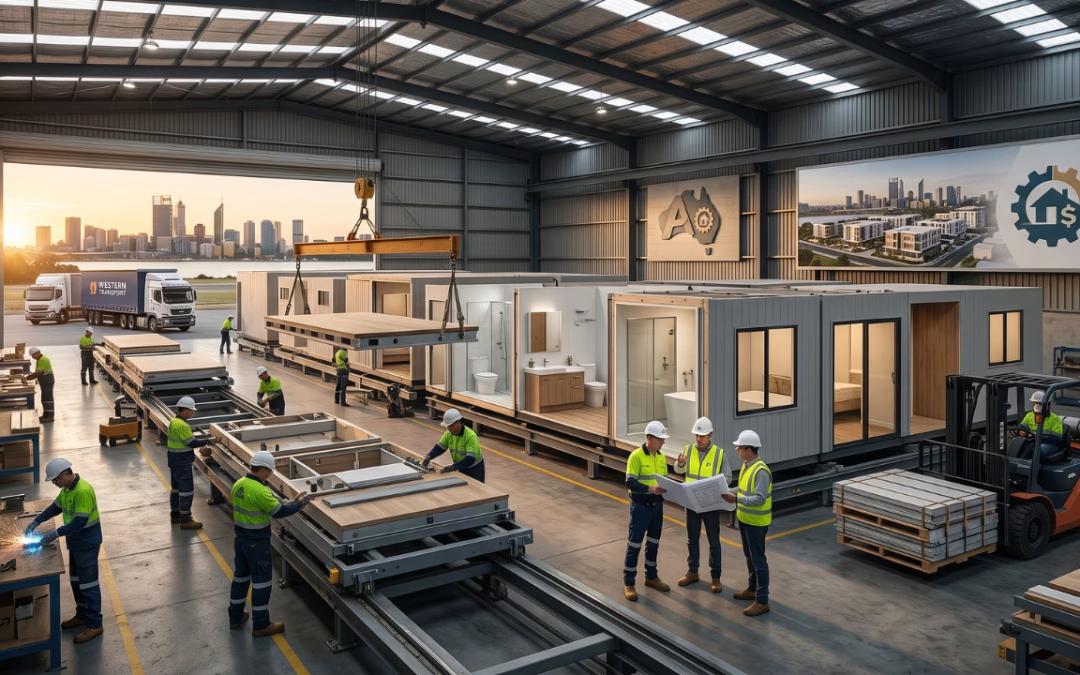
The five terraces, each with a double garage and built to an 8-Star NatHERS standard, were delivered through a manufacturing-led approach developed in partnership with prefabrication specialist Signex. Construction was completed predominantly in a controlled factory environment before rapid on-site assembly.
That factory-first model is the core difference. When a home is built in a controlled environment, weather is not a variable. Material handling is more precise. Trades work in sequences that would be impossible on a traditional site. Wastage drops. Rework drops. Time compresses.
Kincaid Director Kris Burt described the project as a clear proof point for prefabrication in a market that has long treated the method as a future concept rather than a present solution.
“In the time it takes to deliver one home traditionally, we can deliver three. That kind of productivity shift is what the industry needs if we are going to materially increase supply.”Kris Burt, Director, Kincaid
The Economics of Faster Building
Builders and developers understand something that does not always make it into the public conversation about housing supply: time on site is money out the door.
Every additional month of construction means more finance costs, more holding costs, more exposure to material price movements, and more risk to project viability. A build that runs three months instead of twelve does not just save time. It fundamentally changes the financial equation.
Burt made the case plainly. The two biggest cost pressures in residential development today are time and tax. Reducing a construction program to three months substantially improves project economics. Locking in pricing upfront, which the prefabricated model enables, removes a layer of market volatility that has made fixed-price contracts increasingly difficult to honour across the industry.
That certainty matters to developers. It also matters to buyers who have watched estimated completion dates shift repeatedly during the past few years of cost and supply chain disruption.
Trades Are Not the Problem Here
One of the common objections raised about prefabrication is that it displaces trades. It is a concern worth taking seriously, particularly as the industry wrestles with a significant skills shortage and the pipeline of new apprentices remains stretched.
The Kincaid model does not sidestep that concern. It reframes it.
Burt’s position is that prefabrication uses the existing workforce more effectively, not less. The same number of skilled tradespeople can deliver more homes in less time when work is concentrated in a factory setting with consistent conditions, set sequences, and less downtime between tasks.
Kincaid COO Joel Martin reinforced that the factory approach did not compromise the quality of the finished product. The terraces were designed with the same level of architectural intent applied across the company’s conventional medium-density work, executed through a panelised construction system.
“Our focus was to deliver architecturally led homes through a prefabricated system without compromising design intent.”Joel Martin, COO, Kincaid
Sustainability That Pays Off
An 8-Star NatHERS rating sits well above the minimum required under the National Construction Code. It is not a gesture toward sustainability. It is a genuine performance specification that translates into lower energy consumption and, in the current cost-of-living environment, lower ongoing bills for residents.
Martin noted that the rating also aligns with the growing ESG requirements of developers and institutional investors who are increasingly expected to demonstrate environmental performance across their portfolios. For Kincaid, the energy efficiency outcome was baked in from the design phase, not added as an afterthought.
That kind of baseline performance, built into a home delivered in 90 days, is a meaningful shift from the position prefabrication has historically occupied in the Australian market.
Does It Scale?
A single completed project, however impressive, does not transform an industry. The question that matters most is whether the model can be replicated at the volume the housing market actually needs.
Kincaid is already exploring further opportunities across Victoria. The model is designed to work across both greenfield and infill sites, and the company is actively pursuing partnerships with developers and institutional investors to expand the pipeline.
The rapid sell-out of the Highlands terraces points to something important. Buyers are no longer choosing between speed, quality, price certainty, and sustainability. They expect all four. As Burt put it, prefabrication is one of the few delivery models that can genuinely meet all those expectations at the same time.
That is a strong commercial argument. Whether the construction industry can back it with the factory capacity, the supply chain partnerships, and the financing structures needed to operate at scale is the next question to answer.
What This Means for Builders
For residential builders, the Kincaid project is worth watching closely, and not just because of the time saving.
The project demonstrates that the gap between traditional and modern construction methods is closing faster than many in the industry expected. What was once positioned as a niche or compromise solution is delivering architecturally designed, high-performance homes that the market is lining up to buy.
It also signals where institutional developer demand is heading. Stockland, one of Australia’s largest residential land developers, is backing this model. That endorsement carries weight.
For builders considering how to respond to the housing supply challenge without taking on unsustainable risk, the Kincaid approach points toward a model worth understanding. Not every builder will pivot to factory construction. But the pressure to build faster, at greater cost certainty, with fewer variables, is only going to increase.
The three-month terrace is a signal. It would be worth paying attention to.
Find out more about Kincaid at kincaid.com.au.
More news on construction methods: Robots on the Tools, Homes in the Factory: The Construction Revolution the World Is Already Running
General Information Only. This article is intended for general informational purposes and does not constitute legal, financial, or professional advice. Readers should seek independent advice relevant to their specific circumstances before making any business decisions.



0 Comments