


A new Queensland Productivity Commission inquiry into changes to federal environmental law is calling for public submissions. The construction and housing sectors are directly in scope.
If you have ever waited years for a housing lot to clear federal environmental approvals, Queensland wants to hear from you.
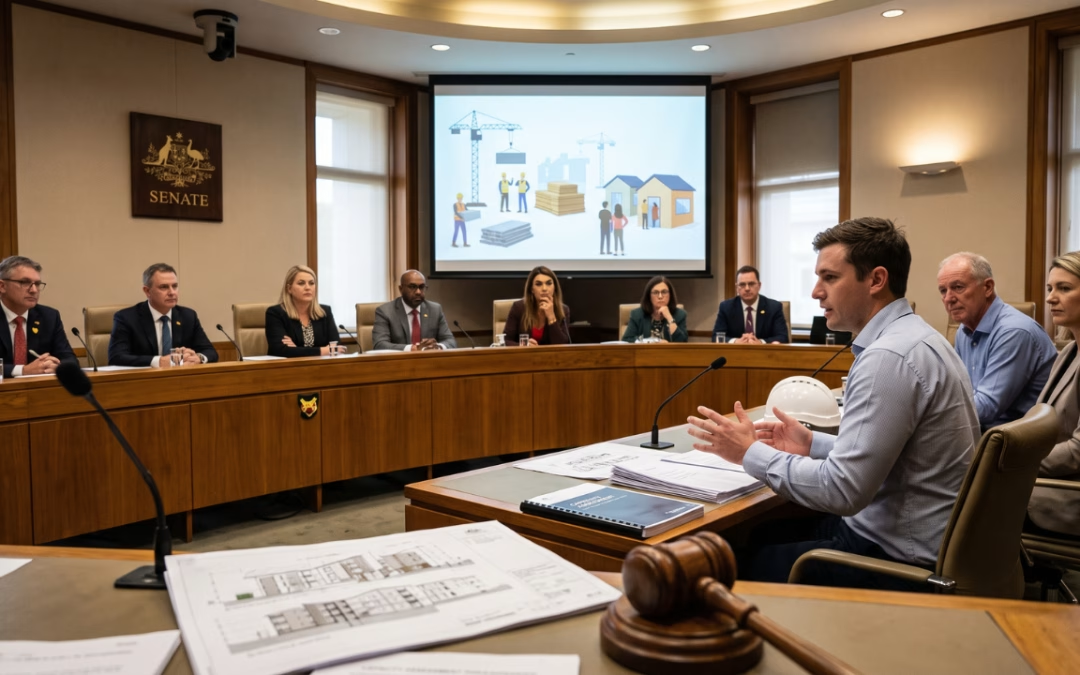
The Queensland Productivity Commission (QPC) has formally commenced an independent public inquiry into the economic impacts of the Federal Government’s 2025 changes to the Environment Protection and Biodiversity Conservation Act 1999, known as the EPBC Act.

It is a significant move. State governments do not often direct independent commissions to scrutinise Commonwealth legislation publicly. The fact that Queensland has done so signals that frustration with federal environmental approval processes has reached a point where formal pressure is being applied.
For builders and developers operating in Queensland, this inquiry is worth understanding. The issues it is examining are not abstract policy questions. They directly affect how long housing projects take to get off the ground and how much they cost before a slab is ever poured.
What the EPBC Act Has to Do With Housing
The EPBC Act is the Commonwealth’s primary environmental legislation. It exists to protect matters of national environmental significance, including threatened species, heritage sites, and sensitive ecosystems.
In practice, that means any development project touching on these matters needs to go through a federal assessment process, often running in parallel with state and local planning approvals. That layering of jurisdictions is where the delays accumulate.
The housing connection is direct. When a residential development is proposed on land that may affect a listed species or ecological community, federal referral is typically required. The assessment process that follows can take years.
We have heard examples of EPBC approvals for new housing lots taking over five years, delaying the construction of tens of thousands of new homes.
That is not a figure pulled from thin air. It is the kind of real-world outcome the QPC inquiry is designed to examine and quantify.
For builders, five years of federal assessment on a housing estate is not just a planning inconvenience. It is five years of holding costs, five years of land sitting idle, five years of homes not built for people who need them.
What Changed in 2025
The Federal Government introduced a package of reforms to the EPBC Act in 2025. The stated aim was to modernise environmental assessment processes and strengthen protections for matters of national environmental significance.
The changes updated how referral thresholds work, how Matters of National Environmental Significance are evaluated, and what assessment pathways are available to different project types.
One of the key points of contention is the National Interest Fast-Track Assessment Pathway. This mechanism was designed to allow projects with significant economic or strategic value to move through the federal process more quickly.
The Queensland Government’s position is that certain projects, including resource and energy developments, have been excluded from this pathway in a way that does not reflect their genuine national importance. The Taroom Trough oil project, which Queensland has been pushing to develop as a domestic fuel security measure, sits at the centre of that argument.
But the fast-track exclusion question is not just about resources. It creates a precedent for how fast-track pathways are interpreted and applied across project types, including large-scale residential land releases.
Why Builders Should Pay Attention
The QPC inquiry is seeking input from stakeholders across agriculture, housing, construction, and resources. The housing and construction sectors are not a side note here. They are central to the scope.
The inquiry is specifically examining compliance costs, approval delays, and uncertainty for Queensland businesses. These are the same friction points builders deal with regularly. They have a name for it. They call it the approval bottleneck.
When federal environmental assessments run long, the downstream effects are predictable. Site works cannot start. Trades cannot be engaged. Supply chain commitments cannot be locked in. Construction timelines are pushed out, often repeatedly, and cost forecasts become almost meaningless.
A one-year delay in environmental assessment on a $400 million project can add upwards of $20 million in holding and opportunity costs.
That figure, cited by the Queensland Renewable Energy Council in the context of the inquiry, translates proportionally to smaller residential projects. Holding costs on land do not care what the project is. They accumulate regardless.
There is also a broader market confidence issue. When approval timelines are unpredictable, capital becomes more cautious. Developers hesitate to commit to projects when they cannot reliably forecast when they will be able to build. That hesitation reduces land supply. Reduced land supply means fewer homes. Fewer homes means the housing shortage deepens.
Queensland is already facing significant housing pressure. The state needs to be building more homes, faster. Any process that adds years to that timeline works against the outcome everyone says they want.
The Dual Approval Problem
One of the structural issues the inquiry is expected to examine is the duplication between state and federal assessment processes.
Queensland has its own environmental approval framework. State assessment processes already evaluate ecological and environmental impacts for most development proposals. Federal EPBC assessment then repeats much of that work, applying Commonwealth criteria to a project that has often already been comprehensively reviewed.
This duplication is not new. It has been a source of complaint across the industry for years. What is new is the level of formal scrutiny being directed at it.
The Queensland Renewable Energy Council has publicly called for the inquiry’s terms of reference to be expanded to examine how state and local government approvals interact with EPBC assessments. The argument is that looking at the EPBC changes in isolation does not capture the full picture of how jurisdictional layering creates delays.
That is a reasonable position. For builders and developers, the experience of navigating multiple approval processes simultaneously, with different agencies, different timelines, and different criteria, is a genuine operational burden.
How to Have a Say
The QPC is now accepting public submissions. The initial submission period closes on 13 July.
In-person consultation events are planned across Queensland, including Cairns, Townsville, Mackay, Rockhampton, Roma, Toowoomba, and the Gold Coast. Builders, developers, and trades operating in these regions can register their interest to attend.
An interim report is due in November 2026. A final report will be delivered to the Queensland Government in April 2027.
The process is designed to inform how Queensland engages with the Commonwealth in bilateral negotiations and implementation of the EPBC reforms. In plain terms, what industry says in submissions will shape how Queensland pushes back on, or accepts, the federal changes.
That makes participation genuinely worthwhile. This is not a consultation exercise where the outcome is already decided. It is an independent inquiry tasked with producing a credible economic assessment of how federal environmental law is affecting real projects in Queensland.
If your business has experienced delays, cost blowouts, or project uncertainty linked to EPBC approvals, your evidence is exactly what the QPC needs to build its case.
What Builders Can Do Now
Start by documenting your experience. If you have had projects delayed by EPBC assessment processes, record the timeline, the costs incurred during the wait, and the downstream effects on your operations. Specific, quantified examples carry far more weight in inquiry submissions than general frustration.
Industry associations including the Housing Industry Association and Master Builders Queensland are likely to make coordinated submissions. It is worth engaging with them to ensure the residential construction sector’s experience is well represented.
If you attend one of the regional consultation events, come prepared with specific examples. The QPC is an independent body. It is not looking for political arguments. It is looking for evidence.
The Good Builder Take
The EPBC inquiry is not going to rewrite federal law on its own. But it creates a formal record of how environmental approval complexity is affecting housing supply in Queensland. That record matters. It gives state government a documented basis for pushing harder on Commonwealth processes in bilateral negotiations. For builders, the most useful thing right now is to contribute to that record. The QPC cannot quantify what it does not know about. If the approval system has cost your business time and money, say so. Make it count.
More from Queensland: Queensland House Approvals Hit Their Highest Level Since August 2021. The Industry Is in a Very Different Place Than Last Time.

Author: TGB Editorial



0 Comments